

Version 4.0 (Updated 06/2026)
- 05.01 Rd6 Combat
- 05.02 Rd6 Combat: Scale
- 05.02.01 Rd6 Combat: Tech Level Scale
- 05.03 Rd6 Damage, Wounds, & Healing
- 05.04 Rd6 Special Combat Rules
- 05.04.01 Rd6 Movement
Time & Rounds
During normal play, time flows naturally, with the Game Master determining how long actions take. During combat, chases, or any other fast-paced encounter, time is divided into Rounds to track each character’s actions more precisely.
A Round represents approximately five seconds of game time. During each Round, every character has an opportunity to act. Characters take their turns in Initiative order until everyone has acted, after which a new Round begins. This process continues until the encounter ends.
Combat Basics
Combat in RonD6 is designed to be fast, cinematic, and easy to adjudicate. Once Initiative has been determined, each character takes their turn in Initiative order until every participant has acted. This completes one Round. Combat continues until one side is defeated, flees, surrenders, or the encounter otherwise ends. Every attack follows the same basic sequence.
The Combat Sequence
- Determine Initiative.
- Take Actions in Initiative order.
- Resolve attacks and defenses.
- Resolve damage and apply any effects.
Repeat these steps each Round until combat ends.
Determine Initiative
Initiative determines the order in which characters act during a Round. At the beginning of each Round, every player rolls Perception and adds any Initiative bonuses. The Game Master rolls once for each important NPC or group of similar NPCs.
Characters act from the highest Initiative total to the lowest. Characters who are unconscious, immobilized, surprised, or otherwise incapable of acting lose their turn until they are able to act again.
Breaking Initiative Ties
If two or more characters tie, determine their order using the following priorities:
- A Talent or special ability that grants Initiative priority.
- Highest Agility.
- Highest applicable combat skill.
- The Game Master decides based on the situation.
Taking Actions
When your Initiative comes up, decide what your character does.
A character may perform one or more Actions, up to their Multi-Action Limit. Before making any rolls, determine how many Actions your character intends to perform during the Round. Every Action beyond the first applies a Multiple Action penalty to all Actions taken that Round.
A character is not required to declare every Action in advance—only the total number of Actions they intend to perform.
Action Types
RonD6 uses three types of actions: Free Actions, Actions, and Full Actions.
Free Actions
Free Actions require little effort and normally do not require a skill roll. They may be performed in addition to a character’s normal Actions, provided the Game Master feels they are reasonable.
Examples of Free Actions include:
- Speaking a few words.
- Dropping an item.
- Looking around the immediate area.
- Drawing attention with a shout or gesture.
- Making a Damage Resistance roll.
- Rolling Resolve or another defensive test when required.
The Game Master may limit Free Actions if they become excessive or would interfere with the flow of play.
Actions
An Action represents a task requiring concentration or effort that can normally be completed within a single Round.
- Common examples include:
- Making a melee or ranged attack.
- Using a skill.
- Drawing or readying a weapon.
- Reloading a weapon.
- Throwing an object.
- Grappling or escaping a grapple.
- Disarming an opponent.
- Using a Talent or Special Ability.
- Making a Partial Move.
This list is intended as a guideline rather than a complete catalog of possible Actions.
Full Actions
Some activities require a character’s complete concentration or physical effort. These are known as Full Actions. A character performing a Full Action cannot perform any other Actions during that Round.
Examples include:
- Making a Full Move.
- Sprinting.
- Carefully aiming a weapon.
- Operating complex machinery.
- Any Action specifically designated as a Full Action.
Multiple Actions
Characters may attempt multiple Actions during a single Round. The first Action is made normally. Every additional Action applies a –1D penalty to every Action performed during that Round.
| Actions This Round | Penalty to All Actions |
| 1 | None |
| 2 | –1D |
| 3 | –2D |
| 4 | –3D |
| 5 | –4D |
| 6 | –5D |
Damage rolls, Damage Resistance rolls, and Initiative rolls are never reduced by Multiple Action penalties. No Action may ever be reduced below 1D.
Multi-Action Limit: A character’s Multi-Action Limit determines the maximum number of Actions they may attempt during a single Round. A character’s base Multi-Action Limit equals their Agility Die Code.
Examples:
- Agility 3D = 3 Actions
- Agility 4D = 4 Actions
- Agility 5D = 5 Actions
The Quickness Talent increases this limit. Each Rank of Quickness grants +1 additional Action, up to 3. Spending a Fate Point doubles the character’s Multi-Action Limit for one Round.
Waiting
Rather than acting immediately, a character may choose to Wait.
Waiting counts as one Action.
A waiting character may interrupt another character later in the Round after that character declares an Action but before its effects are resolved. The waiting character must still have an unused declared Action available to perform the interruption.
Unused Actions remaining at the end of the Round are lost.
Movement
Movement is measured in Combat Spaces. As a general guideline, 1 Combat Space equals approximately 2 meters (2 yards).
A typical human has a Move of 5 Combat Spaces. Characters with 3D or higher in Strength: Athletics or Stamina: Fortitude begin play with a Move of 6 Combat Spaces.
Movement is divided into two categories.
Partial Move: A Partial Move allows a character to move up to half of their Move value. A Partial Move counts as one normal Action and may be combined with other Actions during the Round.
Full Move: A Full Move allows a character to move up to their full Move value. A Full Move is a Full Action and may not be combined with any other Actions during the Round.
Difficult terrain, obstacles, hazards, or other environmental conditions may reduce movement or require an Athletics Test at the Game Master’s discretion.
Terrain
Terrain and environmental conditions may affect movement.
| Situation | Examples | Difficulty Modifier |
| Easy | Flat ground, calm water, ladder | None |
| Moderate | Uneven ground, small obstacles, tree climbing | +1 Difficulty Level |
| Rough | Rubble, strong current, rough wall | +2 Difficulty Levels |
| Very Rough | Dense obstacles, storm conditions | +3 Difficulty Levels |
| Hazardous | Minefield, narrow ledge, smooth wall | +4 Difficulty Levels |
| Extreme | Falling debris, hurricane, complete darkness | +5+ Difficulty Levels |
Normal Movement: As part of a Basic Action, a character may move up to their full Move. As a Free Action, a character may move up to half their Move, rounded down.
Movement Tests
Running, swimming, and climbing are resolved using Strength: Athletics with the appropriate specialization. A character may move farther than their normal Move by making a Movement Test. Each additional multiple of the character’s Move increases the Test Difficulty by one Difficulty Level.
| Distance | Difficulty |
| Up to Move | No Test |
| Up to 2× Move | Easy |
| Up to 3× Move | Standard |
| Up to 4× Move | Moderate |
| Up to 5× Move | Difficult |
| Up to 6× Move | Very Difficult |
Running up to 2× Move is a Basic Action. Moving farther than 2× Move is a Full Action. If the Test fails, the character moves only their normal Move.
Swimming: A character’s swimming Move is half their normal Move (rounded up).
Climbing: Characters with Strength: Athletics (Climbing) climb at their normal Move. Characters without the specialization climb at half their normal Move.
Jumping: Jumping is resolved with a Strength: Athletics (Jumping) Test. A standing jump covers 1 Combat Space. Every 2 Result Points increases the jump by 1 additional Combat Space, to a maximum of 6 additional Spaces. A running start of at least half the character’s Move grants +1D to the Test. The Game Master may modify the Test for unusual gravity or environmental conditions.
Holding Your Breath: Without preparation, a character may hold their breath for a number of seconds equal to 10 × their Stamina: Fortitude Die Code. With proper preparation, a character may hold their breath for a number of minutes equal to 5 × the result of a Stamina: Fortitude Test.
Fatigue: A character may perform continuous strenuous activity for a number of Rounds equal to their Stamina: Fortitude Die Code. After this limit is reached, they must make a Stamina: Fortitude Test each Round. The Difficulty increases by one Difficulty Level each additional Round. On a failure, the character becomes Fatigued and must immediately stop the strenuous activity.
Resolve attacks and defenses
Making an Attack
When a character attacks, they choose the appropriate combat skill and make a Test against the target’s Defense. Unless modified by circumstances, this is a Standard Opposed Test. Range, cover, Talents, Conditions, and defensive actions may increase this Difficulty.
If the attacker equals or exceeds the required Difficulty, the attack hits. Any additional Successes become Result Points, which may increase damage or activate special combat effects (see Combat Feats).
Range
The effectiveness of most ranged attacks depends on the distance to the target. Every ranged weapon lists four range values: Point Blank, Short, Medium, and Long.
When making a ranged attack, determine which range band the target occupies and apply the appropriate modifier to the Attack Test.
| Range | Distance | Difficulty Modifier |
| Point Blank | 1 Space | +5 |
| Short | As per weapon | 0 |
| Medium | As per weapon | -5 |
| Long | As per weapon | -10 |
Point Blank: A target within 1 Combat Space is considered to be at Point Blank range. Attacks at Point Blank gain a +5 modifier to the Attack Test.
Unarmed attacks may only be made against targets at Point Blank range unless a Talent, weapon property, or Special Ability states otherwise.
Short Range: Short Range is the weapon’s normal effective range and applies no modifier to the Attack Test.
Medium Range: Targets at Medium Range are more difficult to hit. Apply a -5 modifier to the Attack Test.
Long Range: Targets at Long Range are extremely difficult to hit. Apply a -10 modifier to the Attack Test.
Targets beyond a weapon’s Long Range cannot normally be attacked. The Game Master may apply additional modifiers for poor visibility, weather, moving targets, or other environmental conditions.
Reach
Some melee weapons have exceptional reach, allowing them to strike opponents farther away than normal. A melee weapon with the Reach property may attack targets beyond the normal Point Blank range. The maximum Reach of a weapon is listed in its profile and is measured in Combat Spaces. Unless otherwise noted, melee attacks may only target opponents within 1 Combat Space.
Defense
Every character has some ability to avoid or withstand attacks. RonD6 uses two forms of Defense:
- Passive Defense, representing natural awareness, positioning, and equipment.
- Active Defense, representing a deliberate attempt to avoid or block incoming attacks.
A defender chooses whether to actively defend when their turn comes up during the Round.
Active Defense remains in effect until the beginning of the defender’s next turn.
Passive Defense
Passive Defense represents a character’s normal ability to avoid attacks without taking a defensive Action. A character’s Passive Defense is equal to the Standard Test Difficulty, modified by their Passive Agility.
Passive Defense = Standard Test Difficulty + (Passive Agility − 2)
Talents, equipment, shields, cover, Conditions, and other circumstances may further modify a character’s Passive Defense.
Active Defense
A character may spend an Action to actively defend against incoming attacks. An Active Defense replaces the character’s Passive Defense with an Opposed Test against the attacker.
To use an Active Defense, the defender makes the appropriate Defense Test. The attacker then compares their attack Test against the defender’s Defense Test.
If the attacker equals or exceeds the defender’s total, the attack is resolved normally.
If the defender wins the Opposed Test, the attack misses. In addition, any Defense Result Points generated by the Defense Test are added to the character’s Passive Defense until the start of their next turn.
Active Defense is subject to the normal Multiple Action penalty. The appropriate skill depends on the type of defense being used.
| Defense Type | Attribute & Skill | Effective Against |
| Dodge | Agility: Dodge | Ranged and melee attacks |
| Parry | Strength: Melee Weapons | Melee weapon attacks |
| Block | Strength: Fighting | Unarmed attacks |
Full Defense
A character may devote their entire Round to defense. A Full Defense is a Full Action. When making a Full Defense, the character gains +2D to their Active Defense Test.
Resolve the defense as a normal Active Defense. If the defender wins the Opposed Test, the attack misses, and any Defense Result Points generated are added to the character’s Passive Defense until the start of their next turn.
Because Full Defense requires complete concentration, the character may perform no other Actions during the Round.
Combat Feats
Combat Feats allow a character to spend Result Points generated by a successful attack to perform cinematic combat maneuvers or enhance the attack’s effects. (See Result Point Feats for a complete list)
Interaction Attacks
Not every conflict is resolved through violence. Characters can use social influence, intimidation, deception, or physical feints to gain an advantage over their opponents.
An Interaction Attack is resolved like any other Attack Test, except the goal is to influence the target rather than inflict damage.
The attacker makes the appropriate Skill Test opposed by the target’s relevant defense. A target may resist with either Passive Defense or Active Defense, depending on the type of interaction.
If the Interaction Attack succeeds, the attacker may spend Result Points to inflict one or more effects from the appropriate Interaction Attack table.
| Interaction | Attack Skill | Defense |
| Intimidation | Presence: Persuasion (Intimidation) | Will Power: Resolve |
| Taunt | Presence: Persuasion (Taunt) | Will Power: Resolve |
| Trick | Presence: Persuasion (Trick) | Will Power: Resolve |
| Maneuver | Strength: Athletics (Maneuver) or Agility: Acrobatics (Trick) | Strength: Athletics (Maneuver) or Agility: Acrobatics (Trick) |
Interaction Result Points
| Cost | Effect |
| 1 | Target becomes Stymied. |
| 2 | Target becomes Fatigued. |
| 3 | Target becomes Untrained. |
| 4 | Target suffers a Setback. |
| 5 | Target immediately loses their next Action. |
| 6 | Target suffers a Setback and immediately loses their next Action. |
The same effect may not be applied to the same target more than once from a single Interaction Attack unless the Game Master rules otherwise.
Roleplaying Interactions
Some interaction skills are generally used outside of combat and are resolved through roleplaying rather than Interaction Attacks.
| Skill | Typical Use |
| Charm | Influence attitudes, negotiate, and build relationships. |
| Persuasion | Convince, bargain, or negotiate. |
| Interrogation | Extract information from a reluctant subject. |
Interaction Actions
Interaction Actions allow characters to influence opponents through words, deception, or physical skill rather than direct damage. Unless otherwise noted, an Interaction Action is a Basic Action and is resolved as an Interaction Attack.
Intimidation
The character attempts to frighten, threaten, or bully an opponent into hesitation or submission.
Attack Skill: Presence: Persuasion (Intimidation).
Defense: Will Power: Resolve.
A successful Intimidation may inflict Conditions or other effects as determined by the Interaction Attack rules.
Maneuver
The character uses footwork, feints, positioning, or similar techniques to gain a tactical advantage over an opponent.
Attack Skill: Strength: Athletics (Maneuver).
Defense: Strength: Athletics (Maneuver).
A successful Maneuver may inflict Conditions or other effects as determined by the Interaction Attack rules.
Taunt
The character insults, mocks, or provokes an opponent in an attempt to make them lose focus or act recklessly.
Attack Skill: Presence: Persuasion (Taunt).
Defense: Will Power: Resolve.
A successful Taunt may inflict Conditions or other effects as determined by the Interaction Attack rules.
Trick
The character deceives, distracts, or misdirects an opponent with words or actions.
Attack Skill: Presence: Persuasion (Trick).
Defense: Will Power: Resolve.
A successful Trick may inflict Conditions or other effects as determined by the Interaction Attack rules.
Acrobatic Trick
The character uses agility, tumbling, or acrobatic movement to confuse or outmaneuver an opponent.
Attack Skill: Agility: Acrobatics (Trick).
Defense: Agility: Acrobatics (Trick).
A successful Acrobatic Trick may inflict Conditions or other effects as determined by the Interaction Attack rules.
Resolve damage and apply any effects.
After applying all applicable modifiers, the attacker rolls the appropriate combat skill against the target’s Defense Value.
If the attacker’s Test equals or exceeds the target’s Defense Value, the attack hits. Any amount by which the Test exceeds the Defense Value becomes Result Points. Result Points may increase damage or be spent to perform Combat Feats, as described in the Basics chapter.
If the attacker’s Test is lower than the target’s Defense Value, the attack misses. If the target was using an Active Defense or Full Defense, any Defense Result Points generated by the successful Defense Test are added to the target’s Passive Defense until the start of their next turn.
A failed attack does not necessarily mean the attacker completely missed. The Game Master should describe the outcome appropriately, such as a near miss, a glancing blow, a successful parry, or a well-timed dodge.
Damage & Wounds
Damage in RonD6 is intentionally straightforward. Instead of tracking multiple wound categories, characters simply accumulate Wounds.
When a character is hit, compare the attack’s Damage Total to the target’s Damage Resistance Total.
- If the Damage Total is less than the Damage Resistance Total, the attack has no lasting effect.
- If the Damage Total equals or exceeds the Damage Resistance Total, the target is Stunned.
- For every 6 points by which the Damage Total exceeds the Damage Resistance Total, the target suffers one Wound.
Wounds are cumulative until healed.
Damage Resistance Total
When a character is successfully hit by an attack, determine their Damage Resistance Total and compare it to the attack’s Damage Total to determine the effects of the attack.
Toughness + Armor + Special Abilities + other modifiers
Armor, Talents, Special Abilities, environmental effects, and similar circumstances may modify the Damage Resistance Total. A character may spend Character Points or a Fate Point to improve a Damage Resistance roll as normal.
Base Toughness
A character’s Base Toughness represents their natural ability to withstand injury and is derived from their Strength.
Base Toughness = Strength Die Code × 4
Damage Resistance Total
A character’s Damage Resistance Total is equal to:
Base Toughness + Armor Dice Total + Special Abilities + other modifiers
Armor, Talents, Special Abilities, environmental effects, and similar circumstances may modify a character’s Damage Resistance Total.
Unlike previous D6 systems, characters do not normally roll Strength to resist damage. Using a static Damage Resistance Total greatly speeds play by eliminating an additional roll for every successful attack.
Spending Character Points
A character may spend Character Points to improve their Damage Resistance.
Each Character Point spent adds one Wild Die to the Damage Resistance Total. Roll each Wild Die separately, applying the normal Wild Die rules, and add the results to the Damage Resistance Total.
Spending a Fate Point
A character may spend a Fate Point to dramatically increase their ability to withstand injury.
When resisting damage with a Fate Point, double all Damage Resistance values that represent rolled dice before applying any other modifiers. This normally includes:
- Base Toughness
- Armor
Flat modifiers from Talents, Special Abilities, environmental effects, Conditions, and similar sources are not doubled unless specifically stated otherwise.
Damage Resistance Total with a Fate Point = (Base Toughness × 2) + (Armor × 2) + other modifiers
Injury Effects
| Injury | Effect |
| Stunned | The character suffers -1D to all physical Tests until they recover. Recovery requires one successful Stamina: Fortitude Test or one full Round spent taking no Actions. |
| 1–2 Wounds | Each Wound imposes a cumulative -1D penalty to all Tests until healed. |
| 3 Wounds | The character is Incapacitated. They immediately fall unconscious unless they succeed on a Standard Stamina or Will Power Test. If successful, they remain conscious but suffer a -3D penalty to all Tests. |
| 4 Wounds | The character is Mortally Wounded and immediately falls unconscious. At the end of each minute, roll Strength. If the result is less than the number of minutes since receiving the wound, the character dies. |
| 5 Wounds | The character dies immediately. |
Additional Wounds continue to accumulate until the character is healed or dies.
Conditions
Conditions represent temporary physical or mental effects that hinder a character. A character may suffer multiple Conditions at the same time, and their effects are cumulative unless otherwise stated. Unless a Condition specifies a duration, it remains in effect until the source is removed or the Game Master determines the character has recovered.
Confused
The character is mentally disoriented or unable to think clearly.
Effect: The character cannot spend Character Points or Fate Points and suffers a -5 modifier to all Standard Tests.
Recovery: The duration is determined by the effect that caused the Condition.
Fatigued
The character is physically exhausted from exertion, environmental hazards, or lack of rest. The character can take up to 3 Fatigue Conditions before falling Unconscious.
Effect: The character suffers -1D to all physical Tests for each Fatigue Condition..
Recovery: The character recovers after sufficient rest or by any other means specified by the source of the Condition.
Setback
The character suffers an unexpected complication that temporarily interferes with their plans.
Effect: The Game Master immediately introduces a minor complication appropriate to the situation. Examples include dropping a weapon, running out of ammunition, losing footing, exposing a weakness, fumbling an item, or suffering another temporary disadvantage.
A Setback should never directly inflict damage, but it should meaningfully complicate the character’s current situation.
Recovery: A Setback lasts only until the complication has been resolved.
Stunned
The character has been momentarily dazed or staggered.
Effect: The character suffers -1D to all physical Tests.
Recovery: A character may remove the Stunned Condition by succeeding on a Standard Stamina: Fortitude Test or by taking no Actions for one full Round.
Stun Damage: Some weapons are designed to incapacitate rather than kill. After determining the number of Wounds inflicted, reduce the result by 2 Wounds, to a minimum of Stunned. A character affected by Stun Damage falls unconscious for a number of minutes equal to the difference between the Damage Total and the Damage Resistance Total. Stun Damage has no effect on inanimate objects or devices unless specifically noted.
Stymied
The character is distracted, off balance, or unable to perform at their best.
Effect: The character loses the ability to reroll the Wild Die. If a 6 is rolled on the Wild Die, it is treated as a normal result and is not rerolled. This restriction also applies to any Wild Dice gained from spending Character Points.
Recovery: The duration is determined by the effect that caused the Condition.
Untrained
The character loses confidence, composure, or concentration, making even familiar tasks feel unfamiliar.
Effect: Until the end of the character’s next turn, they are treated as Untrained in any Skill they use. They may not add Skill Dice to Skill Tests, rolling only the associated Attribute. Skills that cannot normally be used Untrained may not be attempted.
Recovery: The Condition ends at the end of the character’s next turn unless otherwise specified.
Massive Damage
If a character suffers 2 or more Wounds from a single attack, they are reeling from the impact. Until the end of their next turn, they may only move, defend, or perform one Action. A successful Standard Stamina: Fortitude Test at the beginning of their next turn ignores this restriction.
Special Combat Rules
All-Out Attack (Melee)
The character throws caution aside in favor of a devastating attack. An All-Out Attack is a Full Action. The attacker gains +2D to the Attack Test and +1D to Damage. Until the start of their next turn, the character cannot use Active Defense.
Breaking Objects (Melee/Ranged)
A character may attack an object just as they would any other target. The attacker makes a normal Attack Test against the object’s Defense (if any). If the attack hits, compare the Damage Total to the object’s Damage Resistance Total.
If the Damage Total equals or exceeds the Damage Resistance Total, the object is damaged. The object suffers one level of structural damage for each Result Point generated by the attack. The Game Master determines the effects of each level of structural damage based on the object’s size, construction, and purpose.
Object Toughness
| Construction | Toughness |
| Flimsy (thatch, thin wooden door) | 1D |
| Tough (hardwood door, most weapons) | 2D |
| Sturdy (brick wall, reinforced interior door) | 3D |
| Very Sturdy (castle gate, heavy metal door) | 4D |
| Reinforced (fortifications, vault door, jail cell) | 6D |
The Game Master may modify an object’s Toughness based on its size, thickness, construction, or existing damage.
Burst Fire as Single (Ranged)
A weapon capable of Burst Fire (BF) may instead fire a single round. This attack uses the weapon’s normal Attack Test and Damage but expends only one round of ammunition with a -2D to damage.
Called Shot (Ranged)
A character may target a specific body part, held item, or vulnerable location instead of making a normal attack. The size of the target determines the Attack Test modifier using the Scale rules. If the attack succeeds, the character achieves the intended effect. Examples include:
- Striking a specific body part.
- Shooting a weapon from an opponent’s hand.
- Pinning clothing to a wall.
- Damaging a vital area.
- Activating or disabling a device.
The Game Master determines any additional effects based on the location struck. If the target is particularly vital, such as the head or heart, the Game Master may award additional damage.
Charge (Melee)
A Full Action. Move at least 2 Combat Spaces and up to twice your Move directly toward a target before making a single melee attack. Gain +2D to the Attack Test and suffer -1 Passive Defense until the start of your next turn. Weapons set to receive a charge gain +2D Damage against the charging character.
Coordinated Attack (Melee/Ranged)
Characters attacking the same target may coordinate their efforts.
For each additional allied attacker beyond the first, every participating attacker gains a +1 pip bonus to their Attack Test, to a maximum bonus of +1D.
A maximum of four attackers may benefit from a Coordinated Attack against the same target.
| Participating Attackers | Attack Bonus |
| 2 | +1 |
| 3 | +2 |
| 4 or more | +1D |
Escape (Melee)
A Grappled character may attempt to break free as an Action. The character makes a Strength: Fighting Test opposed by the grappler’s Strength: Fighting Test.
If the escaping character equals or exceeds the grappler’s Test, the Grapple immediately ends. Otherwise, the character remains Grappled. A Grappled character may attempt to Escape once per Action.
Full Auto (Ranged)
Only weapons with the Full Auto (FA) fire mode may make a Full Auto attack.
A Full Auto attack is a Full Action. The attacker gains +1D to the Attack Test and +2D to Damage.
Because of the character’s total concentration on maintaining automatic fire, they cannot use Active Defense until the start of their next turn.
Heads Down (Ranged)
A character uses automatic or rapid fire to suppress an area rather than inflict damage.
Heads Down is a Full Action. Instead of resolving damage, the Attack Test becomes an Intimidation Interaction Attack against every target within the affected area.
Each affected target must succeed on an opposed Will Power Test or immediately seek cover, losing their next Action. Targets also suffer any normal effects of the Intimidation interaction.
Lunge (Melee)
A character wielding a melee weapon with the Reach property may make a Lunge to extend the weapon’s Reach by 1 Combat Space for a single attack. A Lunge suffers a -1D modifier to the Attack Test and -1D to the weapon’s Damage. A Lunge is a Basic Action.
Multiple Weapons (Melee or Ranged)
A character may attack with a weapon in each hand during the same Action. The attack is treated as a Multiple Action, with each attack suffering the normal Multiple Action penalty.
If the character attacks with their off hand, that attack suffers an additional -1D penalty unless the character possesses the Ambidextrous Talent.
A character with the Ambidextrous Talent ignores the off-hand penalty.
Prone (Melee/Ranged)
A Prone character is lying on the ground.
Effects:
- Ranged attacks against a Prone character suffer a -5 modifier unless the attacker is within Point Blank range.
- Melee attacks against a Prone character gain a +5 modifier.
- A Prone character’s Movement is reduced to half while crawling.
- Standing from a Prone position requires one Action.
Rapid Fire (Ranged)
A character using a Semi-Automatic weapon may fire multiple rounds at a single target.
Each additional round fired grants +1 to the Attack Test and +1D to Damage, up to the weapon’s ammunition capacity.
Rapid Fire is a Basic Action when firing no more than half the weapon’s remaining ammunition. Firing more than half the remaining ammunition is a Full Action.
Ready a Weapon (Melee/Ranged)
Readying a weapon normally requires one Action. This includes drawing a weapon, unsheathing a blade, retrieving a stowed item, reloading a firearm, or preparing a weapon for use.
Some weapons or devices may require additional Actions to ready, as noted in their descriptions.
The Game Master may require an appropriate Skill Test when attempting to ready a weapon under particularly stressful or difficult circumstances.
Characters with the Quick Draw Talent may Ready eligible weapons as described in that Talent.
Surprise (Any)
A character who catches an opponent completely unaware gains a significant advantage.
A Surprised character cannot use Active Defense against the first attack made against them and suffers a -1D penalty to their Initiative Test during the first Round of combat.
The Game Master determines when Surprise applies. Common examples include ambushes, attacks from concealment, attacks from behind, or any situation in which the target is genuinely unaware of the impending attack.
Sweep Fire (Ranged)
A character sprays an area with automatic or rapid fire rather than carefully aiming. Sweep is a Full Action. The attacker gains +1D to the Attack Test but suffers -3D to Damage. The Game Master determines which targets within the affected area may be struck.
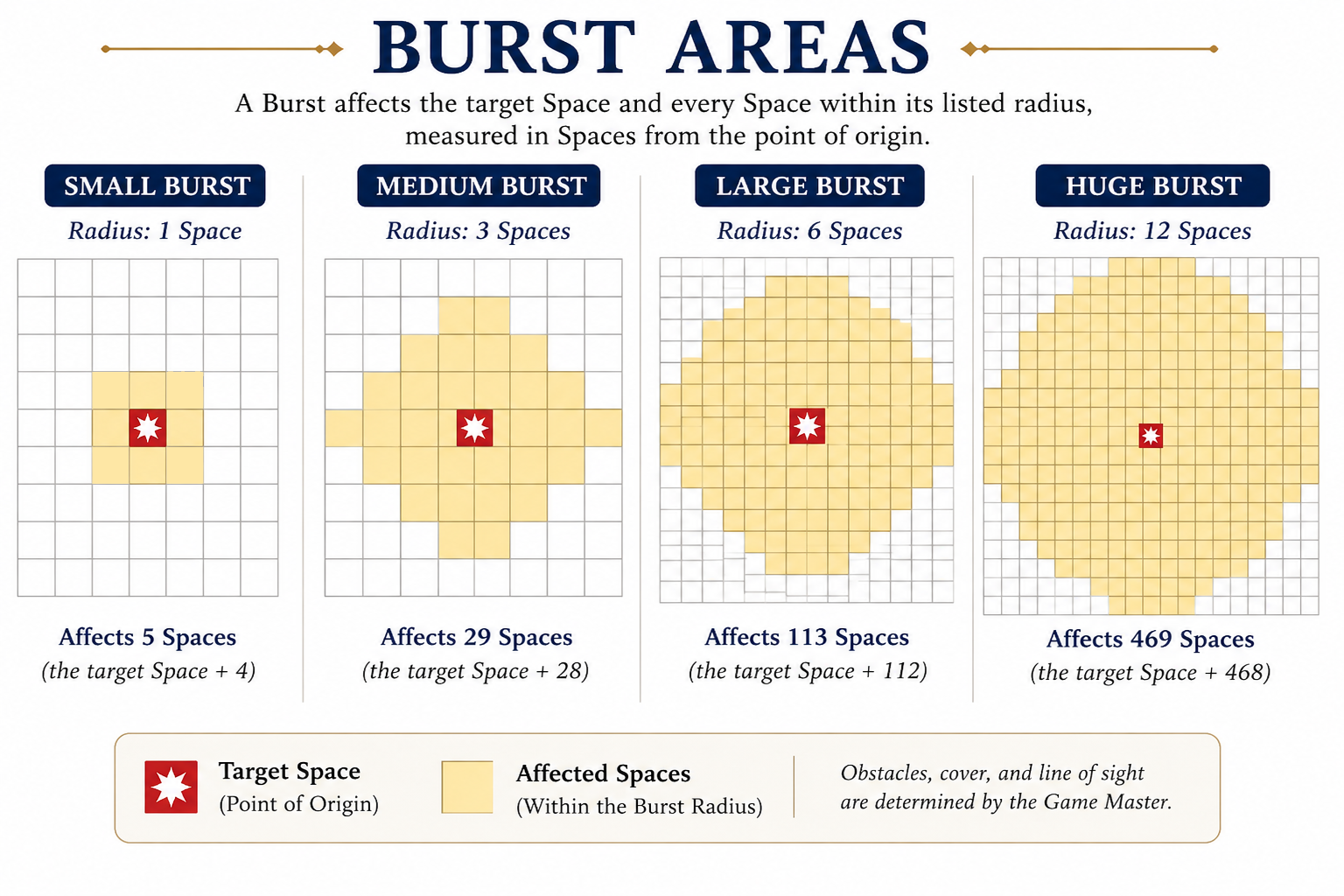
Burst Areas
Some attacks, powers, and abilities affect an area rather than a single target. These use Burst Areas, measured in Spaces from the target Space (the point of impact or origin).
| Burst Size | Radius |
| Small Burst | 1 Space |
| Medium Burst | 3 Spaces |
| Large Burst | 6 Spaces |
| Huge Burst | 12 Spaces |
A Burst affects the target Space and every Space within its listed radius. Unless a power or ability states otherwise, the point of origin must be within the attack’s range, and all characters, creatures, and objects within the Burst Area are affected.
The Game Master determines whether walls, barriers, or other terrain block or reduce the effects of a Burst Area.
Cone Areas
Some attacks, powers, and abilities project their effects outward from the user in a widening arc. These use Cone Areas, measured in Spaces from the origin Space occupied by the attacker.
A Cone always begins in a Space adjacent to the attacker and extends directly away from them in the chosen direction. A Cone cannot extend through the attacker’s own Space.
| Cone Size | Length |
|---|---|
| Small Cone | 3 Spaces |
| Medium Cone | 6 Spaces |
| Large Cone | 9 Spaces |
| Huge Cone | 12 Spaces |
A Cone widens as it extends from its point of origin. The affected Spaces are shown on the Cone template for the appropriate size. The attacker chooses the Cone’s facing (north, south, east, west, or any diagonal if diagonal facing is used) when the attack is made.
Unless a power or ability states otherwise:
- Every character, creature, and object within the Cone is affected.
- The Cone originates from a Space adjacent to the attacker.
- The attacker is never affected by their own Cone unless a rule specifically states otherwise.
- Walls, barriers, and solid terrain block the Cone beyond the point of impact, at the Game Master’s discretion.
- Cover provides its normal benefits against Cone attacks unless the effect specifically ignores cover.
Cone templates are intended to provide fast, consistent play on a square grid. Players simply place the appropriate Cone template adjacent to the attacker, facing the desired direction, and resolve the effect against every occupied Space within the template.
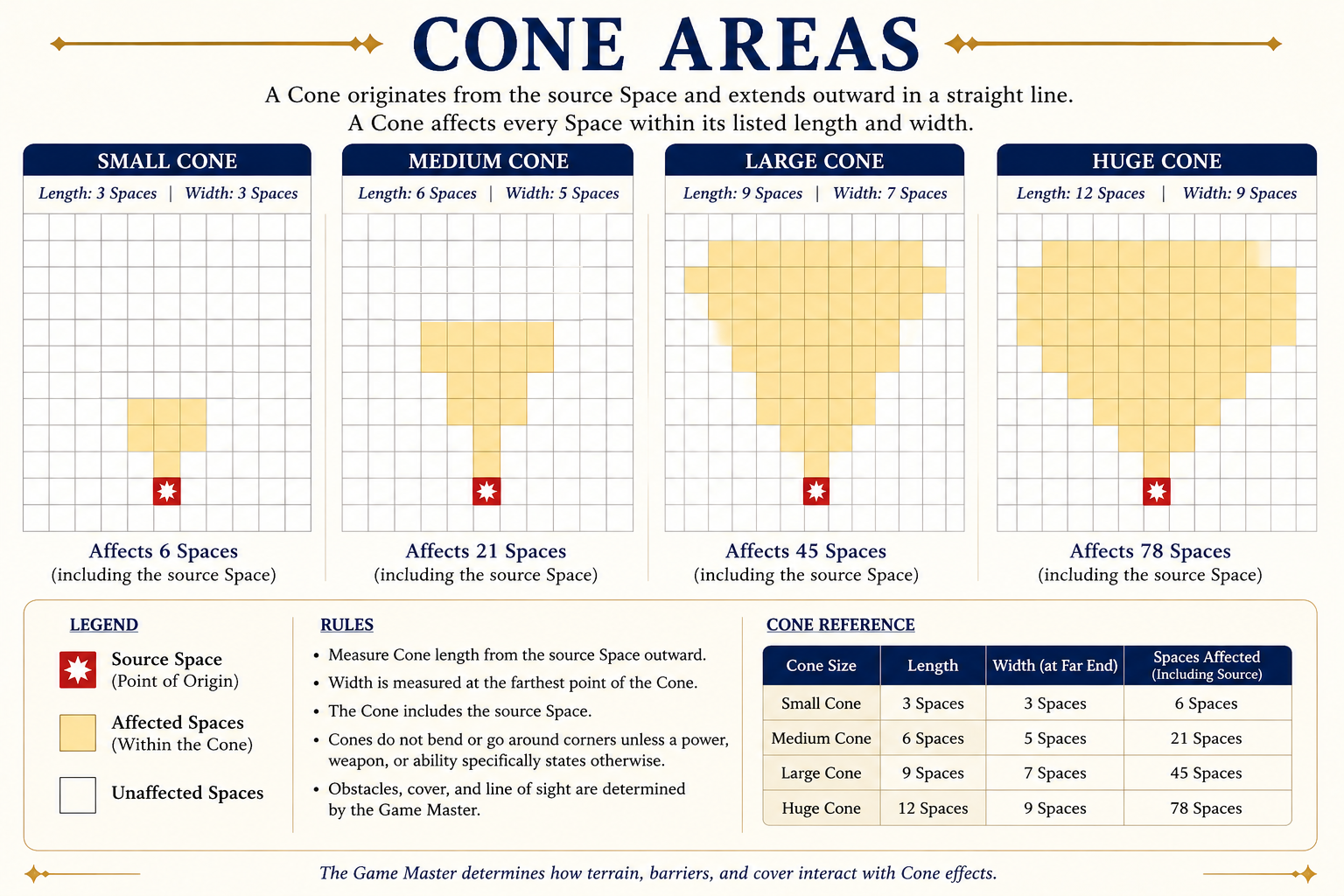
| Distance from Origin | Small Cone (3) | Medium Cone (6) | Large Cone (9) | Huge Cone (12) |
|---|---|---|---|---|
| 1 | 3 Spaces | 3 Spaces | 3 Spaces | 3 Spaces |
| 2 | 3 Spaces | 3 Spaces | 3 Spaces | 3 Spaces |
| 3 | 3 Spaces | 3 Spaces | 3 Spaces | 3 Spaces |
| 4 | — | 5 Spaces | 5 Spaces | 5 Spaces |
| 5 | — | 5 Spaces | 5 Spaces | 5 Spaces |
| 6 | — | 5 Spaces | 5 Spaces | 5 Spaces |
| 7 | — | — | 7 Spaces | 7 Spaces |
| 8 | — | — | 7 Spaces | 7 Spaces |
| 9 | — | — | 7 Spaces | 7 Spaces |
| 10 | — | — | — | 9 Spaces |
| 11 | — | — | — | 9 Spaces |
| 12 | — | — | — | 9 Spaces |
Healing
Characters recover from injuries through rest, medical treatment, or extraordinary means. Healing removes Wounds, allowing a character to gradually recover from their injuries.
A character who is Stunned or Fatigued is not considered Wounded and recovers much more quickly.
Natural Healing
A character may recover naturally through rest. After the appropriate recovery period, the character makes a Stamina: Fortitude Test. Characters who perform strenuous activity, travel, or otherwise fail to rest during the Recovery Time must Test against oneDifficulty higher check.
Characters who rest for twice the required recovery period gain +1D to the Test.
Recovery Times
| Injury | Recovery Time |
| Stunned | 1 minute |
| 1 or more Wounds | 3 days per Wound |
| Incapacitated | 2 weeks |
| Mortally Wounded | 5 weeks |
Natural Healing Results
| Test Result | Effect |
| Critical Failure | The character suffers one additional Wound. |
| Failure | No recovery. |
| Success | Heal 1 Wound. |
| 2 or more Result Points | Heal 2 Wounds. |
A character can never heal more than 2 Wounds from a single Natural Healing Test.
Assisted Healing
Another character may provide medical treatment using the Medicine skill. Emergency first aid requires no special equipment, though a medical kit may provide bonuses as described in its equipment entry.
The healer makes a Medicine Test using the following Difficulty.
| Patient’s Condition | Difficulty |
| Stunned | Easy |
| 1 Wound | Standard |
| Each additional Wound | +1 Difficulty Level |
If successful, the patient immediately heals 1 Wound. If the healer generates 1 or more Result Points, the patient heals 2 Wounds instead. A character may only benefit from one successful Assisted Healing attempt for each injury.