

Sokaran
The Fractured Communion
The Sokaran are a tall, unusually proportioned species inhabiting scattered settlements throughout the Fringe. Recognized for their distinctive tripod anatomy, enlarged cranium, remarkable linguistic abilities, and natural sensitivity to psionic phenomena, the Sokaran are among the more enigmatic civilizations of the Shattered Expanse. Although technologically sophisticated and intellectually accomplished, they have never established a unified interstellar empire. Instead, their civilization consists of independent communities bound together by shared ancestry, philosophical traditions, and a profound fascination with the nature of consciousness.
To the Sokaran, individuality is sacred, yet consciousness is universal. This apparent contradiction lies at the heart of their civilization, influencing everything from their social customs and religious beliefs to their political institutions and relationships with other species. Their ability to perceive the emotions and mental impressions of others has produced a society deeply concerned with personal identity, mental privacy, and the boundaries separating one consciousness from another.
Despite their unusual appearance and sometimes unsettling abilities, most Sokaran are naturally inquisitive, adaptable, and willing to engage with other civilizations. Throughout the Fringe, they are encountered as merchants, explorers, interpreters, philosophers, scientists, and Mentalists. Their settlements are often centers of cultural exchange, though some communities deliberately isolate themselves from outsiders.
Physical Appearance and Biology
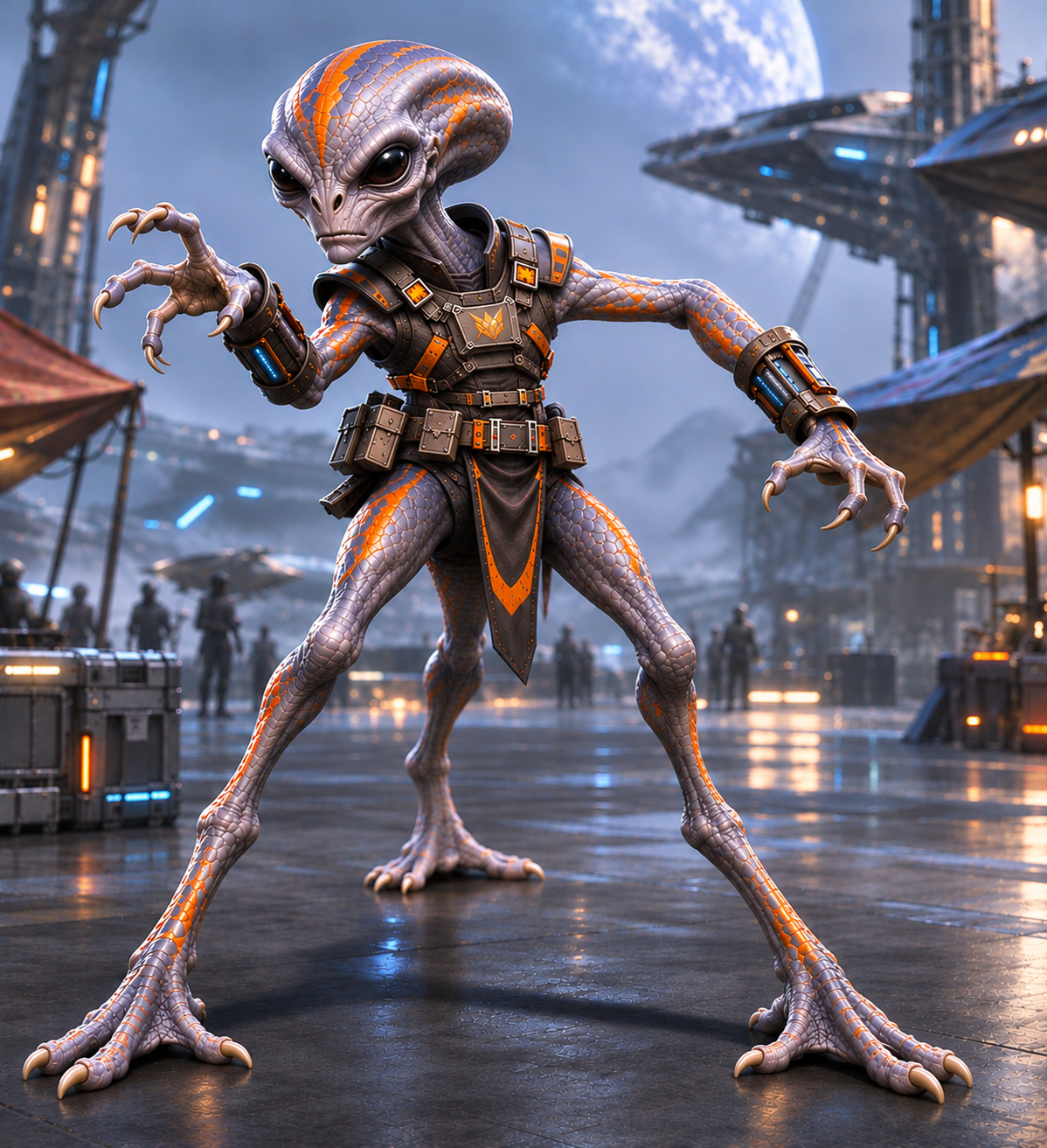
Sokaran are tall, slender humanoids, generally standing between 2.2 and 2.8 meters in height. Their most distinctive physical characteristic is their unusual three-legged anatomy. Three long, powerful legs extend from the lower torso in a tripod configuration, providing exceptional stability and allowing them to distribute their weight efficiently across uneven terrain. Their legs are remarkably flexible, capable of folding beneath the body to lower their overall height when navigating confined spaces or interacting with shorter species.
Their upper bodies are comparatively narrow, with two long, muscular arms ending in dexterous hands equipped with elongated fingers. Although their limbs appear delicate, Sokaran possess surprisingly powerful musculature and can perform precise movements requiring considerable coordination. Their unusual anatomy makes conventional humanoid furniture, clothing, and equipment difficult to use without modification.
The Sokaran head is disproportionately large, with an expanded cranium housing a highly developed nervous system. Their faces are relatively flat, dominated by large, uniformly dark eyes capable of functioning in low-light environments. A narrow nasal structure and thin mouth give them an expression that many outsiders find difficult to interpret. Their necks are comparatively short but muscular, allowing considerable flexibility without the exaggerated proportions of some other long-necked species.
Their skin ranges from pale gray and lavender to darker slate and violet tones, often displaying subtle patterns of pigmentation. Some individuals possess distinctive bands or streaks of brighter coloration, including orange, amber, or blue. The epidermis consists of small, overlapping dermal structures that provide a degree of natural protection while retaining flexibility.
To most outsiders, Sokaran appear remarkably similar. Their facial structures, proportions, and physical characteristics vary considerably less than those of many other intelligent species. Sokaran, however, recognize subtle differences in pigmentation, scent, movement, and vocal expression that distinguish one individual from another.
Reproduction and Development
Sokaran reproduce through a form of parthenogenesis, producing offspring without the need for biological fertilization. Their species possesses a single reproductive sex, and offspring are genetically similar to their progenitors. Although genetic variation occurs naturally over successive generations, the relatively limited diversity of their reproductive system contributes to the remarkable physical similarities observed throughout the species.
This biological characteristic has profoundly influenced Sokaran philosophy. Despite their genetic similarities, every Sokaran develops a unique personality, consciousness, and sense of identity. Their philosophers have debated for centuries whether individuality arises entirely from personal experience or whether consciousness possesses qualities independent of physical biology.
Some Sokaran believe their reproductive biology provides compelling evidence that consciousness cannot be explained through genetics alone. Others reject such interpretations, arguing that differences in environment, experience, and neurological development adequately explain individual identity.
The debate remains unresolved and continues to influence Sokaran scientific and religious thought.
Senses and Communication
Sokaran possess vision, hearing, and tactile sensitivity comparable to many other intelligent species, though their senses have evolved along somewhat different paths. Their large eyes provide excellent low-light vision, while their highly developed olfactory systems allow them to distinguish remarkably subtle chemical signatures.
A Sokaran can often identify another individual by scent, even when visual identification proves difficult. Familiar locations, objects, and individuals leave recognizable chemical impressions that can persist long after their original source has departed. This ability makes Sokaran particularly effective trackers and investigators, especially in environments where chemical traces remain undisturbed.
Their vocal anatomy is equally unusual. Specialized structures within the mouth and nasal passages allow them to produce a remarkable range of tones, harmonics, and complex sounds. Spoken Sokaran languages incorporate subtle variations in pitch, resonance, and rhythm that other species frequently struggle to reproduce.
Individual vocal expression is particularly important within Sokaran society. Because physical appearance provides relatively few obvious distinguishing characteristics, many Sokaran cultivate highly personalized speaking styles. Some develop elaborate tonal patterns, while others adopt unusual accents or incorporate elements of foreign languages into their everyday speech.
Sokaran are exceptionally talented linguists. Their vocal flexibility, acute hearing, and sensitivity to subtle behavioral cues allow them to learn unfamiliar languages with remarkable efficiency. Many become accomplished interpreters, diplomats, and cultural intermediaries.
However, their most unusual form of communication extends beyond spoken language.
Psionic Sensitivity
The Sokaran possess an unusually high natural affinity for psionic phenomena, particularly those associated with telepathy and empathy. Their enlarged cranial structures contain extensive neural networks devoted to sensory integration and the perception of subtle mental activity.
Unlike many species, where psionic ability appears only among a relatively small portion of the population, some degree of passive psionic sensitivity is common among Sokaran. Most can perceive faint emotional impressions from nearby intelligent beings, particularly when those individuals experience powerful emotions such as fear, anger, grief, or joy.
This sensitivity does not necessarily allow them to read thoughts or communicate telepathically. Such abilities require considerable training and the development of specialized mental disciplines. Only a portion of the Sokaran population possesses the aptitude and dedication necessary to become fully trained Mentalists. Nevertheless, their natural sensitivity has profoundly shaped Sokaran civilization.
For a Sokaran, communication is rarely limited to words. Subtle emotional impressions, changes in mental disposition, and instinctive perceptions of another individual’s state of mind frequently accompany ordinary conversation. These impressions are not always conscious or intentional, and Sokaran must learn to distinguish genuine emotional perceptions from their own assumptions and reactions.
Mental Discipline and Privacy
Sokaran society places extraordinary importance on mental privacy. The ability to perceive another individual’s emotional state is considered a responsibility rather than an entitlement, and deliberately intruding upon another person’s thoughts without permission is regarded as a serious violation of personal autonomy.
From an early age, Sokaran children are taught techniques for recognizing and controlling their natural sensitivity. These practices emphasize emotional regulation, concentration, and the establishment of mental boundaries. Even individuals who never become Mentalists receive basic instruction in maintaining psychological independence.
Among the Sokaran, the expression “Your mind is your own” carries profound cultural significance. It represents the belief that every conscious being possesses an inherent right to independent thought, personal identity, and freedom from unwanted mental intrusion.
These principles are not universally interpreted. Some communities maintain extremely strict prohibitions against telepathic contact without explicit consent, while others consider limited emotional exchanges a natural and acceptable part of social interaction.
Sokaran Mentalists are generally expected to observe particularly demanding ethical standards, though the absence of a centralized government means these expectations vary considerably between communities.
Psychic Overload
Their natural sensitivity is not without disadvantages. Sokaran exposed to intense emotional disturbances may experience considerable psychological discomfort, particularly in crowded environments or situations involving widespread suffering.
Battlefields, disasters, and other traumatic events can overwhelm individuals who lack sufficient mental discipline. A particularly sensitive Sokaran might experience fragments of fear, desperation, or anguish from numerous nearby minds, making it difficult to distinguish external emotional impressions from personal feelings.
Consequently, Sokaran communities place considerable emphasis on mental training and psychological resilience. Specialized institutions provide instruction in controlling unwanted perceptions, while experienced Mentalists often serve as counselors and teachers.
These practices have also contributed to the development of sophisticated Sokaran theories concerning consciousness, psionic interaction, and the relationship between the mind and physical reality.
Society and Individuality
The Sokaran are an intensely individualistic species whose culture celebrates the uniqueness of personal consciousness. Their physical similarities have encouraged the development of elaborate traditions through which individuals distinguish themselves from others.
Clothing, jewelry, body ornamentation, vocal expression, and artistic achievement are particularly important forms of personal identification. Sokaran fashion is extraordinarily diverse, incorporating influences from countless civilizations encountered throughout the Expanse.
Some favor elaborate garments adorned with brilliant colors, intricate patterns, and exotic materials. Others prefer austere clothing that emphasizes simplicity and philosophical discipline. Still others incorporate technological accessories, illuminated ornaments, or personalized equipment into their appearance.
Fashion is rarely regarded as a trivial pursuit. To many Sokaran, personal appearance represents a deliberate declaration of individuality and an outward expression of the consciousness inhabiting an otherwise familiar biological form.
Their fascination with personal identity extends into language, religion, occupation, and social behavior. Sokaran frequently pursue unusual interests or adopt customs from other civilizations, sometimes combining seemingly incompatible traditions into highly personalized lifestyles.
Despite their individualism, Sokaran society generally emphasizes personal equality and mutual respect. Their biological similarities have historically discouraged the development of rigid social hierarchies based upon physical characteristics or hereditary distinctions.
However, Sokaran civilization is not free from inequality.
The considerable prestige associated with advanced psionic ability has occasionally produced social divisions between trained Mentalists and those possessing only limited sensitivity. Some communities regard accomplished Mentalists as natural leaders, while others actively resist granting them political authority.
These disagreements have contributed to the fragmented political structure of Sokaran civilization.
The Fractured Communion
The Sokaran do not possess a unified interstellar government. Instead, their civilization consists of numerous independent settlements, colonies, enclaves, and small political associations scattered throughout the Fringe.
Collectively, these communities are often referred to as the Fractured Communion, a term describing their shared cultural identity rather than a formal political organization.
The Communion has no central capital, supreme ruler, or universally recognized governing authority. Individual settlements establish their own laws, institutions, and relationships with neighboring civilizations. Some operate as democratic communities, others as councils of scholars or Mentalists, and still others as commercial republics or religious societies.
Although Sokaran communities maintain extensive cultural and commercial connections, they frequently disagree over matters of philosophy, governance, and the proper application of psionic abilities.
This decentralized structure has prevented the Sokaran from emerging as a major territorial power. It has also allowed them to preserve considerable independence from the Confederation and the various Sovereignties.
Negotiating with the Sokaran can be frustrating for foreign governments. An agreement reached with one community carries no automatic authority over another, and even neighboring settlements may maintain sharply different political positions.
Nevertheless, the shared principles of individual autonomy, intellectual exploration, and respect for consciousness provide a cultural foundation that continues to connect the scattered Sokaran populations.
The Contemplatives
The Contemplatives represent one of the oldest and most respected philosophical movements within Sokaran civilization. They believe that consciousness is the highest expression of existence and that the refinement of the mind represents the ultimate purpose of intelligent life.
Their communities emphasize meditation, philosophical inquiry, scientific investigation, and disciplined psionic development. Many Contemplative settlements are relatively isolated, allowing their inhabitants to pursue intellectual and spiritual advancement without the distractions of larger interstellar societies.
Contemplative institutions are renowned for their Mentalist training, and some maintain extensive archives documenting unusual psionic phenomena encountered throughout the Fringe.
Although generally peaceful, the Contemplatives are not necessarily passive. Many believe that protecting independent consciousness from coercion or manipulation is a fundamental moral obligation.
The Expressionists
The Expressionists believe that consciousness achieves its greatest significance through individual experience and creative expression. Their communities are often vibrant, cosmopolitan settlements characterized by artistic experimentation, commercial activity, and extensive interaction with other civilizations.
Expressionist Sokaran are particularly fascinated by foreign languages, fashions, philosophies, and cultural traditions. Their settlements frequently become important trading centers where merchants, artists, travelers, and scholars from numerous species exchange goods and ideas.
Expressionists tend to oppose rigid social structures and restrictions upon personal behavior, provided individual freedom does not infringe upon the rights of others.
They are among the Sokaran most frequently encountered beyond their own settlements, serving as merchants, explorers, entertainers, diplomats, and independent Riftrunners.
The Convergence
The Convergence represents one of the most controversial philosophical movements within Sokaran society.
Its followers believe that individual consciousness is merely an intermediate stage in the evolution of intelligent life. They argue that the natural capacity of minds to communicate and interact psionically suggests the possibility of a greater collective intelligence.
According to Convergence philosophy, multiple individuals might voluntarily unite their consciousness into a shared mental existence, achieving forms of understanding impossible for isolated minds.
Some Convergence communities conduct carefully controlled experiments in collective meditation and telepathic synchronization. Others pursue more ambitious research into sustained mental integration.
These activities have generated considerable suspicion among other Sokaran, particularly those who regard individuality as an inviolable principle.
The greatest controversy concerns the question of consent. If an individual willingly joins a collective consciousness, can that individual subsequently withdraw? Does the original personality continue to exist independently, or does integration fundamentally transform the participants?
The Convergence has yet to provide answers acceptable to the broader Communion.
While most followers insist that participation must remain voluntary, rumors persist of isolated groups pursuing increasingly extreme experiments. Whether these accounts represent genuine abuses or merely the fears of rival philosophical movements remains uncertain.
Religion and Philosophy
Religion occupies an unusual position within Sokaran civilization. Their natural psionic sensitivity has encouraged a widespread fascination with consciousness, spiritual existence, and the possibility that the mind possesses qualities extending beyond conventional physical reality.
Rather than developing a single dominant religion, Sokaran communities have embraced an extraordinary diversity of spiritual traditions.
Many study the religions of other intelligent species, believing that different civilizations have discovered unique insights into the nature of existence. Sokaran scholars frequently compare religious teachings with scientific theories concerning consciousness, memory, and psionic phenomena.
Some have adopted the teachings of the Church of Balance, finding meaning in its emphasis on equilibrium and spiritual discipline. Others are drawn to the Priests of the Hearth, whose traditions concerning memory, identity, and the preservation of the self resonate with Sokaran philosophical concerns.
Numerous smaller religious movements have emerged within the Communion, ranging from contemplative traditions devoted to personal enlightenment to elaborate belief systems concerning reincarnation, ancestral consciousness, and the persistence of the mind after death.
Not all Sokaran are religious. Materialist philosophers and skeptical scientists maintain a strong presence throughout their civilization, arguing that psionic phenomena represent natural processes that can eventually be understood through rigorous investigation.
These competing perspectives rarely produce universal agreement, but the Sokaran generally regard philosophical disagreement as an essential component of intellectual advancement.
The Abyss and Consciousness
The existence of the Abyss has generated considerable debate among Sokaran scholars and Mentalists.
Some believe that reports of unusual psychological experiences, distorted perceptions, and altered states of consciousness associated with the Abyss suggest the existence of mental phenomena beyond conventional understanding.
Others warn that such interpretations are dangerously speculative, emphasizing that the Abyss remains poorly understood and that its apparent effects upon consciousness may represent threats rather than revelations.
A small number of Sokaran communities have become particularly interested in studying the Abyss, occasionally establishing research expeditions near regions associated with its influence.
These efforts are controversial, and many Contemplative institutions strongly discourage direct experimentation involving poorly understood Abyssal phenomena.
Relations with Other Civilizations
The Sokaran maintain complex relationships with the civilizations of the Shattered Expanse. Their decentralized political structure, unusual biology, and widespread psionic sensitivity have made them both valuable partners and objects of suspicion.
Their settlements frequently maintain commercial relationships with Confederation merchants, independent Riftrunners, and neighboring Fringe communities. Sokaran interpreters and negotiators are particularly valued in situations involving unfamiliar species or complicated cultural disputes.
Their relationship with the Luminar Accord is especially noteworthy. Both civilizations possess strong traditions concerning emotional awareness and psionic development, creating opportunities for cooperation in education, diplomacy, and scientific research.
However, their philosophical approaches are not always compatible. Sokaran emphasis on individual mental autonomy can conflict with traditions that place greater importance on emotional openness or collective understanding.
Other civilizations regard Sokaran Mentalists with varying degrees of caution. Some governments welcome their expertise, while others impose restrictions upon their activities out of concern for telepathic intrusion or the unauthorized acquisition of sensitive information.
Their distinctive appearance also creates difficulties in less cosmopolitan regions. Many species find their large dark eyes, unusual tripod anatomy, and limited facial expressions unsettling. Such reactions are often reinforced by exaggerated rumors concerning their psionic abilities.
Although Sokaran generally prefer peaceful interaction, they are not universally pacifistic. Individual communities maintain security forces, defensive installations, and armed vessels when circumstances require them.
Their commitment to personal autonomy can make them particularly determined opponents when confronted with enslavement, forced mental manipulation, or attempts to impose external political authority.
Technology and Exploration
Sokaran technological development places considerable emphasis on neural science, communications, sensory enhancement, and the study of psionic phenomena.
Their medical institutions possess sophisticated knowledge of neurological development and psychological health, while their research facilities investigate the interaction between biological consciousness and advanced technology.
Many Sokaran technologies are designed to accommodate their unusual physiology. Their ships, vehicles, and habitats frequently incorporate adjustable workstations, specialized seating, and control systems adapted to their three-legged anatomy.
Psionic research is particularly prominent, although its sophistication varies considerably between communities. Some settlements maintain advanced laboratories investigating the measurable effects of mental activity, while others rely upon traditional training methods developed over generations.
Sokaran explorers are frequently drawn toward remote regions of the Fringe, particularly locations associated with unexplained signals, unusual neurological phenomena, or evidence of lost civilizations.
Their curiosity has occasionally led them into dangerous situations, but it has also contributed to their reputation as accomplished investigators and researchers.
Although they have never established a unified territorial empire, Sokaran individuals can be found aboard independent starships, research vessels, commercial transports, and exploration expeditions throughout the Expanse.
The Sokaran in the Shattered Expanse
To outsiders, the Sokaran are often a contradiction. They are physically similar yet fiercely individualistic, naturally sensitive to other minds yet intensely protective of mental privacy, spiritually curious yet intellectually skeptical, and technologically advanced despite possessing no unified interstellar government.
Their civilization demonstrates that a species need not establish an empire to exert influence upon the wider galaxy.
Throughout the Fringe, Sokaran communities serve as centers of scholarship, cultural exchange, and psionic research. Their Mentalists are sought after for their expertise, their linguists bridge cultural divisions, and their philosophers continually challenge conventional assumptions concerning identity and consciousness.
Yet the greatest challenges facing the Sokaran arise from within their own civilization. The growing influence of the Convergence, disagreements concerning the ethical application of psionics, and the tension between individual autonomy and collective responsibility threaten to deepen the divisions separating their communities.
For the Sokaran, the question is not simply whether consciousness can transcend the limitations of the physical body.
It is whether such transcendence can be achieved without sacrificing the individuality that makes each conscious being unique.
To the Sokaran, the mind is both the greatest mystery of existence and the one possession that must never be surrendered.