

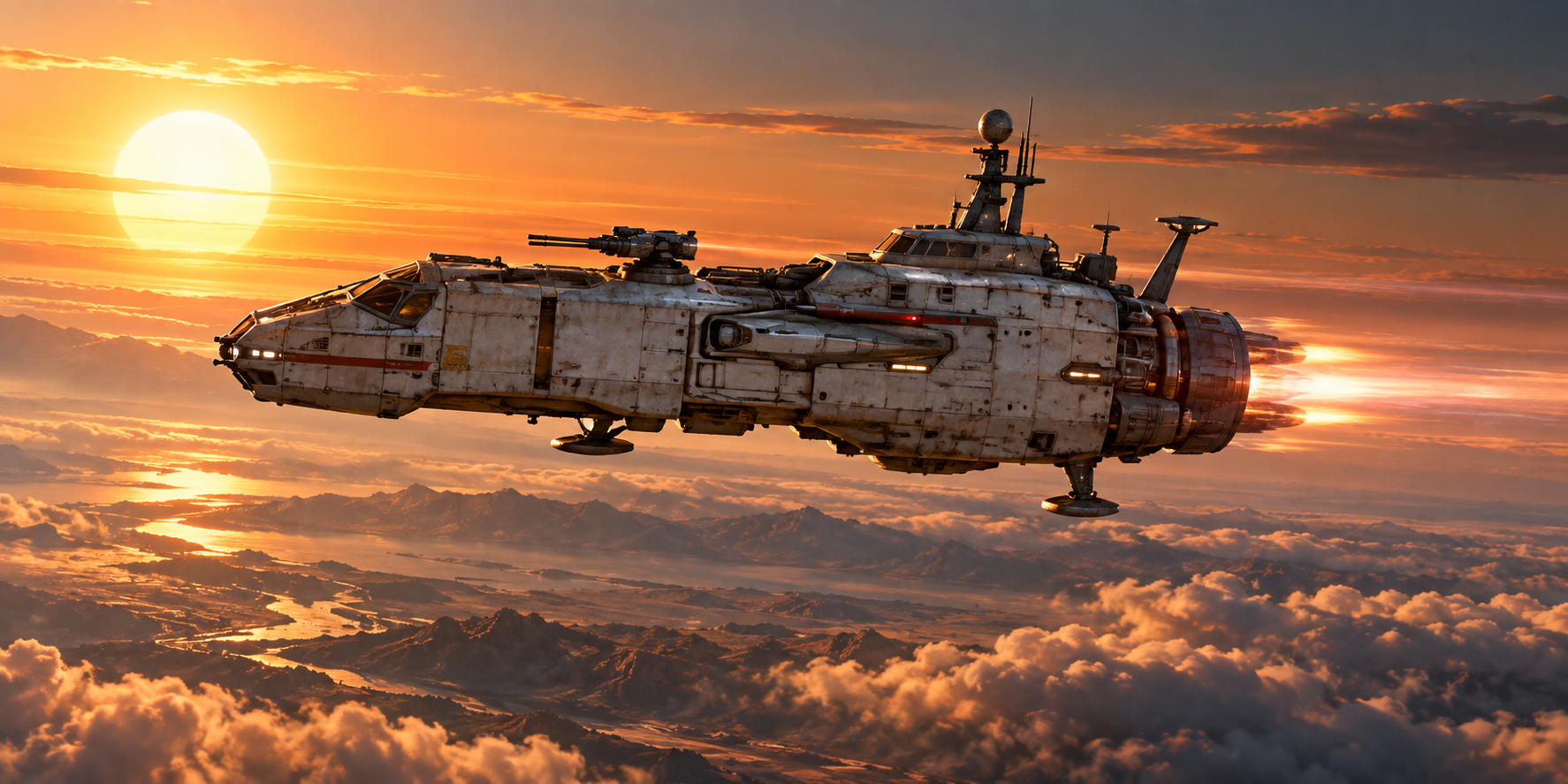
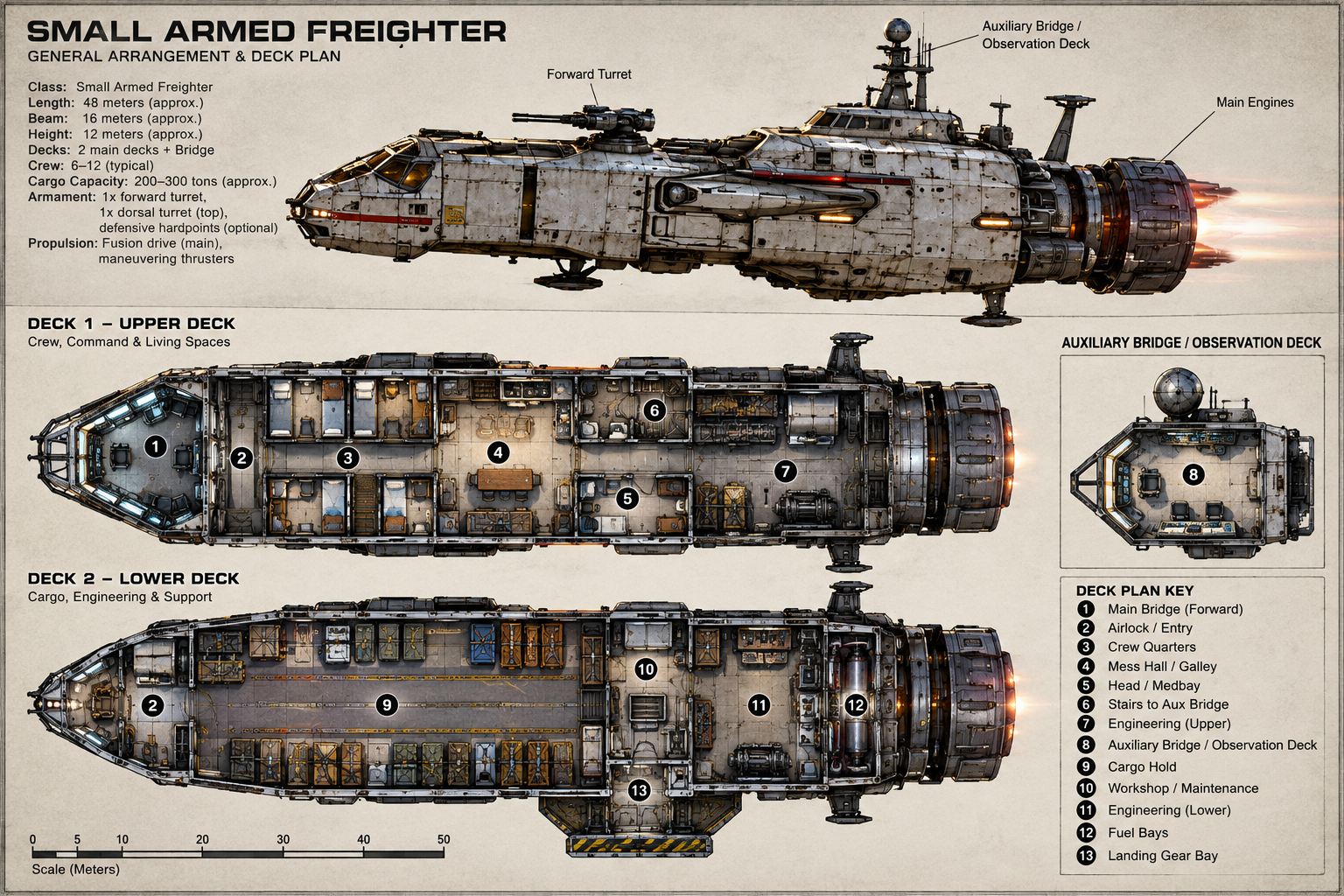
Sagittarius — a light freighter and passenger ship, operating around the Fringe. She has the look of a working vessel rather than a purpose-built warship: armed enough to protect herself, rugged enough for frontier operations, and capable of carrying both cargo and paying passengers.
Captain John A. Flamor
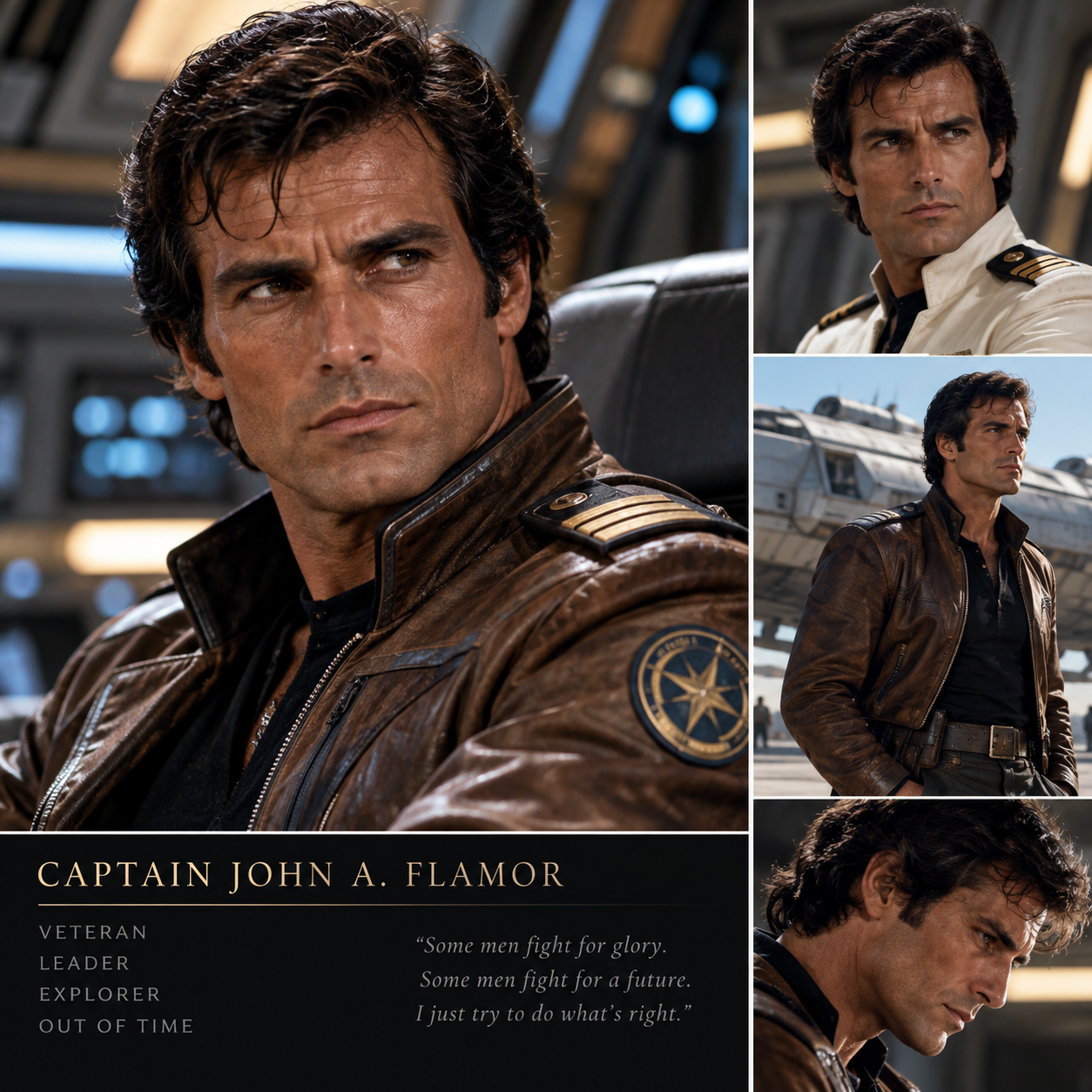
The Soldier Out of Time
Captain John A. Flamor is a Bastion military officer whose distinguished family history conceals an extraordinary secret. To his contemporaries, he is a descendant of one of the Bastion Compact’s most celebrated military heroes, a man who has followed in his ancestor’s footsteps and established a respectable career of his own. In reality, John is not a distant descendant of that legendary figure. He is the man’s son, a surviving veteran of the original Karian War who has been displaced by centuries.
John was born into the shadow of his father’s reputation. His father was a decorated military hero whose accomplishments during the original Karian War earned him considerable respect and influence within Bastion society. Growing up, John admired his father but struggled with the expectations associated with the Flamor name. He wanted to become a soldier and distinguish himself through his own courage, discipline, and accomplishments rather than through the privileges afforded by his family.
Unfortunately, his father’s influence followed him into military service. Opportunities that other soldiers had to earn were sometimes offered to John simply because of his surname. Although he was capable and determined, he frequently questioned whether his superiors recognized his abilities or merely sought to curry favor with his famous father.
The most significant example of this favoritism came when John received an advanced suit of military powered armor. The armor was an expensive and highly sophisticated piece of equipment normally reserved for commissioned officers. John was not an officer and had no entitlement to such equipment, but his father’s influence secured it for him nonetheless.
John resented the gift. To him, the armor represented everything he was trying to escape. His father, however, regarded it as a means of protecting his son during an increasingly dangerous war. Neither man could have imagined just how important that decision would become.
During the original Karian War, John served in a Bastion military force conducting operations against the Karians. Although he had not attained an officer’s rank, he was determined to demonstrate that he possessed the qualities of a leader. His opportunity came during an offensive into a remote region of space that has since been lost to modern civilization and largely disappeared from contemporary navigational records.
John participated in an assault against a fortified Karian position. As the operation unfolded, the Bastion forces encountered unexpectedly fierce resistance. The situation deteriorated rapidly, and casualties among the commanding officers forced John to assume leadership of the surviving troops.
For the first time, John found himself commanding soldiers not because of his father’s influence, but because circumstances demanded someone capable of taking charge. He rallied the survivors, organized their remaining resources, and led an assault against the Karian defenses. Whatever the ultimate outcome of the engagement, John’s actions demonstrated the leadership qualities he had spent his military career trying to prove.
Unfortunately, the larger operation collapsed. Bastion forces were overwhelmed, their ships destroyed or driven from the region, and John’s surviving troops were cut off. During the fighting, John encountered evidence suggesting that the Karians were receiving assistance from another civilization: the Sarginians. At the time, the Sarginians were not publicly recognized as participants in the war. Their involvement was concealed, and the accepted historical accounts of the conflict would make no mention of their assistance to the Karians.
John’s armor recorded critical battlefield information, including evidence of Sarginian involvement. These records would eventually become among the most important surviving pieces of evidence concerning the conflict. But John would not have the opportunity to report what he had discovered. His vessel suffered catastrophic damage, leaving him facing almost certain death.
Unknown to most soldiers, John’s officer-grade powered armor possessed an extraordinary emergency preservation system. Designed to protect valuable military personnel under otherwise unsurvivable conditions, the armor incorporated an autonomous stasis field. If its sensors detected catastrophic damage to the wearer, the destruction of the surrounding vessel, or an environment in which survival was impossible, the system could activate automatically. Once engaged, the stasis field would preserve its occupant in suspended animation for an effectively indefinite period, maintaining the wearer until rescue or external intervention became possible.
As John’s vessel was destroyed, the armor activated its emergency protocols. John disappeared into the wreckage, preserved within the protective field. For him, the battle ended in an instant. For the rest of the galaxy, centuries passed. His comrades died, the war became history, and the region where he had fought gradually disappeared from the knowledge of modern navigators.
His father lived out the remainder of his life without knowing what had happened to his son. John never returned home, never received recognition for his actions, and never had the opportunity to reconcile with his father over the privileges he had resented. Ironically, the very equipment John believed undermined his independence had become the reason he survived.
Hundreds of years after the original Karian War, a Sarginian expedition discovered the remains of an ancient Bastion military vessel drifting in a remote region of space. The wreckage was an extraordinary archaeological find, dating to an era for which surviving records were incomplete. Among the debris, the expedition discovered an intact suit of antiquated powered armor containing a human occupant.
The Sarginians determined that the armor’s preservation system remained operational and that the occupant was still alive. Intrigued by the possibility of speaking with someone from a nearly forgotten period of galactic history, they undertook the difficult task of safely disengaging the stasis system.
John Flamor awoke to discover that centuries had passed since his final battle. The civilization he remembered had changed beyond recognition. His comrades, family, and everyone he had known were long dead. The war that had defined his life was now a subject of historical study.
Even more unsettling was the identity of his rescuers. The Sarginians had revived him. John knew something about their civilization that modern historians, including many Sarginians themselves, did not fully understand. During the original Karian War, Sarginian interests had secretly assisted the Karian forces. Yet the modern Sarginians who recovered him appeared genuinely unaware of that history.
They had revived him out of historical curiosity, not because they understood the significance of his battlefield experiences or the evidence preserved within his armor. To them, John was a remarkable survivor from antiquity. To John, they were the descendants of a civilization that had secretly supported his enemies.
The Sarginian involvement in the original Karian War represents a potentially explosive historical revelation. For centuries, the accepted accounts of the conflict have portrayed it as a war between the Bastion forces and the Karians. The possibility of outside assistance was either overlooked, deliberately concealed, or lost as the surviving records became increasingly fragmented.
John possesses solid evidence that this understanding is incomplete. His armor preserved battlefield recordings and other information establishing that Sarginian resources or personnel were involved in supporting the Karian war effort. However, the evidence does not necessarily establish who authorized that assistance. It remains unknown whether the Sarginian government officially supported the Karians, whether a rogue political or military faction conducted an unauthorized operation, or whether some other arrangement existed between the two civilizations.
Modern Sarginian society has little reliable knowledge of these events. The relevant history has been forgotten, partially erased, or obscured by the passage of centuries. Consequently, the Sarginians who revived John do not fully appreciate what he knows. John himself possesses only part of the truth. He can establish that Sarginian involvement occurred, but he cannot yet explain its origins, its full extent, or its ultimate purpose.
The discovery creates a difficult personal conflict. The people who saved John’s life belong to the same civilization whose predecessors may have contributed to the destruction of his military unit. At the same time, John recognizes that the modern Sarginians are not necessarily responsible for decisions made centuries before their births. Uncovering the truth may require him to cooperate with the very people whose ancestors helped his enemies.
Eventually, John returned to Bastion society, where his extraordinary origins presented a serious problem. He was a soldier from a long-dead generation, carrying firsthand knowledge of military events that had become ancient history. Revealing his true identity would invite intense scrutiny from military authorities, historians, political leaders, and anyone interested in the circumstances of his survival. Instead, John’s origins remained concealed.
To the people around him, John Flamor is a modern member of the distinguished Flamor family, descended from the famous Bastion war hero of the original Karian War. The explanation is plausible. His surname connects him to a well-established military legacy, and his apparent family resemblance reinforces the assumption.What no one realizes is that the celebrated hero was not his distant ancestor. He was his father.
John has since earned the rank of Captain, achieving the professional standing he once desperately sought. Unlike the young soldier who received privileged equipment through his father’s influence, the modern Captain Flamor has established his credentials through his own service and leadership.
Nevertheless, the shadow of his father continues to follow him. People admire the Flamor name, recount stories of his father’s accomplishments, and occasionally compare John’s achievements to those of the legendary officer. John must listen quietly, even when the historical accounts are inaccurate. He cannot correct certain details without revealing knowledge that no contemporary descendant should possess. The irony is painful. John has finally become the officer he always wanted to be, but he remains trapped beneath the reputation he spent his first life trying to escape.
Only Commander Lyda knows the truth about John’s identity. She understands that he is not merely a descendant of a famous Bastion military hero but the actual son of that man, preserved for centuries by experimental powered armor. She also knows that John survived the original Karian War and possesses evidence of Sarginian involvement in the conflict.
The reasons she continues to protect his identity are important to their relationship. Revealing his origins would expose John to considerable political and military attention, potentially transforming him from a serving officer into an object of historical investigation. His knowledge of the Karian War could also create serious diplomatic complications.
The Sarginians’ secret involvement has never been fully explained, and John’s evidence could challenge generations of accepted history. Until the circumstances surrounding that involvement are better understood, public disclosure could have unpredictable consequences.
For now, Lyda protects John’s secret, allowing him to live and serve as an ordinary member of the modern Bastion military.
Their shared knowledge creates an unusual bond. Lyda is one of the few people capable of understanding the true scale of John’s displacement, even though she cannot fully comprehend what it means to lose everyone and everything familiar. John, in turn, must trust her with a truth that could fundamentally alter his life if revealed.
Despite the historical and political significance of John’s survival, his greatest unresolved conflict remains his relationship with his father. John spent his youth struggling to escape the reputation of a man he genuinely admired. He wanted his father to recognize him as an accomplished soldier in his own right, rather than someone who needed protection or special treatment.
The powered armor became the clearest symbol of that struggle. His father had secured the equipment because he wanted his son to survive the war. John interpreted the gesture as another example of his father’s inability to let him succeed or fail on his own merits. Their differences remained unresolved when John departed on his final mission.
When his vessel was destroyed, John believed he was about to die without ever proving himself to his father. Centuries later, he knows that the armor saved his life. Without his father’s intervention, he would have died alongside his comrades. That realization brings gratitude, but also guilt.
He can no longer confront his father, explain his resentment, or express appreciation for the gift that ultimately preserved him. Nor can he tell his father that he finally became a Captain. Perhaps most painfully, he cannot know whether his father would have been proud of the man he became.
The historical records describe his father as a hero, but John remembers him as a man: accomplished, influential, protective, and sometimes frustratingly unwilling to let his son find his own way. Those memories belong to John alone. To everyone else, his father is a figure from the distant past.
Captain John A. Flamor now lives between two eras. He is a veteran of a war that modern society barely understands, a son whose father has become a historical legend, and an officer whose most important military experience cannot appear in his official service record.
He carries evidence of a forgotten conspiracy that could alter relations between the Bastion Compact, the Karians, and the Sarginians. He owes his life to technology he once resented and to a civilization whose historical involvement in his greatest defeat remains unexplained. Yet John is not simply a relic of the past.
He is a capable soldier who has adapted to a radically different age, earned his present rank, and found a new purpose among people who know little of his extraordinary history. His greatest ambition remains unchanged. He wants to be judged by his own actions rather than by the accomplishments of his father. But the past refuses to release him.
Somewhere in the surviving records of the original Karian War lies the truth about the Sarginians, the lost military campaign, and the events that destroyed John’s former life. Whether that truth should remain buried is a question John may eventually have to answer. For now, he continues his service as Captain John A. Flamor, carrying the name of a legendary hero and guarding the secret that he is not merely that hero’s descendant.
He is the son who never came home.
Commander Lyda Tarn

Second in command and responsible for cargo operations, including manifests, loading arrangements, and commercial freight management. She serves as the captain’s principal deputy aboard ship. She too is a veteran of the Yethran Conflict.
Commander Lyda Tarn never imagined she would become a military officer, much less the second-in-command of a freighter traveling the dangerous reaches of the Fringe. She was born on Yethra IV, an agricultural colony whose fertile lands supplied food to settlements throughout the Yethran region. Her parents were farmers, and Lyda grew up surrounded by sprawling fields, agricultural machinery, and the hard work necessary to keep a frontier farm operational.
She learned to fly long before she considered joining the military. Her family’s farm employed hover flyers for crop treatment, pest control, and agricultural surveying. Lyda took to the controls naturally, mastering the low-altitude maneuvering required to navigate fields, irrigation towers, and uneven terrain. By the time she reached adulthood, she could handle a farm flyer with a precision that impressed even experienced pilots. Then came the Yethran Conflict.
Yethra IV became one of the contested worlds caught between Human and Karian military operations. The agricultural colony, never intended to withstand a sustained military campaign, suffered terribly. Lyda’s family was among the casualties. Both of her parents were killed during the fighting, leaving her with little more than memories of the farm and a deep, enduring hatred of the Karians. She enlisted in the Human military effort, determined to make the Karians pay for what they had done to her home.
Her experience piloting agricultural hovercraft proved unexpectedly valuable. The same instincts that allowed her to skim meters above fields translated remarkably well to military flight operations. Lyda quickly distinguished herself as a capable pilot, earning a reputation for aggressive maneuvering, precise flying, and an uncanny ability to anticipate danger.
During the conflict, she served for a period as Xirix “Greenhawk” Kazix’s copilot. The two developed an effective working relationship, learning to anticipate each other’s decisions during combat. Greenhawk’s experience complemented Lyda’s natural instincts, and together they survived engagements that claimed many less fortunate crews.
Eventually, Lyda earned command of her own squadron. It was a considerable achievement for someone whose formal flying experience had begun in a farm hover flyer.
Her hatred of the Karians, however, never diminished. For Lyda, the Yethran Conflict was not simply a military campaign or a territorial dispute. It was the destruction of her home and the loss of her family. Although she understands the political realities of the Human–Karian Accords, she has never entirely accepted the idea that the past should simply be forgotten.
Lyda’s relationship with Captain John A. Flamor began during their military service and developed into something considerably more personal. Both were accomplished pilots and veterans of the same conflict. They understood the demands of military service, the pressures of command, and the emotional burdens that came with surviving a war. Their friendship eventually became romantic.
For a time, the relationship worked. But the complications of military life, personal responsibilities, and their strong personalities eventually made maintaining a romance increasingly difficult. Rather than allow their feelings to destroy their friendship, they ended the romantic relationship.
Today, Lyda remains Flamor’s closest friend and most trusted confidante. They work exceptionally well together aboard the Sagittarius, often communicating through little more than a glance or a few words. Years of shared experiences have given them an understanding of one another that few outsiders can appreciate.
Neither is entirely free of the feelings they once shared. Lyda still cares deeply for John, but she has learned to place those emotions aside when the job demands it. John, however, may not have moved on quite as completely as she has. He has never admitted it, and Lyda has never pressed him on the matter. For now, their friendship and the successful operation of the Sagittarius are more important than revisiting a relationship that might complicate everything they have built together.
Among the crew, Lyda is known for something that even experienced veterans struggle to explain: her extraordinary intuition. She has an uncanny ability to recognize when something is wrong, even when there is no obvious evidence of danger. A seemingly legitimate cargo contract might strike her as suspicious. A routine approach to a station might suddenly feel unsafe. An unfamiliar contact might inspire immediate distrust despite offering every outward appearance of honesty.
More than once, these feelings have proven correct. During the Yethran Conflict, her instincts helped her squadron avoid ambushes, anticipate enemy movements, and survive situations that should have ended disastrously. Since joining the Sagittarius, those same instincts have saved the ship and its crew from dangerous encounters.
Flamor trusts Lyda completely, but her intuition is one of the reasons he values her judgment so highly. Even when he cannot see the danger she senses, he has learned that ignoring her warnings is rarely wise.
Greenhawk, who flew beside her during the war, has witnessed this ability firsthand. The Urxian knows better than most how frequently Lyda’s seemingly irrational decisions have turned out to be the correct ones.
Whether her intuition is simply the product of extraordinary perception, years of combat experience, or something more unusual remains uncertain. Lyda herself has never given the matter much thought. She simply trusts her gut.
As the ship’s first officer, Lyda oversees cargo operations, freight manifests, loading arrangements, and the commercial responsibilities that keep the Sagittarius financially viable. Her agricultural upbringing gave her an appreciation for logistics and the practical realities of transporting goods, while her military experience taught her the importance of discipline, preparation, and decisive leadership.
She serves as Flamor’s principal deputy and assumes command whenever he is unavailable.
Although her responsibilities are primarily administrative and operational, Lyda remains an accomplished pilot. She can take the controls whenever necessary, and her experience commanding a military squadron makes her particularly valuable during dangerous situations.
The Sagittarius has become something Lyda never expected to find after the destruction of her home: a place where she belongs.
She has no intention of losing another family.
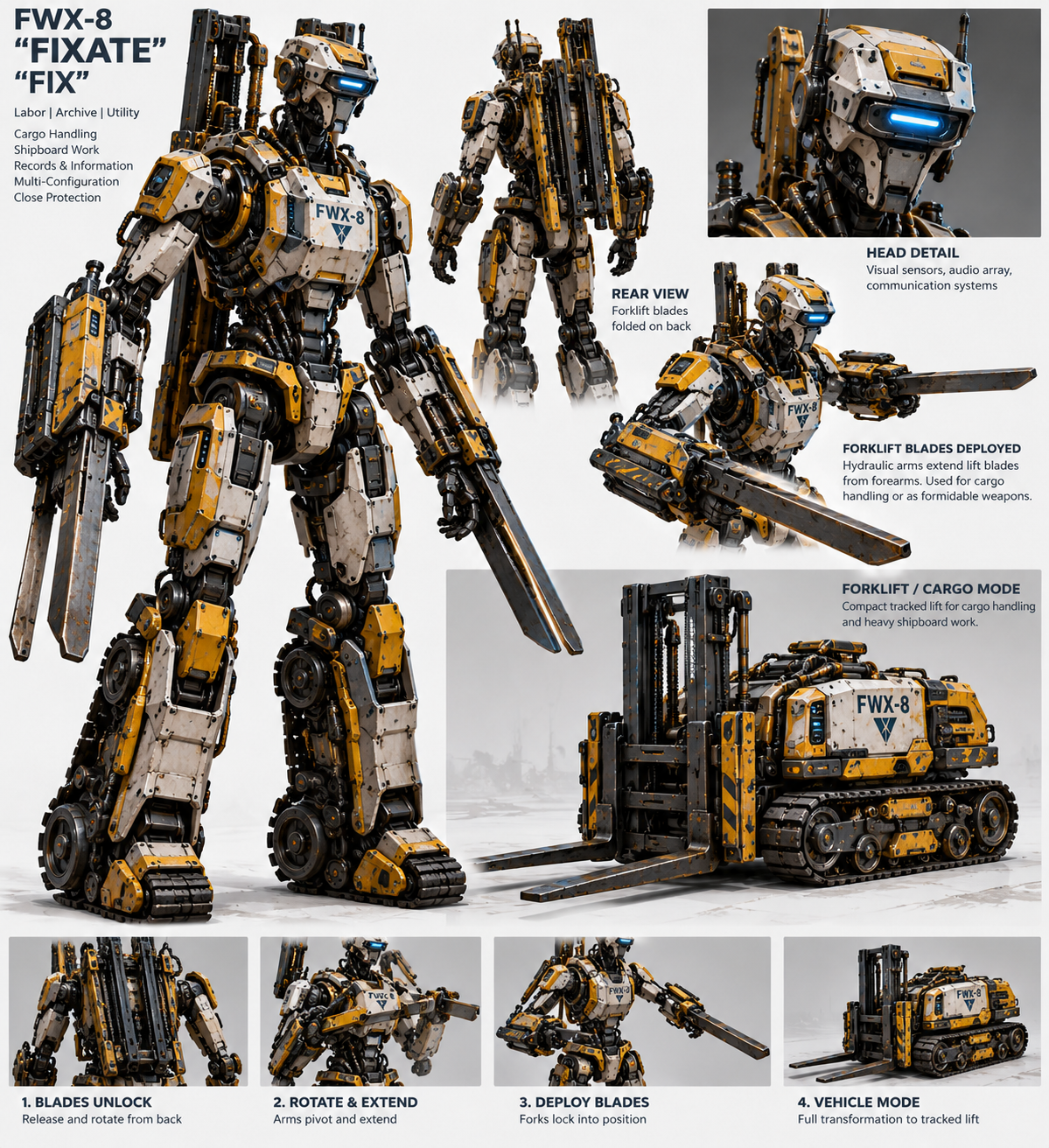
FWX-8 “Fixate” (Fix)
A multipurpose labor and archive droid with an unusual combination of capabilities. Normally humanoid, Fix can transform into a forklift-like configuration for moving heavy cargo. It also maintains the ship’s archives, operational records, manifests, and information repositories.
Lieutenant Xirix “Greenhawk” Kazix
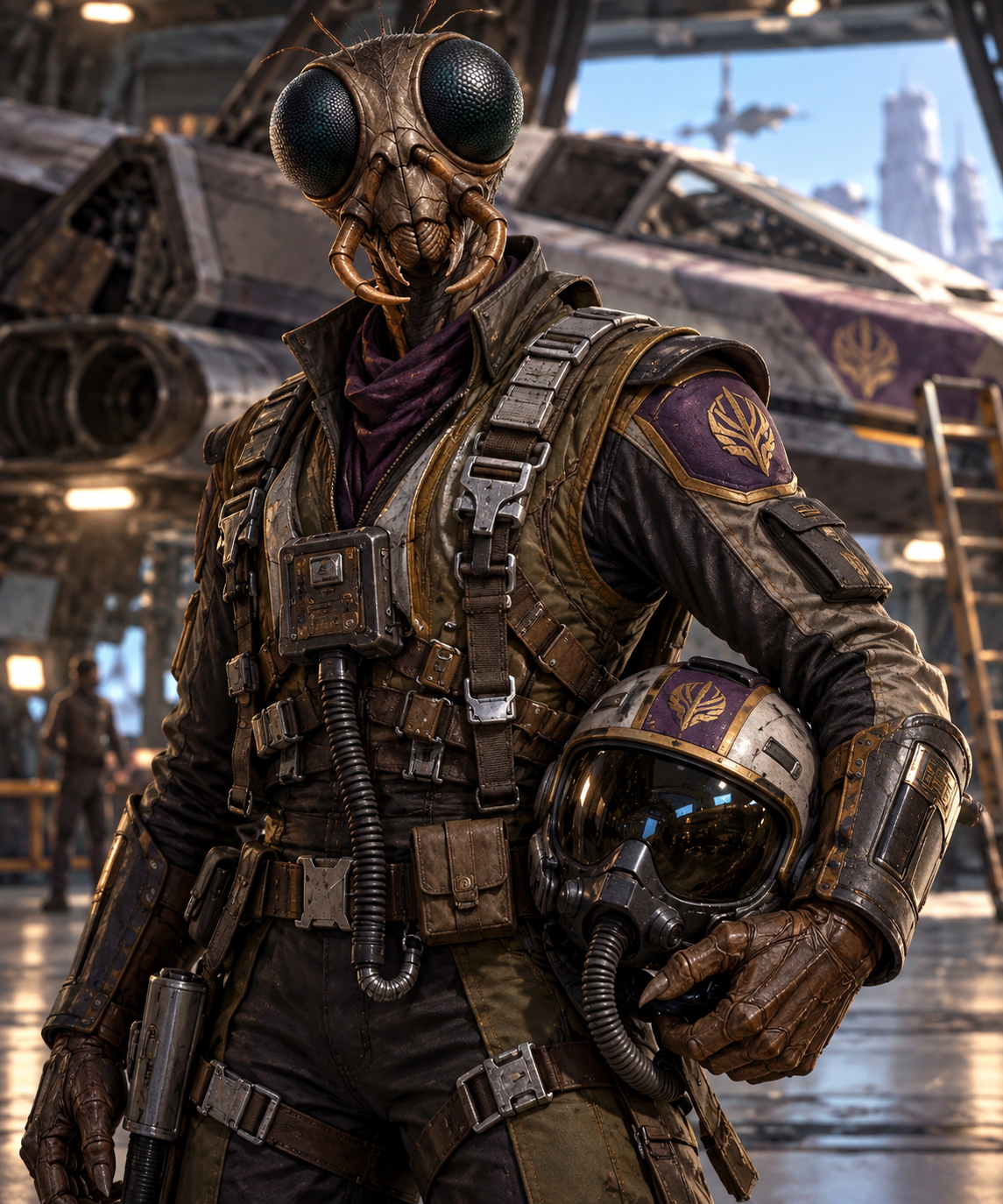
An Urxian former military pilot whose callsign, Greenhawk, dates from his service. In addition to piloting the Sagittarius, Xirix acts as a fixer and dealmaker, using his contacts and negotiating abilities to secure opportunities throughout the Fringe. He is also a veteran of the Yethran Conflict.
Lieutenant Xirix Kazix, better known by the callsign Greenhawk, was born into a life of privilege and diplomatic expectation. The offspring of a respected Urxian diplomat who works closely with the mysterious Sarginians, Xirix was expected to follow the family tradition of diplomacy, negotiation, and service to the greater interests of Urxian society. Instead, Xirix joined the military.
For the Kazix family, the decision was an embarrassment. A diplomatic career offered prestige, influence, and opportunities rarely available to ordinary Urxians. Military service, while necessary, was hardly considered a suitable occupation for the offspring of such a distinguished family. Xirix’s parental unit made its displeasure abundantly clear. Greenhawk couldn’t have cared less.
The Urxians have maintained a close relationship with the Bastion Compact for generations. Some historians believe the alliance stretches back to the days of the ancient Terran Empire, although much of that history has been lost or obscured by the Empire’s collapse. Whatever its origins, the relationship remains strong, with Urxian military personnel frequently serving alongside Bastion forces.
When the Yethran Conflict erupted, Greenhawk was among the Urxian pilots assigned to support the Human military effort against the Karians. It was there that Xirix met John A. Flamor, another military pilot whose reputation would eventually become inseparable from Greenhawk’s own.
The two flew numerous missions together during the conflict, often under desperate circumstances. More than once, Greenhawk found themself facing certain death, only for Flamor to intervene. Whether through extraordinary piloting, sheer audacity, or an unwillingness to abandon a fellow pilot, Flamor repeatedly saved Xirix’s life.
Eventually, Greenhawk swore a personal oath of honor to Flamor. For Xirix, this was no casual promise of friendship or gratitude. It was a solemn obligation, binding their future to the man who had repeatedly risked his own life to save theirs. When Flamor eventually left military service and acquired the Sagittarius, Greenhawk followed.
Today, Xirix serves as the ship’s primary pilot, navigating the dangerous and often poorly charted regions of the Fringe. Years of military flying have made Greenhawk an exceptional pilot, but it is their upbringing in a diplomatic household that makes them equally valuable when the ship is safely docked.
Despite rejecting the diplomatic career intended for them, Xirix absorbed far more of their parental unit’s teachings than they care to admit. Greenhawk understands negotiation, political maneuvering, and the value of knowing the right people. They have developed an extensive network of contacts, brokers, smugglers, and legitimate traders throughout the Fringe.
This makes Greenhawk the Sagittarius’s unofficial fixer and dealmaker, frequently securing contracts, arranging introductions, and finding opportunities that would otherwise escape the crew’s attention.
Greenhawk may have rejected diplomacy as a profession, but they have never entirely escaped their upbringing. And despite the years that have passed since the Yethran Conflict, their oath to Flamor remains unbroken.
Cam Morsonor
A Greyblood Human veteran of the Yethran Conflict, responsible for the Sagittarius’s engineering systems, propulsion, maintenance, and mechanical reliability.
Cam Morsonor has always been a fix-it man. Give him a broken engine, a damaged transmission, or a machine everyone else has written off, and Cam will find a way to make it work. During the Yethran Conflict, he served as a military mechanic, repairing everything from field artillery and armored transport trucks to aircraft that had no business ever flying again. He learned to work with whatever parts were available, often under enemy fire, and developed a reputation for keeping equipment operational long after it should have been scrapped.
Transitioning from military ground equipment and aircraft to starships was no small challenge. A starship’s propulsion systems, life-support infrastructure, and complex engineering networks demanded knowledge and experience far beyond anything Cam had encountered during the war. But Cam was never one to shy away from a challenge. He studied, experimented, made mistakes, and gradually mastered the systems aboard the Sagittarius.
Today, the ship is his pride and joy. While Captain Flamor owns her, Cam considers the Sagittarius his baby. He knows every vibration in her engines, every temperamental power coupling, and every peculiar noise that might indicate trouble. He can often diagnose a malfunction simply by listening to the ship.
But Cam carries something far more troublesome than an aging freighter’s maintenance problems.
The Yethran Conflict left him with a dark history, something he has spent years trying to bury. Whatever happened during the war, Cam has never spoken openly about it, even with the crewmates who served alongside him. Only one person aboard the Sagittarius knew the truth: the ship’s former security officer.
That man is now dead.
Whether his death has brought Cam relief or renewed his fears is something even Cam might struggle to answer. The secret remains his alone, but the loss of the only person who understood what happened has left him increasingly isolated.
He finds comfort in his work. Machines are predictable. They break for reasons that can be understood, and with enough effort, they can usually be repaired.
People, memories, and mistakes are another matter entirely.
Orion Rummand
A Torani serving as the ship’s security officer, responsible for protecting the crew, passengers, and cargo.
Orion Rummand is the newest member of the Sagittarius crew, hired to replace the ship’s former security officer, a veteran of the Yethran Conflict who died under circumstances the crew does nto share. Unlike most of his crewmates, Orion has no connection to that war or the shared experiences that bind the others together.
Although competent and qualified for his position, Orion has struggled to find his place aboard the ship. The captain, first officer, pilot, and engineer share a history of military service, old friendships, and experiences that Orion can never fully understand. Their conversations frequently turn to people, places, and events from the conflict, leaving him feeling like an outsider.
Complicating matters is the memory of his predecessor. The former security officer was more than a colleague; he was one of their own. Orion sometimes senses that the crew measures him against a man he never met, expecting him to understand traditions and unspoken rules that developed long before he came aboard.
As a Torani, Orion comes from a society where loyalty to one’s Pack is deeply ingrained. He understands the importance of belonging, perhaps better than most. Yet aboard the Sagittarius, he has found himself outside a tightly bonded group whose trust cannot simply be earned through competence.
He does not resent the crew for their loyalty to their fallen companion. He simply wants an opportunity to establish his own place among them.
The central theme of Orion’s character is belonging. He’s trying to become part of a family that is still grieving one of its own.
The Yethran Conflict
Period: 1300–1310 EE
Region: Yethra frontier, near the site of the original hostilities that sparked the Great Karian–Human War.
Belligerents: Human military forces and Karian forces, operating through deniable military formations and proxies.
Official Status: Undeclared conflict, with much of its history classified or deliberately obscured.