

Gazagorans
Warriors of the Fringe
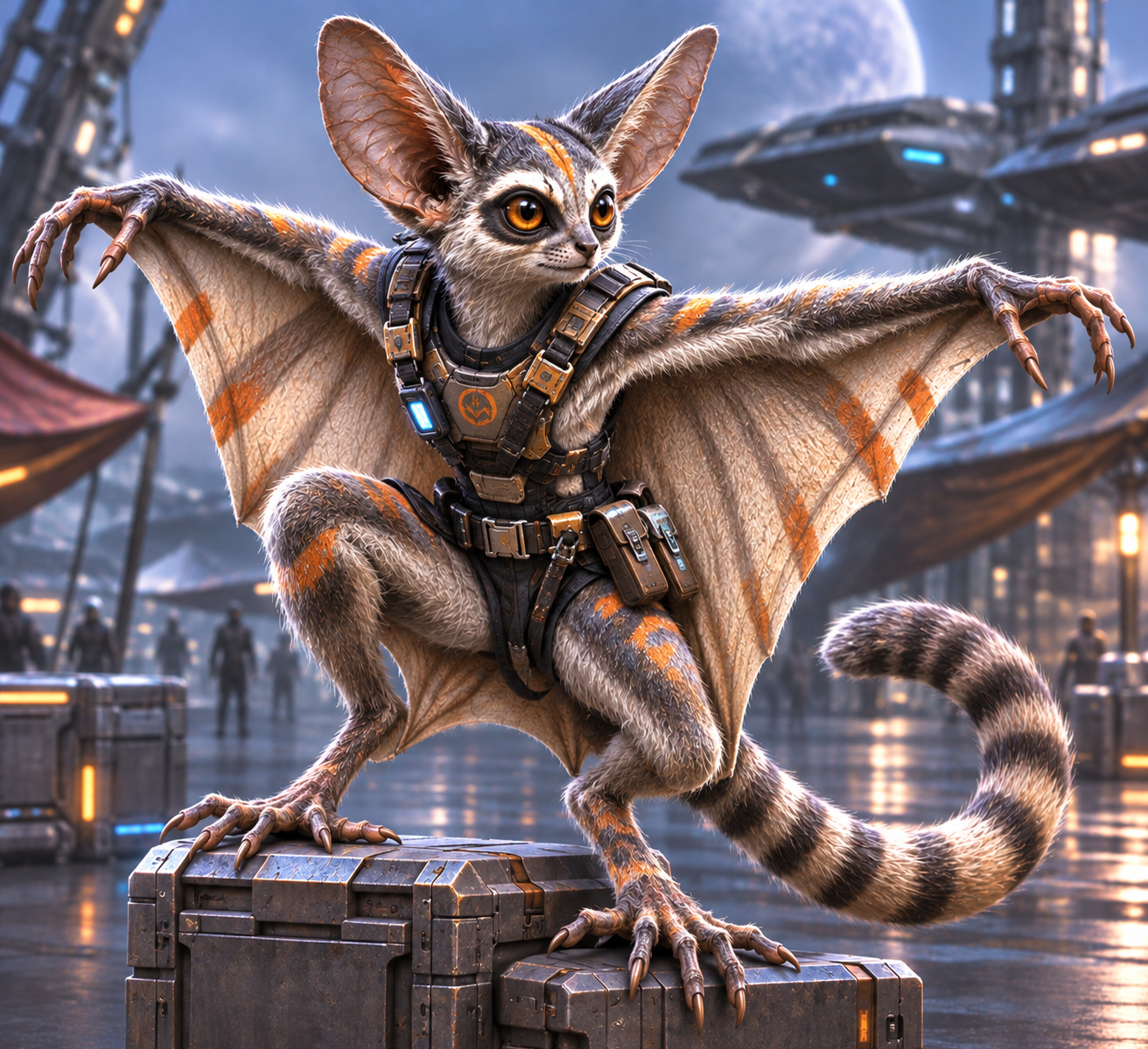
The Gazagorans are a small, agile mammalian species native to the Fringe, renowned for their exceptional hearing, retractable gliding membranes, and fiercely independent warrior traditions. Their large eyes, oversized ears, and relatively diminutive stature give them an almost harmless appearance, leading many unfamiliar with the species to underestimate their physical abilities and martial prowess. Such assumptions have proven costly to more than a few pirates, mercenaries, and would-be conquerors.
Despite their appearance, the Gazagorans descend from highly adapted nocturnal predators whose survival depended upon speed, agility, and an extraordinary awareness of their surroundings. Their civilization developed among immense forests, towering cliffs, and deep valleys, where competition for territory and resources produced a complex society of fiercely independent clans. Over generations, these conflicts gave rise to sophisticated martial traditions emphasizing discipline, precision, and personal responsibility.
Although the Gazagorans have never established a unified interstellar empire, their communities have spread throughout the Fringe, where they are encountered as explorers, scouts, merchants, mercenaries, and independent Riftrunners. Their warriors are particularly respected for their unconventional tactics, remarkable mobility, and ability to overcome opponents considerably larger and stronger than themselves.
Gazagoran culture places tremendous importance upon personal honor, clan loyalty, and the fulfillment of individual obligations. Their martial traditions do not glorify violence for its own sake. Instead, they emphasize that true strength comes from discipline, determination, and knowing when to fight.
Physical Appearance and Biology
Gazagorans are relatively small humanoids, generally standing between 1.3 and 1.6 meters in height. Their bodies are lean but muscular, with disproportionately powerful hind legs, elongated arms, and highly flexible joints. Their overall appearance resembles that of an ancient arboreal mammal, particularly the small nocturnal primates once found on Terra.
Their most recognizable features are their enormous forward-facing eyes and unusually large, independently mobile ears. Their faces possess short muzzles, delicate nasal structures, and expressive features capable of conveying a wide range of emotions. Their ears can rotate independently, allowing them to monitor sounds from multiple directions without moving their heads.
Gazagoran fur varies considerably in coloration, ranging from gray and cream to russet, brown, and nearly black. Many possess distinctive facial markings, darker extremities, or contrasting patterns across their shoulders and backs. Their fur is generally short and dense, although some individuals develop longer tufts around the ears, neck, or tail.
Their hands and feet possess elongated digits equipped with specialized gripping pads and small claws. These adaptations allow Gazagorans to climb rapidly, maintain their grip upon narrow surfaces, and navigate complex environments with remarkable confidence. Their hind legs contain exceptionally powerful musculature, enabling impressive leaps both vertically and horizontally.
Many Gazagorans possess long, flexible tails that assist with balance during climbing, leaping, and gliding. Although not fully prehensile, the tail provides considerable control over body orientation during rapid movement.
Despite their small stature, Gazagorans are surprisingly strong for their size. Their musculature emphasizes explosive movement rather than sustained physical force, making them exceptionally effective at sudden changes of direction, rapid acceleration, and acrobatic maneuvers.
Retractable Gliding Membranes
One of the Gazagorans’ most distinctive biological adaptations is a pair of specialized gliding membranes known as patagia. These flexible structures extend from the wrists along the sides of the torso toward the upper legs, creating broad aerodynamic surfaces when fully deployed.
Unlike the permanent gliding membranes found among many other species, Gazagoran patagia are naturally retractable. Specialized muscles and flexible cartilaginous supports allow the membranes to fold into narrow recesses along the arms and flanks when not in use.
When retracted, the membranes are barely noticeable, permitting unrestricted movement during walking, climbing, running, and ordinary physical activity. This adaptation also protects the delicate tissues against abrasion and environmental damage.
Deployment occurs almost instantaneously. By extending their arms and adjusting the supporting musculature, Gazagorans can spread their membranes and transition directly from a leap into a controlled glide.
The membranes consist of highly elastic connective tissues reinforced by fine structural fibers. Small muscular adjustments allow the individual to alter their curvature, controlling direction, descent, and stability while airborne.
Gazagorans cannot achieve true powered flight. Their gliding abilities require sufficient altitude and suitable atmospheric conditions, although favorable air currents can significantly extend their range.
Their natural agility makes them exceptionally capable aerial maneuverers, particularly in environments containing numerous elevated surfaces and opportunities for controlled descent.
Senses and Perception
Gazagorans possess exceptionally developed auditory and visual senses, reflecting their evolutionary origins as nocturnal hunters.
Their large eyes are highly sensitive to available light, providing excellent vision under dim conditions. They can navigate environments that would leave many other species nearly blind, although they cannot see in complete darkness without technological assistance.
Extremely bright environments can cause discomfort, and Gazagorans frequently wear tinted goggles or protective eyewear when operating under intense illumination.
Their hearing is even more remarkable.
Gazagoran ears contain sophisticated auditory structures capable of detecting frequencies beyond the normal range of human hearing, including portions of the ultrasonic spectrum. Their independently mobile ears allow them to isolate individual sounds and determine their direction with extraordinary accuracy.
A Gazagoran can distinguish faint footsteps, subtle mechanical vibrations, and distant movement that would escape the attention of most other species. Experienced individuals can recognize familiar companions by their breathing patterns, footfalls, and other distinctive sounds.
These abilities are particularly valuable during nocturnal movement and gliding, allowing Gazagorans to detect nearby creatures and environmental hazards even when visibility is limited.
Their sensitive hearing can also become a disadvantage. Sudden, extremely loud noises or specialized sonic weapons may cause considerable discomfort. Protective musculature within their auditory canals provides some defense against ordinary environmental noise, but extreme acoustic disturbances remain potentially dangerous.
Homeworld and Evolution
The Gazagoran homeworld – Gazagor – lies within the Fringe, in a remote system characterized by extensive forests, towering mountain ranges, and enormous geological formations separated by deep valleys and chasms.
Much of the planet’s inhabited territory consists of immense vertical environments where conventional ground travel is difficult. Dense forests cover vast regions, while steep escarpments and isolated plateaus create natural barriers between populations. These conditions strongly influenced Gazagoran evolution.
Their ancestors developed powerful jumping abilities and gripping extremities to navigate elevated terrain. Over successive generations, gliding membranes evolved to permit controlled movement between trees, cliffs, and other elevated surfaces.
Their exceptional hearing and low-light vision developed alongside these adaptations, allowing them to hunt, evade predators, and navigate complex environments during the long periods of darkness common to their native ecosystems.
The planet’s geography also contributed to the development of Gazagoran civilization. Communities established upon isolated cliffs, elevated forests, and defensible plateaus often remained separated for generations, producing distinct cultural traditions and strong territorial identities.
Competition for access to favorable nesting grounds, food sources, and defensible settlements eventually produced the clan-based societies that continue to influence Gazagoran culture.
Even after developing advanced technology, the Gazagorans retained a strong preference for vertical environments. Their cities frequently incorporate elevated platforms, interconnected towers, open-air terraces, and specialized landing areas designed around their natural gliding abilities.
To a Gazagoran, a city is not merely a collection of structures connected by streets. It is a three-dimensional environment through which inhabitants move vertically as readily as horizontally.
Society and Clan Traditions
Gazagoran society is traditionally organized around extended family groups known as clans. These communities developed from ancestral territorial associations whose members shared responsibility for protecting their settlements and maintaining access to essential resources.
Each clan historically occupied a territory known as an Aerie, encompassing its settlements, hunting grounds, defensive positions, and ancestral landmarks. An Aerie represents considerably more than a geographical location. It embodies the clan’s identity, history, traditions, and collective obligations.
Clan membership carries expectations of mutual assistance, loyalty, and personal responsibility. Individuals are encouraged to contribute to the prosperity of their communities through whatever abilities they possess, whether as warriors, artisans, scientists, merchants, or explorers.
Historically, competition between Aeries frequently resulted in territorial disputes and armed conflict. Some rivalries persisted for generations, producing elaborate systems of alliances, inherited grievances, and ceremonial obligations.
The development of advanced technology and interstellar travel gradually reduced the importance of territorial competition. However, clan identity remains a powerful cultural influence.
Modern Gazagoran clans operate settlements, commercial enterprises, exploration vessels, and military organizations throughout the Fringe. Some maintain close connections with their ancestral territories, while others have established entirely new communities beyond their homeworld.
Although clan loyalty is highly valued, it is not absolute. Gazagorans recognize that personal honor sometimes requires challenging the decisions of one’s own leaders.
A clan chief who acts dishonorably or recklessly may lose the respect of those they command, regardless of ancestry or political authority.
Honor and Responsibility
Gazagoran concepts of honor emphasize the fulfillment of obligations rather than personal prestige or public recognition. A warrior who protects their companions during a hopeless engagement may be regarded as honorable even in defeat. Conversely, a victorious commander who unnecessarily sacrifices subordinates may be condemned for poor judgment. Courage is admired, but recklessness is not.
Aggression without purpose is considered a sign of inadequate discipline, while restraint in the face of provocation is frequently regarded as evidence of genuine strength.
These values extend beyond military service. Gazagoran merchants are expected to honor agreements, scientists to pursue their work with integrity, and leaders to accept responsibility for the consequences of their decisions.
Although individual clans interpret these principles differently, the relationship between honor, obligation, and personal conduct remains central to Gazagoran cultural identity.
The Vow of Ascendancy
One of the most distinctive Gazagoran traditions is the Vow of Ascendancy, a personal commitment through which an individual dedicates themselves to overcoming a particular challenge, adversary, injustice, or limitation.
The tradition originated during the ancient clan conflicts, when warriors frequently swore vows to defeat rival champions, recover lost territories, or avenge wrongs committed against their communities. Over time, the practice evolved beyond its military origins.
Modern Gazagorans may undertake vows involving almost any sufficiently meaningful objective. A warrior might dedicate themselves to defeating a notorious pirate responsible for destroying their settlement. A scientist might vow to discover a cure for a devastating disease. An explorer might commit to reaching an unexplored region of the Fringe, while a merchant might dedicate years to overcoming a powerful commercial rival.
The importance of the Vow lies not in the destruction of an enemy but in the determination required to overcome a meaningful obstacle.
A Gazagoran who undertakes a Vow publicly acknowledges that the chosen challenge will influence their future actions and personal responsibilities.
The commitment is considered serious, and abandoning it without sufficient cause may result in considerable loss of respect.
However, fulfillment does not always require violence or the complete destruction of an adversary. A rival may be overcome through superior achievement, reconciliation, or the demonstration of greater wisdom.
Some Gazagorans spend much of their lives pursuing a single Vow, while others complete several during their lifetimes.
Not every Gazagoran chooses to undertake one. Some regard the practice as an outdated tradition, while others prefer to pursue their ambitions without publicly binding themselves to a particular objective.
These differences have become increasingly common among younger generations raised beyond the traditional clan territories.
The Warrior’s Focus
Gazagoran martial traditions emphasize a disciplined state of heightened awareness known as the Warrior’s Focus.
Developed through generations of combat training, the Warrior’s Focus teaches practitioners to suppress unnecessary movement, regulate their breathing, and concentrate their senses upon the immediate environment.
Rather than surrendering to uncontrolled aggression, a trained Gazagoran warrior attempts to achieve an almost unnatural calm during combat.
Their exceptional hearing allows them to recognize subtle changes in an opponent’s movements, while their agility enables them to exploit brief openings with remarkable precision.
The discipline is particularly effective when combined with their natural abilities to leap, climb, and glide.
A Gazagoran warrior might remain motionless upon an elevated platform, listening to the approach of an enemy, before launching into a sudden attack from an unexpected direction.
The Warrior’s Focus is not an innate ability possessed by every member of the species. It is a learned martial discipline requiring extensive training and practice.
Although most commonly associated with warriors, elements of the discipline are also taught to scouts, hunters, and other individuals whose occupations demand exceptional concentration and environmental awareness.
Some Gazagoran philosophers regard the Warrior’s Focus as a form of practical meditation, arguing that the greatest achievement of a disciplined mind is the ability to act decisively without surrendering control to fear or anger.
Warfare and Military Traditions
Gazagoran warfare developed around the principle that control of terrain is often more important than physical strength.
Their ancient warriors rarely relied upon prolonged frontal engagements against larger opponents. Instead, they exploited elevation, concealment, and mobility to isolate enemies and attack vulnerable positions.
These methods proved particularly effective in the dense forests and vertical landscapes of their homeworld, where an experienced Gazagoran could approach from above, strike unexpectedly, and withdraw before an opponent could respond.
Modern Gazagoran military organizations have adapted these principles to advanced technology.
Their soldiers favor lightweight armor, compact weapons, and equipment that accommodates their retractable gliding membranes. Specialized tactical harnesses permit rapid deployment of their patagia, while advanced sensors and communications equipment complement their natural perceptive abilities.
Gazagoran assault teams are particularly effective in dense urban environments, industrial complexes, rugged planetary terrain, and large structures containing multiple vertical levels.
Their preferred tactics emphasize reconnaissance, coordinated ambushes, rapid repositioning, and attacks from unexpected directions.
Although capable of serving alongside conventional military formations, Gazagoran units generally perform best when granted considerable tactical independence.
Their commanders are trained to exploit opportunities rather than adhere rigidly to predetermined battle plans.
The Underestimated Warrior
The Gazagorans’ relatively small stature and large-eyed appearance have contributed to a persistent misconception that they are physically weak or naturally timid.
This misunderstanding has proven disastrous for many unfamiliar opponents.
A trained Gazagoran warrior possesses extraordinary agility, excellent situational awareness, and the ability to strike from positions that larger combatants may find difficult to reach.
Their powerful legs allow them to leap over obstacles or opponents, while their gliding membranes permit sudden changes in elevation and unexpected approaches.
Their exceptional hearing makes approaching them unnoticed particularly difficult.
Gazagorans generally recognize the advantages of being underestimated and rarely feel compelled to correct such assumptions.
Among their warriors, a common saying expresses this philosophy:
“The tallest warrior falls just as far as the smallest.”
Gazagoran Mercenaries
Throughout the Fringe, Gazagoran mercenary companies have developed formidable reputations for their mobility, discipline, and unconventional tactics.
Many originated as clan defense organizations that gradually expanded their operations beyond their ancestral territories.
Some maintain strict codes of conduct based upon traditional concepts of honor and obligation. Others operate as independent military contractors whose loyalties are defined primarily by negotiated agreements.
Gazagoran mercenaries are particularly valued for reconnaissance, infiltration, close-quarters engagements, and operations requiring rapid movement through complex environments.
Their relatively small size and unusual appearance occasionally cause inexperienced employers to question their effectiveness. Veteran military commanders, however, recognize that Gazagoran combat units can accomplish missions that would prove extremely difficult for conventional infantry.
A few companies have become particularly renowned for undertaking assignments considered nearly impossible by larger military organizations.
Clothing and Equipment
Gazagoran clothing reflects the practical requirements of their unusual anatomy and the cultural traditions of their clans.
Garments are typically designed to accommodate the deployment of their gliding membranes without restricting movement. Many employ flexible materials, segmented panels, or specialized openings that allow the patagia to extend freely.
Traditional clothing frequently incorporates clan colors, distinctive patterns, and ornamental elements associated with particular Aeries.
Warriors often favor lightweight garments and protective equipment that emphasize mobility rather than heavy armor.
Modern Gazagoran equipment manufacturers produce specialized environmental suits, combat armor, and utility harnesses designed to accommodate the species’ retractable membranes.
These systems often incorporate flexible expansion sections or articulated structures that permit limited gliding without compromising essential protection.
In hazardous environments, Gazagorans may be forced to keep their membranes retracted, particularly when wearing rigid armor or sealed protective equipment.
Protective eyewear is common, especially when operating in brightly illuminated environments. Their exceptional hearing also makes specialized acoustic protection valuable during industrial work or military operations involving powerful sonic disturbances.
Relations with Other Civilizations
The Gazagorans maintain complex relationships with the civilizations of the Shattered Expanse.
Their decentralized political structure and strong clan identities have prevented them from establishing a unified interstellar government. Nevertheless, individual Gazagoran communities maintain extensive commercial, diplomatic, and military relationships throughout the Fringe.
Their reputation as skilled warriors has earned them considerable respect among civilizations that value martial discipline.
The Laconid Clans recognize certain similarities between their own traditions and those of the Gazagorans, particularly concerning honor, clan loyalty, and personal responsibility. However, the two cultures possess very different approaches to combat. Laconid warriors traditionally emphasize endurance and strength, while Gazagorans favor mobility, precision, and tactical flexibility.
These differences have occasionally produced spirited rivalries, although mutual respect is common among experienced warriors.
The Wen’tri share certain physical and cultural similarities with the Gazagorans, creating opportunities for commercial cooperation and cultural exchange. Their respective communities frequently encounter one another along Fringe trade routes.
The Bastion Compact generally respects Gazagoran military discipline, although some Bastion commanders initially question their reliance upon unconventional tactics and relatively lightweight equipment.
Independent Riftrunners often regard Gazagorans as valuable companions, particularly when operating in unfamiliar or dangerous environments. Their exceptional senses, natural mobility, and strong sense of personal obligation make them effective scouts, security specialists, and explorers.
Not all relationships are peaceful. Some Gazagoran clans have longstanding disputes with neighboring Fringe powers, while others have suffered exploitation or territorial encroachment by more powerful governments and corporations.
Such conflicts have reinforced their determination to preserve political independence and maintain effective defensive capabilities.
The Gazagorans in the Fringe
The Gazagorans remain a decentralized civilization whose influence extends far beyond their territorial holdings.
Their clans maintain settlements across numerous Fringe systems, operating commercial enterprises, exploration vessels, security organizations, and independent communities.
Although disagreements between clans are common, external threats can produce remarkably rapid cooperation. Historical rivalries are frequently set aside when Gazagoran independence or the safety of their settlements is endangered.
Their civilization has never developed the centralized institutions necessary to become a major Sovereignty. Many Gazagorans consider this an advantage rather than a weakness, arguing that political independence allows individual clans to preserve their traditions and determine their own futures.
Others believe that continued fragmentation leaves their people vulnerable to exploitation by larger powers.
These competing perspectives have generated ongoing debate concerning the future of Gazagoran civilization.
Some leaders advocate stronger political and military cooperation between the clans, while traditionalists resist any arrangement that might compromise the autonomy of individual Aeries.
Despite these disagreements, the Gazagorans remain united by a shared cultural heritage emphasizing determination, personal responsibility, and the importance of fulfilling one’s obligations.
Their warriors continue to earn respect throughout the Fringe, while their explorers, merchants, and scientists demonstrate that Gazagoran achievement extends far beyond the battlefield.
To those unfamiliar with them, the Gazagorans may appear to be curious, wide-eyed creatures whose small stature makes them ill-suited to the dangers of the Expanse.
Those who know them understand otherwise.
The Gazagorans are not formidable because they seek conflict. They are formidable because generations of survival have taught them precisely when, where, and how to fight.