

Weekly: Associates. Daily: Works hard
Blood & Suns
Daichi “Dai” Mercer
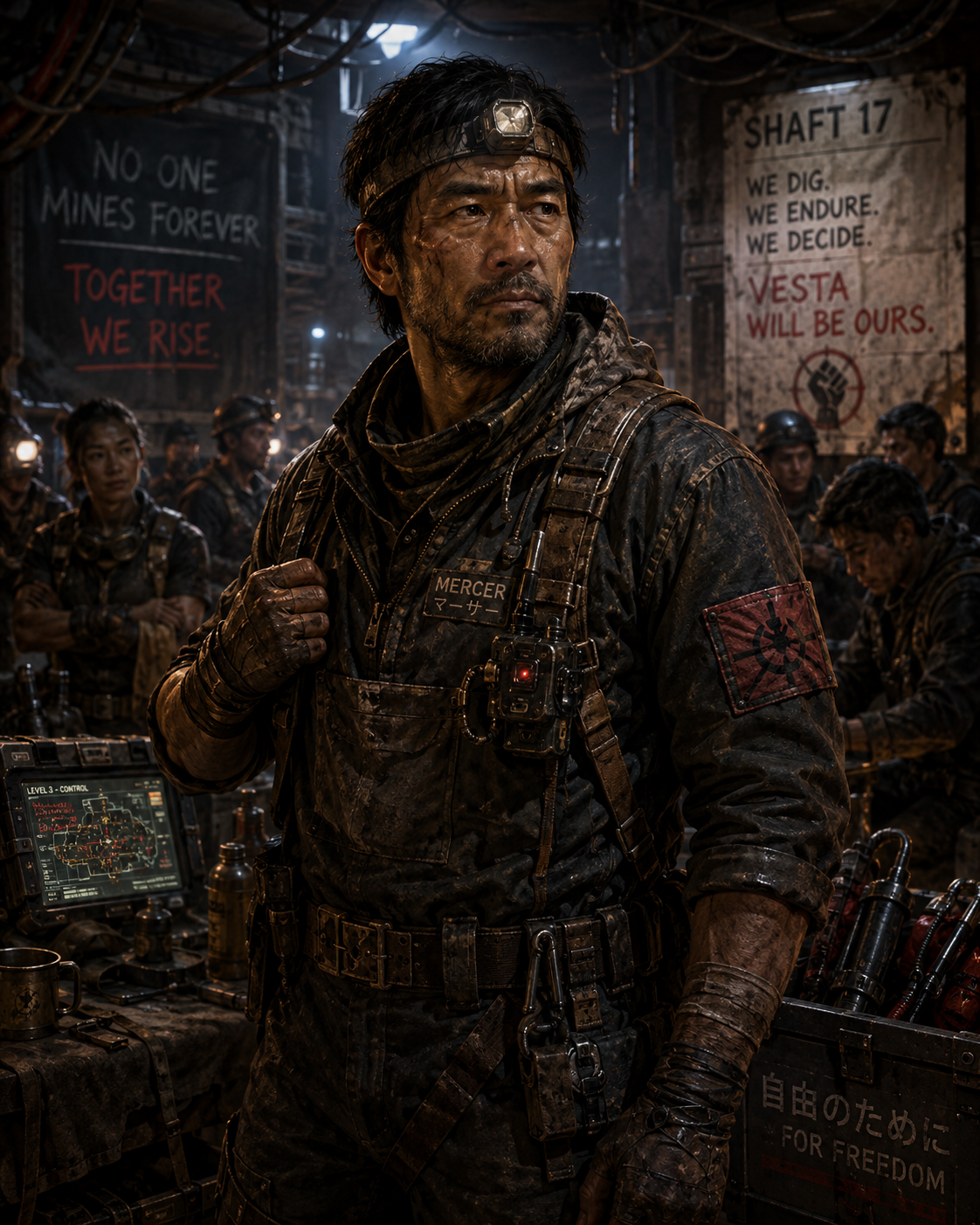
Ancestry: Unter — Belter
Occupation: Asteroid Miner / Shift Foreman
Affiliation: Imperial Mining Combine; secretly Belter Resistance
Location: Vesta Mining District
Age: 46
Associates: The miners of Shaft 17, particularly the eleven people on his work crew
Daichi Mercer has spent twenty-nine years working rocks. He has mined nickel-iron bodies barely large enough to hold themselves together, crawled through excavation shafts where a suit puncture meant death in seconds, worked eighteen-hour emergency shifts repairing life-support machinery, and once spent nearly three days trapped with five other miners after a tunnel collapse severed their section from the main habitat. When rescuers finally cut through, Mercer was still working. That story made him something of a legend among the miners. Mercer hates the story. There were six people trapped in that tunnel when it collapsed. Only five came out.
Endurance in the Belt isn’t about ignoring pain. It is knowing exactly how tired you are and doing the job anyway. Mercer’s knees hurt constantly. His left shoulder has never properly healed from an industrial accident fifteen years ago. Radiation treatments have left pale discolorations running along his neck and jaw. Two fingers on his right hand are prosthetic, and his lungs carry enough accumulated damage that he sometimes wakes coughing after particularly hard shifts.
None of that concerns him very much. His crew does. Mercer knows who hasn’t been sleeping. He notices when someone’s suit seals are beginning to deteriorate. He knows which miner is sending half his wages to a daughter on Hyakutake and which one has started gambling again. He checks oxygen reserves himself even though three other people are responsible for doing it. He remembers birthdays and keeps protein bars hidden in his locker for people working doubles.
When someone complains that Mercer worries too much, his answer is always the same – “Rock doesn’t care about you. Somebody ought to.” That is the heart of his endurance. He doesn’t endure because he believes suffering makes him stronger. He endures because other people are depending upon him.
Mercer works at Kuroda Extraction Facility 17, usually just called Shaft 17, an Imperial corporate mine cut several kilometers beneath Vesta’s surface. Official Imperial broadcasts portray places like Shaft 17 as triumphs of humanity’s expansion into space. Mercer sees something different. Production quotas rise every year. Maintenance windows get shorter. Replacement equipment gets cheaper. Injured workers disappear into administrative reassignment. And every accident is inevitably blamed upon worker negligence.
The miners aren’t technically slaves. They receive wages and have contracts. They are provided housing and can theoretically request transfers. But everything costs money – including their air, housing, medical care, equipment fees, and transportation off Vesta. A miner can spend twenty years working and discover that he owes the company more than when he started. Mercer has endured that system for almost three decades. Now he has decided that endurance does not necessarily mean accepting it.
Mercer became involved with the Belter Resistance eight years ago. At first, he did almost nothing dramatic. A replacement oxygen regulator disappeared from inventory and found its way to an independent mining settlement. A worker scheduled for questioning by Imperial security happened to be assigned to an ore hauler leaving Vesta. Production records occasionally contained errors that concealed several tons of extracted material.
Mercer became useful precisely because nobody thought of him as a revolutionary. He was just Dai Mercer, the tired old shift boss who complained about safety regulations. The man forever repairing something and who volunteered for another shift when someone called in sick. The guy who always seemed to be around but slowly, Shaft 17 became something else – a resistance cell.
Not everyone knows it. Some miners move messages without understanding what they carry. Others deliberately look away when something happens. Perhaps thirty are active participants. Mercer knows nearly all of them. That frightens him more than the Imperial authorities ever have, because when the revolt begins, those people become his responsibility.
The Resistance has learned that the Empire intends to substantially increase extraction from the Vesta mines. New military construction requires raw materials, and Shaft 17’s quotas are about to increase again. Mercer has seen the projections and knows what those numbers mean – more accidents, more radiation exposure, more skipped maintenance, and most importantly, more dead miners.
The resistance leadership has finally approved something Mercer has discussed for years – take the mine. First, disable Imperial communications. Then seize the mining control center. Lock corporate security out of the lower shafts and capture the surface landing facilities. Eventually bring neighboring mining installations into the uprising. It seemed like a good plan.
For years Mercer imagined that moment and now that it is approaching, he cannot sleep – not because he is afraid of dying, but because he knows exactly what rebellion looks like inside an asteroid. Reactors operating must be kept and the atmosphere has to be maintained. Pressure doors must be controlled and someone must make certain an overeager nineteen-year-old miner doesn’t put a mining charge through a wall separating them from vacuum. And finally, someone has to decide what happens when Imperial security begins shooting.
Mercer has spent his entire adult life bringing people home from dangerous shifts. Now he is about to lead those same people into the most dangerous shift of their lives. To their masters, they are simply numbers. Mercer doesn’t think abstractly about the resistance. He sees individuals with names.
Keiko Arata is his deputy foreman and probably knows the mine better than Mercer does. She’s one of the few people he trusts to continue the uprising if he dies.
Mateo Sanz is a twenty-year-old drilling technician whose father died in Shaft 17. Mercer thinks of Mateo almost like a son—and knows the young man is far too eager for the shooting to begin.
Anika Volkov maintains environmental systems. She wants nothing to do with revolution but has agreed to help because Mercer convinced her that somebody competent must keep everyone breathing.
Old Chen is sixty-three, has worked beside Mercer for twenty-two years, and knows about the resistance without ever admitting that he knows. Mercer hasn’t asked him to participate. Chen intends to anyway.
These are the people Mercer sees when someone says revolt. Not flags, not speeches, not freedom. Faces with names. People with fears, families and hopes.
Mercer’s greatest fear is not that the uprising will fail, of course. He fears even more that It is that it will succeed. If Shaft 17 falls quickly, frightened miners throughout Vesta may rise with it. Hyakutake is the Empire’s largest Belt colony, with roughly a million inhabitants and enormous mining, refining, shipbuilding, and military interests. A successful uprising at one facility could become something much larger than Mercer ever intended.
Mercer isn’t a general, he’s a miner. Mercer knows how to keep forty exhausted people working together when everything has gone wrong and perhaps that is exactly what the revolution needs.
How much can one man endure before endurance becomes sacrifice?