

Weekly: Instinct. Daily: Fair of Face
Shattered Expanse
Kharos Vael
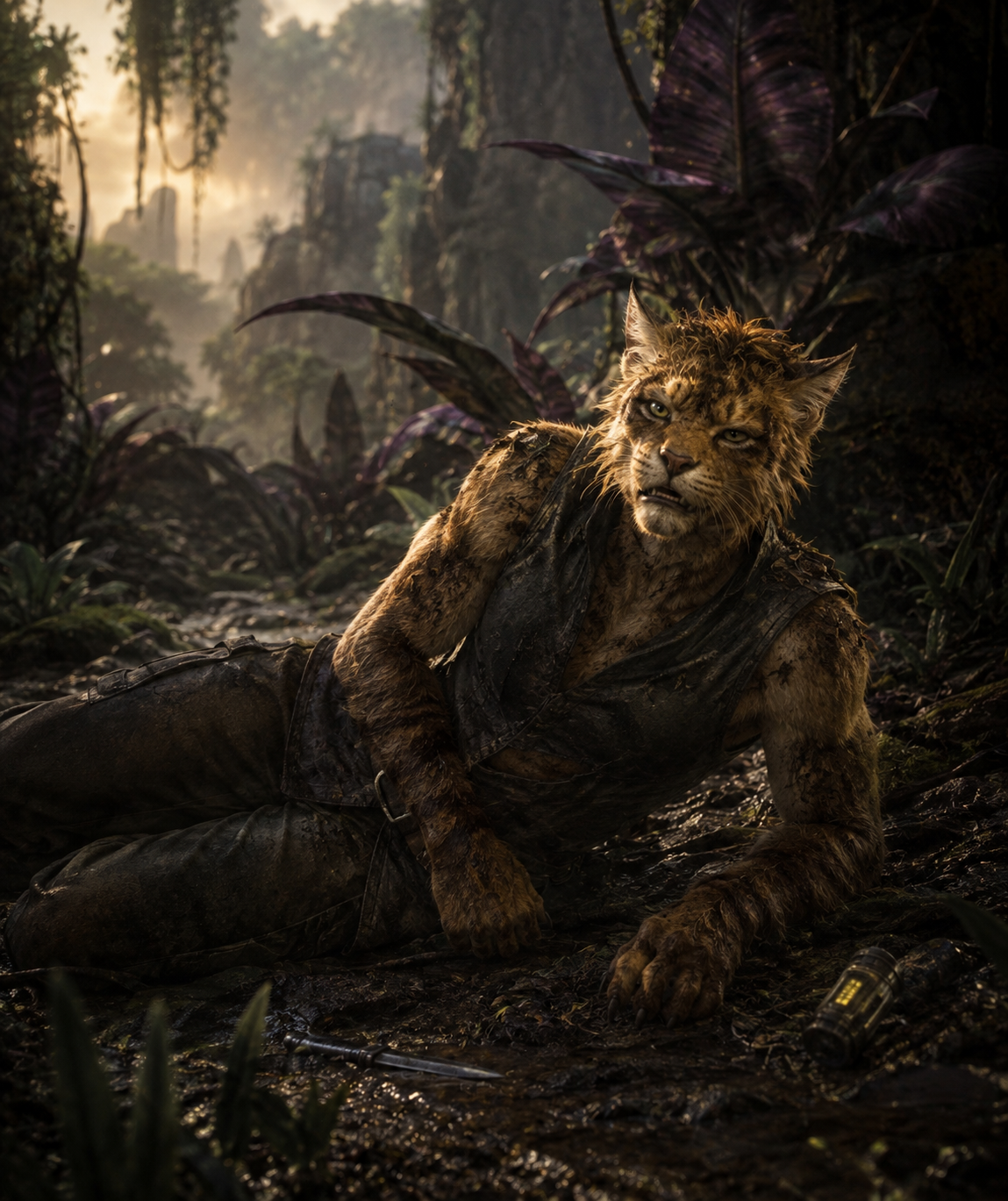
Race: Halogai’
Age: 16 standard years, approximately late adolescence by Halogai’ development
Role: Unwilling Rite-Hunter
Kharos Vael woke with dirt in his mouth. For several seconds, he simply lay there beneath the enormous violet leaves, trying to remember where he was. His head throbbed. His tongue tasted bitter. Something small crawled through the fur along his shoulder.
Then he smelled the air. Wet stone. Rotting vegetation. Musk. Blood. Kharos opened his eyes.
“Oh, you have got to be kidding me.” he growled. He knew the smell from school.
Vharak Reserve.
His parents had sent him hunting.
Kharos Vael had always been handsome. That statement means something very different among the Halogai’ than it does among Humans. Humans first notice his feline face, amber eyes, powerful build, and thick dark-gold coat. A Human might describe him as leonine, perhaps even regal. A Halogai’ sees considerably more.
Kharos possesses an unusually broad muzzle and strong jawline, with perfectly symmetrical whisker beds and prominent cheek ruffs that frame the face without obscuring the ears. His upper canines show slightly when his mouth is relaxed—a desirable trait among young males because it suggests healthy dentition without the coarse oversized fangs associated with some older bloodlines. His ears are small, high-set, and nearly unscarred. His coat is dense and remarkably even, becoming darker along the shoulders and spine before lightening around the throat.
Most striking are his eyes – clear amber surrounded by a narrow ring of black fur. Among Halogai’, these are beautiful features. His lack of scars is not. That contradiction has defined Kharos’s adolescence. He has the face of an ancient warrior portrait and the hide of someone who has never actually been one.
Kharos discovered very young that attractiveness was a kind of power. Other adolescents wanted his attention. Adults remembered him. Teachers tolerated arrogance they would have punished in less appealing students. He learned how to stand, how to tilt his ears, how long to hold another Halogai’s gaze before looking away, and exactly when to expose the faintest hint of fang in a smile.
He became very good at being Kharos Vael. His parents became increasingly concerned that he was becoming good at nothing else. Exposure to the wider Expanse only made matters worse. Kharos adored offworld culture. He followed Human entertainment, wore imported clothing, learned fragments of K’Dasi slang, and spent considerable time among young Bengradi.
That last influence particularly irritated his father. The modern Bengradi emphasis on restraint, scholarship, compassion, and avoidance of unnecessary violence represents almost everything conservative Halogai’ parents fear their children might find appealing about the wider Expanse. Kharos thought the Bengradi sophisticated. His parents thought they were teaching their son that civilization could protect him from consequences.
His father once told him “Your ancestors had instincts. You have opinions.”
Kharos laughed but he was the only one. Three weeks later, his parents invited him to dinner.Kharos remembers the first drink and does not remember the second. He woke on Vharak Reserve with the clothes he was wearing, a survival knife, a small water flask, and a locator implanted beneath the skin of his forearm.
The locator does not tell Kharos where he is. It tells his parents whether he is still alive. There is no rescue beacon, no weapon, and no map. Someone will collect him in twelve days, if he survives.
By the second night, Kharos understands what his parents meant. There is an intensity to existence here that he has never experienced. He hears everything – a branch moving thirty meters away, the flutter of something small overhead, water running beneath rocks and even his own breathing. At first, every sound frightens him, keeps him awake but then something changes.
He begins separating them. Wind. Insect. Prey. Predator. His world becomes astonishingly narrow and impossibly large at the same time. Hunger becomes intense. Thirst becomes intense. Smell becomes intense. Pain becomes intense. Silence becomes unbearable.
There are moments when Kharos realizes he has remained perfectly motionless for twenty minutes without consciously deciding to do so. His ears move independently toward sounds. His nostrils flare. His claws emerge before he realizes something is nearby. The civilized young Halogai’ who spent hours worrying about how his coat lay across his shoulders disappears. Something older and primal takes his place. Not permanently, not completely but enough.
On the fourth day, Kharos catches himself stalking an animal he has never seen before. He does not know its name or if it is dangerous. He does not remember deciding to follow it. His body simply understands things his conscious mind does not. Stay downwind. Do not stare directly at it. Step where the ground is dark. Wait. The instincts of a – Khar’Varesh – true Halogai’ are strong
Now.
Kharos launches himself and for perhaps three seconds there is no civilization, no Dominion, no parents, no Bengradi philosophy, no handsome young male who knows precisely how attractive he is. There is only the hunt – movement, claws, breath, heartbeat and prey.
When it is over, Kharos crouches over the dead animal, panting, hands are shaking and his muzzle is bloody. For the first time in his life, Kharos understands why older Halogai’ sometimes become quiet when young people talk about how primitive the old traditions are. His father was right and of course, Kharos hates that more than anything.
The lesson his parents intended is not that civilization is weakness. Kharos eventually realizes that they do not actually object to his Human friends, his Bengradi acquaintances, imported clothes, or fascination with other cultures. They fear that he has confused having choices with not needing foundations.
A Bengradi can choose restraint because a Bengradi understands what is being restrained. A warrior can choose peace because the warrior understands violence. Kharos had adopted the conclusions of other cultures without developing the instincts his own culture expected him to possess first.
Vharak changes that. The reserve strips away every social mechanism he normally uses. Nothing cares about his family, his appearance and it laughs when he is charming. For the first time, Kharos cannot persuade the world to like him. He has to understand it and understanding Vharak requires an intensity of awareness he never knew he possessed.
Kharos does not stop being vain. That would make the lesson too easy. When he finds his reflection in a pool on the seventh day, his first reaction is horror. His beautiful coat is filthy. One ear is torn. There is dried blood beneath his jaw. Several whiskers are missing, and a thin cut crosses one cheek.
He touches the wound. “Mother is going to kill me.” Then he laughs. His mother is responsible for it.
More importantly, when Kharos eventually returns home, other Halogai’ see something different. Humans might think the ordeal has made him less attractive. Halogai’ disagree. The tiny notch missing from his ear is interesting. The scar crossing his cheek is very interesting. His coat will grow back. But the way Kharos stands has changed. That is what Halogai’ notice most.
He no longer constantly checks who is watching him. His ears unconsciously track movement around the room. He occupies space differently. When someone approaches from behind, his tail moves before his head does. Among Halogai’, attractiveness is therefore not simply feline beauty.
A handsome face attracts attention. Evidence that its owner can survive attracts respect.
Kharos has begun acquiring both. He is intensely annoyed by this. Because when his father sees the scar on his face and gives the smallest approving flick of an ear, Kharos realizes something terrible. The old bastard was right.
New Savage Worlds Racial Edge
Khar’Varesh
“One Who Stands Above the Hunt”
Requirements: Seasoned, Halogai’, Survival d8+, Spirit d8+
A Khar’Varesh embodies the ancient Halogai’ ideal of hunter, warrior, provider, protector, and leader. Though traditionally associated with completing a Proving Hunt, the title cannot simply be awarded. A Halogai’ must demonstrate that strength and instinct have been tempered by responsibility.
A Khar’Varesh gains +1 to Survival and Notice rolls. In addition, whenever the character spends a Benny to reroll a Survival, Notice, or Spirit roll, they add +2 to the final result.
Finally, a Khar’Varesh instinctively protects those who depend upon them. When an adjacent ally is hit by an attack, the Khar’Varesh may spend a Benny to interpose themselves, becoming the target of the attack instead. This must be declared before damage is rolled.
Blood & Suns
Oberwachtmeister Lukas Brenner
Brutal Über — Elite Protective Service

I know when she enters a room without looking at her. That bothers me. It should not happen.
I was trained at sixteen to identify changes in an environment without consciously observing them. Airflow. Footsteps. Reflections. The displacement of a crowd. A hand disappearing beneath a coat. A face turning away too quickly. I can identify the sound of eleven different service pistols being drawn from their holsters. I can tell when someone behind me has changed their breathing. I can estimate the weight of a man by the sound of his footsteps.
Those things are training. Knowing when Sabine Adler enters a room is not. She is a Schönheit. I am Brutal. There should be nothing else to explain.
My purpose is physical security. Hers is representation. The Reich produced different lines because different functions require different qualities. My bones are reinforced. My musculature was selected for strength and endurance. My reflexes were cultivated before I understood what reflexes were.
Sabine was made differently. I know this because I have read her security file. I should not have read the medical annex. Flawless skeletal symmetry. Optimized skin pigmentation. Controlled endocrine development. Vocal harmonics. Pheromonal expression within approved parameters.
There are numbers for all of it. Measurements. Percentages. Generations of breeding records. The Reich can explain precisely why Sabine Adler is beautiful. That should make her beauty meaningless to me. It does not.
When she walks past me, I notice. When she speaks my name, something happens in my chest before my mind understands that she has spoken. When she touches my arm to move around me in a crowded reception, I remember it. I hate that most of all. Not her. Never her. It. The reaction. The weakness.
I have been conditioned against inappropriate attachment. Every Über understands the breeding laws. Bloodlines are controlled because bloodlines are the foundation of civilization. Brutal with Brutal. Schönheit with Schönheit. Gehirn with Gehirn. Approved pairings. Approved genetic compatibility. Approved offspring.
There is nothing complicated about it. Yet sometimes Sabine smiles at me. And every carefully arranged principle becomes complicated. She does not do it intentionally. I know the difference. I have watched her manipulate men before. That is part of her function.
A visiting industrialist becomes more agreeable after she touches his sleeve. A Party official suddenly finds her proposal more reasonable when she leans closer. Foreign delegates stare a second longer than they should. I watch them. I measure them. I despise them for it.
Then I realize I am doing exactly the same thing. So I become angry with myself. Anger is useful. I understand anger. I can turn anger into vigilance. I check the exits again. I watch the balconies. I study the hands of the waiters. I position myself between Sabine and anyone I consider dangerous.I stand closer to her than necessary.
That last part troubles me. I tell myself it is tactical. Sometimes it even is. Three months ago in München, a man reached inside his coat six meters from her. I crossed half that distance before I consciously understood what I had seen. My shoulder struck him hard enough to fracture his sternum. He had been reaching for identification. I apologized.
Sabine laughed about it afterward. “You really would kill someone for me, wouldn’t you, Lukas?“
I told her that was my assignment. She looked at me for several seconds. Then she said “That wasn’t what I asked.”
I had no answer. I still don’t. Perhaps that is what frightens me. I have answers for everything else. Threat appears. Interpose. Weapon appears. Disarm. Attack begins. Neutralize. Evacuation ordered. Extract principal. Everything has an appropriate response.
But there is no procedure for the way I feel when Sabine falls asleep during a long flight and her head rests against the armored bulkhead beside me. There is no drill for noticing that she looks different when she is tired. There is no regulation explaining why I prefer that face to the one she shows cameras. And there is certainly no approved response for imagining what it would be like to touch her face.
So I don’t. I sit beside her. I watch the cabin door. I count the breaths of the security personnel. I listen to the engines. I do my job. Intensity is useful when it has somewhere to go. Mine has nowhere else.
The doctors say the Brutal line has been refined for six generations. The Schönheit line even longer. Every undesirable tendency identified. Every useful characteristic strengthened. Every generation supposedly closer to what our ancestors intended. But sometimes I wonder whether they actually understand what they made.
They strengthened my heart so it could drive blood through a larger body under extreme physical exertion. They strengthened my adrenal system so I could respond instantly to danger. They strengthened my senses so I could notice the smallest change around the person I protect. Then they assigned me to one of the most beautiful women their laboratories ever produced.
And they expect my body to understand regulations. Perhaps that is the mistake. They believe because they can alter instinct, they own it. Because they can encourage one impulse and suppress another, they believe they created them. Because they can arrange two people on a genetic chart, they believe they understand what happens when those two people stand beside each other.
They don’t.
I will protect Sabine Adler. I will obey my orders. I will never touch her in the way I sometimes want to. Perhaps no one will ever know that I wanted to. But the desire exists. Somewhere beneath the conditioning, beneath the training, beneath six generations of careful breeding, something remained that no physician put there.
Something older than the Reich, older than eugenics, older than laboratories. Older, perhaps, than civilization.
They can call me Brutal. They can call her Schönheit. They can decide who we marry. They can decide what children we are permitted to have. They can map our blood, alter our bodies, and tell us what purpose we were born to serve. But they did not create the thing inside me that turns when she enters the room.
And they cannot order it to stop.