

Weekly: Instinct. Daily: Full of Grace
Shattered Expanse

Garik Din’alt Kragar
Chief Executive of Jarrett Noir Consortium
Velvet Syndicate Power Broker
“Dead men make no bets.”
Garik Din’alt Kragar is one of the most influential figures within the Velvet Syndicate and the public Chief Executive of the Jarrett Noir Consortium. To most of the Expanse, he is a fabulously wealthy casino magnate, financier, investor, and social fixture whose holdings stretch from luxury resorts and pleasure stations to discreet banks, shipping concerns, entertainment networks, and information brokers. To those who understand how power actually moves through the Expanse, Kragar is something considerably more important: a man who makes deals between people who officially cannot speak to one another.
Jarrett Noir Consortium does not merely sell products. It sells outcomes. Money can be moved without being traced. Cargo can arrive somewhere it was never officially shipped. A wanted individual can acquire another identity. Political rivals can suddenly discover common interests. Elections can tilt, inconvenient information can surface, and wars can sometimes disappear before anyone fires the first shot. JNC maintains the shell companies, intelligence networks, intermediaries, and layers of plausible deniability necessary to make such things possible.
Ironically, the man sitting at the center of that labyrinth has remarkably little patience for unnecessary deception. Garik Din’alt Kragar is a straight shooter.
Kragar believes that once two people sit down at the same table, there is little reason to pretend they do not understand why they are there. His businesses may operate through intermediaries and shell corporations, but Garik himself is famously direct. He tells people what he wants. More surprisingly, he expects them to do the same.
Someone negotiating with Kragar might spend hours preparing elaborate arguments, carefully concealed threats, false concessions, and layers of diplomatic language only to have Garik interrupt them halfway through.
“You want access to the shipping corridor. I want your mining contracts. You think mine are worth less than I do. Excellent. Now we have something to discuss.”
To Kragar, this is not impatience. It is courtesy. He considers wasting another person’s time a minor form of disrespect. Everyone at his table has something they want. Pretending otherwise merely delays the moment when an actual agreement can be reached.
Kragar’s Rule #3: Say what you want. It saves everyone time.
His directness can be startling because Garik will acknowledge things other powerful figures instinctively deny. He will admit when he is making money from someone’s misfortune. He will tell an ambassador that their government has no negotiating position. He will inform a corporate executive that one of their supposedly loyal subordinates has already approached JNC. He rarely raises his voice while doing so. There is no need.
Garik’s directness is not cruelty. He sees little value in cruelty at all. Humiliation creates enemies, and enemies are expensive. Truth, properly delivered, is usually cheaper.
Kragar has access to some of the finest intelligence money can buy. Crimson Echo Intelligence can prepare exhaustive dossiers on nearly anyone important enough to sit across from him. Garik reads them and then he watches the person.
After decades spent among gamblers, politicians, criminals, merchants, diplomats, mercenaries, aristocrats, executives, spies, and desperate people pretending not to be desperate, Kragar has developed an extraordinary instinct for human and alien behavior. He notices hesitation. He notices which person at the table someone looks toward before answering a difficult question. He notices when someone touches their glass but does not drink. He notices who watches the door. He notices when someone’s anger is genuine and when it has been manufactured for effect.
Most importantly, he understands desperation. A negotiator can conceal greed. Fear can be disguised. Loyalty can be performed. Desperation is much harder to hide. Sometimes Kragar will reject a proposal despite every analyst around him recommending acceptance.
“No.”
His advisors ask why.
“He looked at the waiter before he looked at me.”
Nobody else understands what that means. Garik does. More often than anyone around him would like to admit, he turns out to be right.
Kragar’s Rule #9: If your instincts tell you to leave the table, leave the table. You can apologize tomorrow.
This instinct also shapes his attitude toward violence. Kragar is not a pacifist. Violence is simply a poor negotiating tool once it begins. Dead people cannot repay debts. Destroyed factories cannot produce goods. Bombed cities do not buy luxuries. Refugees rarely make good customers. War destroys markets. Kragar would much rather have two mortal enemies indebted to him than one victorious ally standing over the other’s corpse.
Thus his most famous rule: Kragar’s Rule #1: Dead men make no bets.
Those who expect the head of Jarrett Noir Consortium to behave like a stereotypical crime lord are often confused by Garik’s manners. He is extraordinarily gracious.
Kragar remembers names. He remembers spouses, children, favorite drinks, dietary restrictions, and conversations held years earlier. He thanks servers. He speaks to junior employees rather than through them. A visiting dignitary and the person carrying the dignitary’s luggage may both receive a greeting by name.
When Garik hosts someone, they are his guest. That distinction matters enormously to him. Enemies have dined safely at his table. Criminals with substantial prices on their heads have walked openly through his establishments under his protection. Diplomats representing governments hostile to the Velvet Syndicate have discovered that their preferred drink was waiting before they sat down.
Garik’s hospitality is not weakness. It is a boundary. Someone who accepts his hospitality is expected to respect it in return. But the deeper expression of Kragar’s grace is his refusal to unnecessarily strip people of their dignity.
He does not publicly berate subordinates. He rarely gloats over defeated opponents. When someone loses badly to him, he often provides them with a way to leave the table without being humiliated. Not necessarily a free way, of course. Garik remains a businessman, but there will usually be a way.
Kragar’s Rule #22: Never take a man’s dignity when his money will suffice.
There is pragmatism behind the philosophy. A humiliated enemy dreams of revenge. A defeated enemy who was treated with respect may someday become a customer, partner, informant, or friend. Yet those closest to Kragar suspect there is something more than calculation involved.
Garik genuinely dislikes cruelty. He may profit from vice, corruption, desperation, and weakness, but he sees no reason to make suffering worse merely because he has the power to do so. Whether that constitutes morality is something Garik himself would probably laugh about.
One frequently repeated story about Kragar concerns a young woman who approached his private table at a restaurant on Elysar Lux. His security detail immediately began moving toward her but Garik raised one finger and they stopped. The woman sat opposite him and Garik looked at her for several seconds.
“You’ve come to kill me.”
She froze.
Garik poured another drink. “You’re carrying a pistol beneath your coat. You’ve touched it three times since entering the room. If you were a professional, I would already be dead. So you’re not. Which means I’ve done something to you.” He pushed the glass toward her.
“Tell me what.”
Her father had owned a small company destroyed during a financial maneuver involving one of Jarrett Noir Consortium’s subsidiaries. He lost his business, his home, and eventually his life. His family inherited the debts. The woman expected denial. Garik asked her father’s name and he remembered the transaction.
“Yes,” Garik said. “We destroyed him.”
No excuse. No carefully worded distinction between JNC and its subsidiaries. No attempt to shift responsibility. Just the truth. Then Garik asked about her family. Her mother was alive. Her younger brother was struggling. Their home was gone. The debts remained.
Garik made one call. The debts disappeared. Arrangements were made to return the family home. A fund was established for her brother’s education. The woman stared at him.
“Why?”
Garik reportedly shrugged.
“Your father lost a game with me. You didn’t.”
She asked what she owed him.
“Nothing.” Then Garik glanced toward the kitchen. “Though if you still intend to shoot me, I’d appreciate it if you’d wait until after dessert. The chef becomes unbearable when people leave early.”
Whether every detail of the story is true is impossible to determine. Garik has never confirmed it. He has never denied it either.
Garik’s graciousness becomes most apparent when he has already won. He does not need his opponent to acknowledge defeat and that is an important distinction. Many powerful people require submission. They want apologies, public declarations of loyalty, bowed heads, or some other demonstration proving that everyone understands who won. Garik considers such behavior insecure.
If he owns the debt, controls the contract, possesses the information, or has obtained the concession he wanted, then victory has already occurred. Anything afterward is theater and Garik would rather pour the loser another drink.
Kragar’s Rule #31: If you’ve already won, be gracious. Only amateurs need their opponent to know they’ve lost.
It is one reason people continue dealing with him despite knowing exactly how dangerous he is. You can lose to Garik Din’alt Kragar and survive. You can even leave with your pride intact. What you rarely leave with is the thing Garik wanted.
Over the years, Garik’s sayings have become collectively known as Kragar’s Rules. Employees quote them. Rivals mock them. Gamblers argue over their exact numbering. Some supposedly authentic lists contain dozens more rules than others, and Garik occasionally seems to invent a new one whenever circumstances demand it.
Among the best known are:
Rule #1: Dead men make no bets.
Rule #3: Say what you want. It saves everyone time.
Rule #7: If everyone is angry, nobody is thinking.
Rule #9: If your instincts tell you to leave the table, leave the table. You can apologize tomorrow.
Rule #12: Always know who is really paying.
Rule #15: Never lie when the truth will make the better deal.
Rule #18: Never gamble with a man who has nothing left to lose.
Rule #22: Never take a man’s dignity when his money will suffice.
Rule #31: If you’ve already won, be gracious. Only amateurs need their opponent to know they’ve lost.
Whether these rules represent a carefully developed philosophy or simply the accumulated instincts of a lifelong gambler is unclear. Garik would probably say there is no difference.
Garik occupies an unusual position within the Velvet Syndicate. He is unquestionably dangerous, enormously wealthy, and connected to activities that range from questionable to outright criminal. Yet he has also prevented conflicts, brokered prisoner exchanges, opened trade between enemies, rescued failing colonies when doing so made financial sense, and provided neutral ground for negotiations that no legitimate government could publicly host.
None of this makes him benevolent. Garik helps people because helping them sometimes benefits him. He saves enemies because living enemies can become useful. He prevents wars because peace is profitable. He forgives debts when collecting them would cost more than they are worth. But occasionally he does something generous for which no obvious profit can be found. Those moments make his associates uncomfortable.
When asked why, Garik usually finds some business justification afterward. Perhaps he even believes it. Garik Din’alt Kragar understands the Expanse as an enormous table around which billions of people are continually wagering money, power, loyalty, love, reputation, and sometimes their lives. He has no illusions about the game being fair. He merely believes there are civilized ways to play it. Be direct about what you want. Trust your instincts about the person sitting opposite you. And when fortune gives you the winning hand, have enough grace not to make the loser crawl.
After all, tomorrow there will be another game. And dead men make no bets.
Blood & Suns
Father Matteo Bellandi
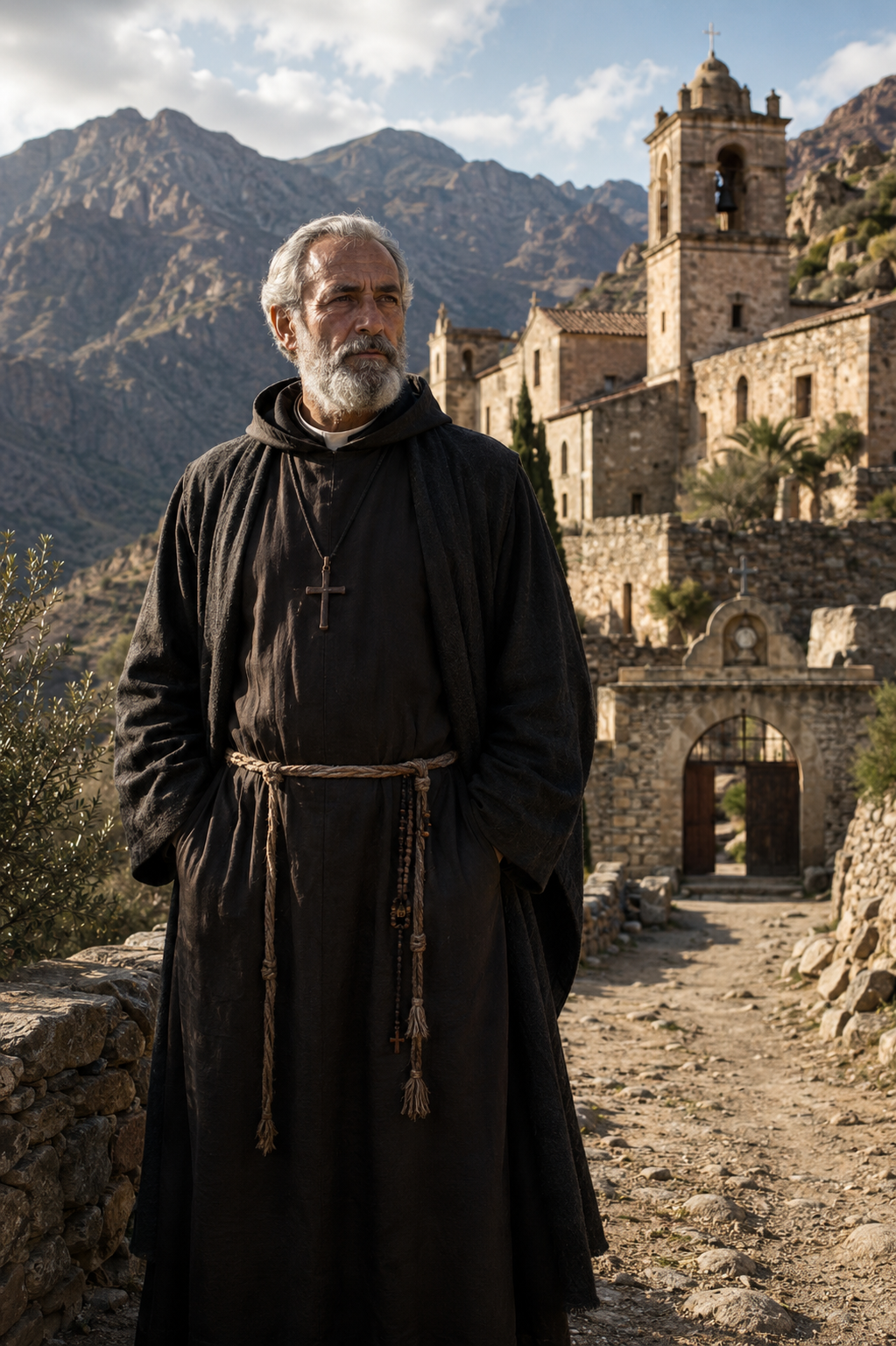
Affiliation: Roman Catholic Church, Vatican
Location: Monastery of Saint Cyprian, Atlas Mountains, North Africa
Role: Priest, physician, monastery prior, unwitting Monolith facilitator
Father Matteo Bellandi has never considered himself a member of Monolith. Monolith considers this distinction extremely important.
Father Matteo is the prior of the Monastery of Saint Cyprian, an isolated Catholic community in the Atlas Mountains. The monastery predates the current political order by centuries, although parts of it have been rebuilt so many times that Matteo jokes that only God remembers which stones are original.
The Vatican maintains the monastery primarily as a hospice, agricultural mission, and refuge. Its brothers cultivate olives, maintain cisterns and solar condensers, operate a small clinic, and provide food and shelter to travelers crossing one of the poorer regions of North Africa. It is also one of the most reliable Monolith safehouses on the continent.
Father Matteo would be extremely annoyed to hear it described that way, because, as he has explained to Monolith repeatedly: “This is a monastery. If someone comes hungry, we feed them. If someone comes wounded, we treat them. If someone comes frightened, we give them somewhere to sleep. If you require something more complicated than that, go somewhere else.”
Monolith eventually realized that arguing with him was pointless, so they stopped.
Monolith’s relationship with Matteo is based upon a peculiar principle Never tell Father Matteo anything he does not need to know. This is not because they distrust him. It is because Matteo will not lie. Not convincingly. Not reluctantly. Not for the greater good. Not to save a Monolith operation. Probably not even to save his own life.
If an SS officer asks Matteo whether a particular man is a Monolith agent and Matteo knows that he is, Matteo will not deny it. Consequently, Monolith makes certain that Matteo doesn’t know. The monastery once sheltered three Monolith operatives for eleven days after an operation went badly. Matteo was told that they were refugees requiring sanctuary. That was true. He gave them beds.
Another time, Monolith needed several crates moved through a Vatican relief shipment. Matteo was told that the shipment contained food and medical supplies destined for hungry people. Most of it did. He signed the transit papers.
A wounded Monolith courier once arrived carrying information desperately needed by another Cell. Matteo was told only that the woman had been shot and needed treatment. He removed the bullet and three days later someone arrived and asked for her rosary. Matteo handed it over and he never asked why.
This arrangement occasionally drives Monolith handlers insane. Matteo finds it perfectly sensible. “You are responsible for your conscience,” he once told a frustrated handler. “I am responsible for mine. This seems an equitable division of labor.”
Matteo does not evade questions and that is what makes dealing with him dangerous. A Reich security officer once arrived at Saint Cyprian searching for two fugitives believed to have passed through the mountains. “Have you sheltered strangers recently?”
“Yes.”
“How many?”
“Seventeen this month.”
“Were any carrying weapons?”
“Yes.”
The officer reportedly stared at him. Matteo waited.
“Were any of them resistance fighters?”
“I don’t know.”
“You didn’t ask?”
“No.”
“Why not?”
“They were hungry.”
There is no cleverness in Matteo’s answers. That is precisely the problem. Interrogators accustomed to fear, deception, rehearsed cover stories, and carefully constructed half-truths find themselves confronted by a man who simply answers the question they actually asked.
Monolith personnel occasionally mistake this for naivety. They usually make that mistake once. Matteo understands perfectly well what happens around his monastery. He simply refuses to pretend knowledge he does not possess. And he refuses to acquire knowledge merely so someone can later force him to conceal it. There is considerable wisdom in that distinction.
The strangest thing about Father Matteo is that his directness almost never feels cruel. He can tell someone that they are behaving like a fool without humiliating them. He can refuse an armed Monolith operative sanctuary and somehow have the operative thank him before leaving. He remembers names. He remembers children. He apologizes when he interrupts people. He serves visitors himself when the other brothers are occupied. He gives the better chair to guests.
When frightened people arrive at Saint Cyprian, Matteo’s first questions are generally whether they have eaten and whether anyone is injured. His hospitality does not depend upon politics. That creates situations Monolith finds deeply uncomfortable.
On one occasion, three wounded Reich soldiers were brought to Saint Cyprian after their patrol vehicle crashed in the mountains. Matteo admitted them. There were two Monolith agents hiding in the monastery at the time. One slept in a storeroom behind the kitchens. The other was recovering from a gunshot wound approximately twenty meters from the Reich soldiers.
A horrified Monolith contact whispered: “Father, those men are SS.”
Matteo corrected him. “No. One is SS. Two are Army.”
“That isn’t the point.”
“It appeared important to them.”
“They would kill us.”
“Possibly.”
“And you’re treating them?”
“They’re wounded.” That ended the conversation.
Matteo spent the evening moving between both rooms. He changed the dressing on a Monolith agent’s wound, then he changed the dressing on an SS corporal’s wound. He brought soup to both. Neither knew the other was there. Matteo prayed with both. This is what Full of Grace means for him.
Grace is not something bestowed upon people Matteo has determined deserve it. If they deserved it, it would not be grace.
Matteo’s instincts are invaluable. Monolith has never determined exactly how he does it. He will suddenly refuse a request that resembles dozens he has accepted before.
“No.”
The handler will explain why it matters.
“No.”
They will offer another route.
“No.”
They will ask why.
“I don’t know.” That answer infuriated Monolith at first. Then they started keeping records.
A courier Matteo refused to shelter was followed by Reich intelligence. A truck he refused to allow through the monastery checkpoint was searched twenty kilometers later. A Monolith agent he refused to introduce to a Vatican contact was arrested six weeks afterward as a double agent.
There is no evidence Matteo is psionic and he claims no visions. He hears no divine voices, he simply watches people. Something in their posture bothers him. Someone asks a question slightly too quickly. A familiar checkpoint guard isn’t working his normal shift. A dog is barking somewhere it usually doesn’t. A traveler drinks water but doesn’t eat. A monastery door has been closed when Matteo remembers leaving it open. Tiny things.
He notices them without consciously understanding their significance. And when his instincts speak, Matteo listens. Monolith now has a standing instruction concerning Saint Cyprian – If Father Matteo says no, the answer is no. No handler may override him. No Directorate authorization supersedes him. The operation moves somewhere else. They have learned the expensive way that Matteo is usually right.
There is one final complication to Monolith’s arrangement with Father Matteo. Everyone assumes Matteo doesn’t know what they are doing. Perhaps he doesn’t. But there have been moments. A wounded woman arrives shortly before midnight. Matteo opens the monastery gate himself.
“You need somewhere to stay?”
“Yes, Father.”
“Are people looking for you?”
“Yes.”
“Will knowing why place my brothers in greater danger?”
She hesitates.
“Yes.”
Matteo nods.
“Then don’t tell me.”
He opens the gate wider. That is the closest he ever comes to conspiracy. He knows enough to recognize when ignorance is morally preferable to curiosity. But even there he is direct. He never says I don’t want to know. He says: “I do not need to know.”
There is a difference.