

Weekly: Instinct. Daily: Loving & Giving
Shattered Expanse
Sera Vahl’kessa
Frak’terian Ward Trauma Specialist, Probationary
Sera Vahl’kessa
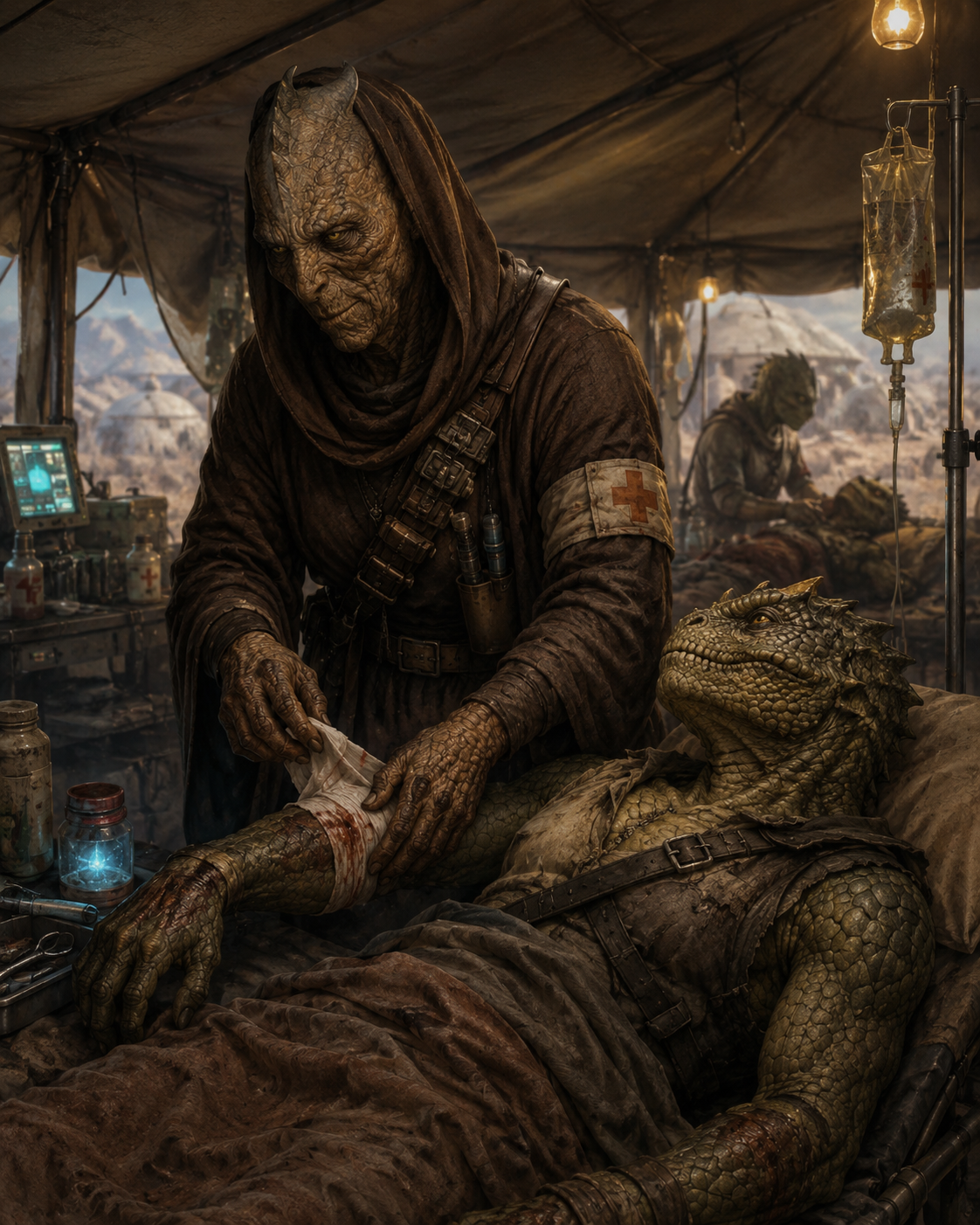
Frak’terian Ward Trauma Specialist
Sera Vahl’kessa had always believed that charity was simple. Someone was hungry, you fed them. Someone was frightened, you comforted them. Someone was injured, you treated them. If another person possessed a need and you possessed the means to answer it, there was little reason to spend time considering whether you should. You simply did.
That instinct was one of the reasons Sera entered the Frak’terian Ward.
She was still a new recruit when she received her first major deployment, assigned as a junior trauma specialist aboard one of several Ward medical vessels sent toward the edge of Que’sha space. The Frak’terians had no territorial claim there, no treaty obligation requiring intervention, and little strategic interest in the contested region. The settlements under attack were Que’sha, and the aggressors were bands of Drax’uuh raiders who had begun striking isolated communities with increasing frequency and savagery.
None of that particularly mattered to the Ward. People were suffering. The Frak’terians had ships, medicine, doctors, supplies, and the ability to help. So they went. For Sera, that was reason enough.
The Ward mission was supposed to be humanitarian rather than military. Its vessels carried defensive systems, but their holds were filled primarily with surgical equipment, pharmaceuticals, replacement organs, emergency shelters, food concentrates, field generators, and medical drones. Ward trauma teams descended to communities after attacks, stabilized the wounded, evacuated critical patients, and supplemented Que’sha medical facilities already stretched beyond their limits.
Sera volunteered for almost every surface rotation she could. At first, Senior Ward-Medic Torren Ka’vahl, the leader of her trauma team, mistook her enthusiasm for the eagerness of a young recruit desperate to prove herself. He soon discovered something more fundamental about her. Sera simply found it extraordinarily difficult to walk away from suffering.
If another medic mentioned that a village clinic was short staffed, Sera volunteered. If a patient needed observation after her shift ended, she stayed. When supplies ran low, items from her own field kit somehow found their way into Que’sha hands. More than once Torren discovered her treating patients long after he had ordered her to sleep.
His reprimands became increasingly severe. “You cannot help tomorrow if you spend all of yourself today,” he told her. Sera understood the argument and even agreed with it.
Then someone cried for help, and her feet started moving before the argument could reach them. That was Sera’s instinct. Someone is hurt. Help them. There was no calculation behind it. She did not ask whether the injured person was strategically important, whether their government could compensate the Ward, whether Frak’terian resources might accomplish more somewhere else, or whether someone else ought to bear responsibility. There was suffering in front of her and she possessed the means to lessen it. For Sera, everything else came afterward.
When Sera arrived, she thought of the Que’sha as the people we came to help. She stopped thinking that way surprisingly quickly. A Que’sha field medic named Hessai was largely responsible.
Hessai had already been working among the frontier communities before the Frak’terian medical ships arrived and possessed an irritating habit of laughing whenever Sera attempted the Que’sha language. Their friendship began with medical necessity, developed through exhausted conversations between emergencies, and eventually extended well beyond the treatment wards. Through Hessai, the casualties acquired lives.
Sera learned families and villages. She learned which foods she liked and which Que’sha delicacies she could barely swallow without offending her hosts. She learned jokes whose meanings did not survive translation and eventually enough of the language to understand why everyone laughed. She discovered that Que’sha children had been making fun of her accent for weeks. She adored them for it.
She came to know an elderly Que’sha matriarch who repeatedly smuggled food onto a Ward shuttle because she had decided the Frak’terian medics were too thin. She knew the farmer who sat outside the recovery ward every night waiting for his daughter to wake. She knew the frightened little boy who stopped crying only when allowed to hold one of Sera’s medical scanners.
Slowly, imperceptibly, professional compassion became affection. Affection became attachment. Sera came to love the Que’sha of that world. And they taught her something about charity that no Ward instructor ever had.
The Frak’terians had arrived believing they were the ones who had something to give. Their medical ships descended from the sky carrying technology, medicines, specialists, and supplies that the battered frontier settlements desperately needed. Yet the Que’sha gave constantly.
Families who had almost nothing shared food with neighbors who had less. Que’sha medical workers continued treating strangers while uncertain whether their own families had survived. Communities took in refugees despite shortages. The bereaved comforted the newly bereaved because they knew precisely what that grief felt like.
After Sera saved the daughter of one Que’sha farmer, he presented her with a tiny handmade keepsake. It was crude and of no monetary value. The man had made it himself while sitting outside the treatment ward. Sera initially tried to refuse it but Hessai stopped her.
“He needs to give something,” the Que’sha medic explained. That sentence remained with Sera.
Sera had unconsciously divided their relationship into giver and recipient. The Ward possessed abundance; the Que’sha possessed need. Therefore, the Frak’terians gave and the Que’sha received. But charity was not ownership of the fortunate. Sometimes the person who possessed almost nothing was the person most determined to give.
Sera kept the little Que’sha keepsake and it became one of her most treasured possessions.
Sera had known about the Drax’uuh before coming to Que’sha space. She had studied the necessary briefings. She understood their reputation for violence and knew the methods employed by the raiders operating along the frontier.
Knowing was different from seeing and Sera rarely saw the battles themselves. She saw what came afterward.
The Ward shuttles descended after the shooting stopped, sometimes while smoke still rolled across settlements. Sera walked through shattered homes and improvised casualty stations. She treated burns, blast injuries, traumatic amputations, internal hemorrhaging, and wounds she had previously encountered only during simulations.
She learned the terrible arithmetic of triage. This one could wait. This one needed surgery immediately. This one could be saved. This one could not. Torren taught her that sometimes a trauma specialist’s most important decision was deciding not to spend limited resources on someone who would almost certainly die when three others might live.
Sera hated him for those decisions, then she began having to make them herself. She hated herself considerably more. Her feelings toward the Drax’uuh changed as the months passed. Academic disapproval became anger. Anger became disgust. After she began knowing the Que’sha personally, every new casualty felt less anonymous.
The Drax’uuh were no longer attacking Que’sha settlements. They were attacking people Sera knew. Torren noticed that change too. He warned her about it. Sera insisted she could separate her feelings from her duty. Then came the raid that proved she could not.
The Ward shuttle arrived before the fires were extinguished. For hours, Sera scarcely looked up from her work. Casualties arrived faster than the team could process them. Hessai worked beside her until exhaustion reduced their communication to gestures and single words. Torren moved from patient to patient, making ruthless decisions about where their dwindling resources could accomplish the most.
Then another stretcher entered the treatment area. Sera turned toward it. Drax’uuh. The raider had been badly wounded and abandoned during the retreat. Que’sha defenders had found him among the ruins and, despite everything that had happened, brought him to the Ward. His injuries were severe. Sera looked at him. Then she looked beyond him.
There were Que’sha still waiting. People she had come here to help. People whose homes his companions had burned. Perhaps people he had personally wounded. Sera hesitated. It lasted perhaps a second. Nobody in the treatment area would have blamed her. Some probably never noticed. Sera did. And that single second horrified her.
The Drax’uuh had a survivable injury. She had the ability to treat it. Every principle she claimed to possess demanded only one response. Yet for one second, Sera had looked at a wounded being and decided that his suffering mattered less because she hated him. Then the deeper instinct asserted itself. Someone is hurt. Help them. Sera stepped forward.
The Drax’uuh’s name was Keth Var and Sera saved his life.
Keth Var did not awaken transformed by Frak’terian kindness. He offered no tearful gratitude. He did not renounce his people, condemn the raid, or suddenly profess affection for the Que’sha. If anything, his attitude initially made Sera dislike him more. That made saving him important.
Sera slowly realized that if she required gratitude, redemption, affection, or repayment, then what she had offered was not charity. It was a transaction. Torren understood what had happened long before Sera spoke to him about it. He also understood why that brief hesitation disturbed her. For once, he did not reprimand his young recruit. Instead, he told her that the Ward did not require its healers to love everyone placed beneath their hands. It required them to remember why their hands were there.
Sera finally began understanding the lessons Torren had been trying to teach her from the beginning. Charity did not mean destroying herself for everyone who needed her. Exhaustion was not virtue. Martyrdom was not automatically generosity. A healer who gave everything today might have nothing left for the wounded tomorrow.
Giving required something more difficult than sacrifice, it required discipline. The Que’sha had taught her something else. Those who receive charity do not cease being people capable of giving. Compassion becomes arrogance when the giver begins viewing another person exclusively through the lens of their need.
And Keth Var taught her the hardest lesson. Giving to someone she loved was easy. Giving to someone she despised was charity stripped of every reward except the act itself.
Sera still loves the Que’sha. She still volunteers too quickly, stays too long, and occasionally forces Torren to order her back aboard the medical ship. She still carries the little handmade Que’sha keepsake given to her by a grateful father. Hessai remains one of her closest friends, and Sera now speaks enough of the local language to insult Que’sha children properly when they tease her accent.
She still hates what the Drax’uuh raiders have done and perhaps part of her even hates Keth Var. But if he were brought bleeding into her trauma ward again, Sera knows what she would do – she would treat him. Sera Vahl’kessa no longer believes Charity is simply giving something to someone who needs it. It is giving when you are tired. Giving when you are frightened. Giving without humiliating those who receive. Giving while allowing others the dignity of giving something back. It is giving to those you love without consuming yourself in the process.
And sometimes it is looking into the face of someone you have every reason to despise and recognizing the one fact that matters at that moment: Someone is hurt. Help them.
Blood & Suns
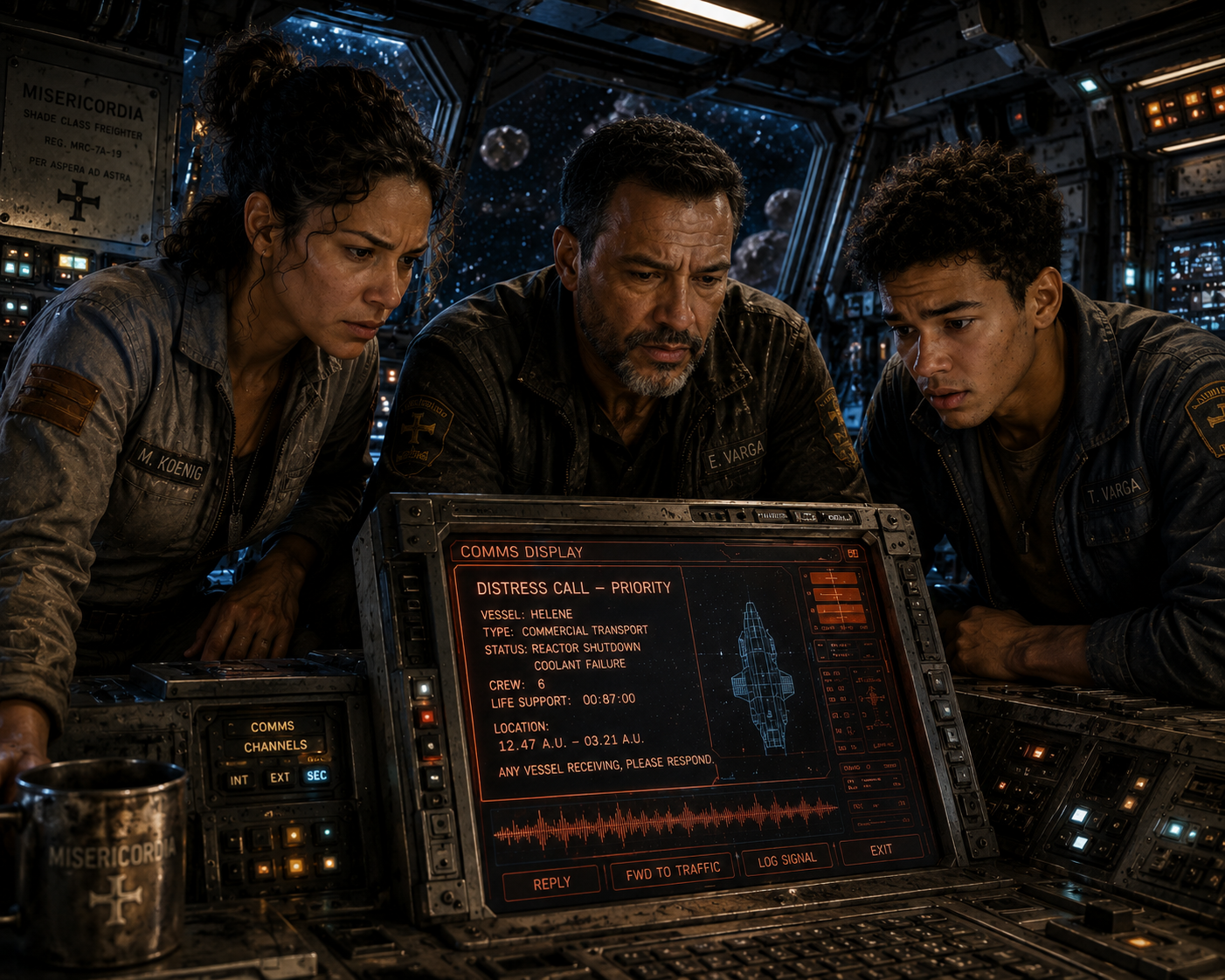
Captain Elias Varga and the Misericordia
Charity is rare in this world. That does not mean kindness is dead. Parents still sacrifice for their children. Lovers still protect one another. Soldiers still drag wounded comrades out of burning vehicles. Resistance fighters still risk everything for people they may never meet. But most kindness in 2099 is reserved for those who belong to you. Family. Crew. Cell. Community.
Charity is something different. Charity means giving to someone who has no claim upon you. It means giving without assurance of repayment. It means choosing to help when you could have safely continued on your way. In the Regimes, that kind of behavior is dangerous.
People grow up learning that generosity creates vulnerability. Governments reward informants. Corporations punish waste. Criminals prey on compassion. Even resistance movements use innocent faces, false identities, and fabricated emergencies to move through the cracks of society.
Everyone has heard stories about people who helped the wrong person. Captain Elias Varga had heard all of them. He simply never learned the lesson they were supposed to teach.
Elias Varga was not an important man. He commanded no warship, held no political office, possessed no secret intelligence, and belonged to no resistance movement. He was captain and owner of the Misericordia, an aging independent freighter that moved cargo between the main Asteroid Belt and Mars. The ship had seen better decades.
Its hull carried patches over patches. Its environmental system complained whenever the filters went too long between replacements. One maneuvering thruster had never fired correctly after an accident near Pallas, and the galley heater worked only when someone struck the panel beside it with the heel of a hand. Elias knew every flaw and he loved the vessel anyway. There were only three people aboard. Elias was captain, navigator, and whatever else needed doing.
Mara Koenig handled engineering. She had been with him for almost fifteen years, long enough that neither of them remembered precisely when their working relationship had become something closer to family. She was practical, suspicious, and generally convinced Elias would have died years ago without her supervision. She was probably correct.
The third crew member was Elias’s nephew, Tomas Varga. Tomas was twenty-three and still learning the trade. His father had disappeared into a Reich labor system several years earlier after a contract dispute with a corporate mining concern. Elias had taken the boy aboard soon afterward. He told people Tomas needed work, but the truth was simpler – Tomas was family. Elias had very little family left.
The three of them made a living carrying machinery, processed metals, food concentrates, replacement parts, and whatever other legal cargo independent contractors could still obtain permits to transport. The money was never good – docking fees and fuel consumed it. Maintenance consumed whatever remained.
Some months, Elias suspected the Misericordia existed solely to ensure that the three of them would have another month aboard. None of them complained much, space had its own kind of freedom. Even in a Solar System dominated by governments obsessed with surveillance and control, there were long stretches between worlds where nobody was watching. Or at least nobody obvious.
They were four days from Mars when the distress call arrived. Tomas heard it first.
“Captain.” Elias looked up from the navigation display.
Tomas was leaning toward the communications console. “We’ve got emergency traffic.”
Mara, half inside an open access panel near the rear of the cockpit, stopped working. That alone told Elias something. Independent crews listened carefully to distress calls. They also feared them. Tomas boosted the signal. Static flooded the cockpit. Then a voice emerged.
“…commercial transport Helene. Reactor shutdown. Coolant failure. Emergency power only. Six crew aboard.”
The message repeated, coordinates followed.
Then the voice returned. “Life support estimated eighty-seven minutes. Any vessel receiving, please respond.”
Mara closed her eyes. “No.”
Elias had not said anything. “I didn’t say anything.”
“You were about to.” Tomas looked between them.
Elias studied the navigation display. The distress signal was not far off their route. Twenty-three minutes at their current acceleration.
Mara pulled herself out of the access panel. “We forward the coordinates to Mars traffic control.”
Elias checked. “Nearest patrol response is at least three hours.”
“Then somebody else gets there.”
“Maybe.”
Mara stared at him. “Elias.”
He said nothing. She pointed at the communications display. “That is exactly how pirates work.”
Tomas looked back at the repeating distress call. The voice sounded exhausted. Frightened. Human.
Mara continued. “They cripple something cheap, sit dark, broadcast an emergency, and wait for somebody decent enough to stop.”
Elias knew – every spacer knew. There were dozens of variations – sometimes the distress call involved children, sometimes radiation exposure, sometimes wounded passengers, and sometimes someone claimed their reactor would breach. The people who answered disappeared.
Tomas spoke quietly. “What if they’re telling the truth?”
Mara looked at him. The question hung in the cockpit. Elias did not answer immediately. He watched the sensor data. The vessel was there – small commercial hull. Low thermal signature. Slow tumble. No active reactor. No visible weapons. Emergency power only. Everything matched the distress signal.
Mara saw the decision forming on his face. “Don’t.”
Elias looked at her. “Eighty-seven minutes.”
“You don’t know that.”
“No.”
“You don’t know them.”
“No.”
“You know us.” That landed harder.
Mara pointed at Tomas. “You know him.”
Elias looked toward his nephew. Tomas lowered his eyes. For a few seconds nobody spoke. Then Elias changed course. Mara swore.
Elias did not think of himself as charitable. He certainly did not think of himself as heroic. He had smuggled goods past inspectors. He had lied on cargo manifests. He had transported people who had clearly been running from someone and deliberately avoided asking why.
He had paid bribes to officials he despised and once abandoned several containers of corporate machinery when the alternative had been allowing customs officers to inspect the concealed compartment beneath them. He did what was necessary, but there was one rule Elias had never broken. You did not leave people stranded in space. It was older than governments, than the Regimes. Older than most of the laws that supposedly governed interplanetary commerce.
A ship in distress was a ship in distress. Vacuum did not care whether the people inside were Reich, Imperial, Republic, criminal, resistance, rich, poor, Über, Ünter, or anything else humanity had invented to divide itself. A failed oxygen recycler killed everyone equally. A ruptured hull did not check identification. Every spacer knew that.
Someday the dead ship drifting in darkness might be yours. Elias never really decided to help people. He simply could not imagine doing otherwise. That was the problem. It was instinct.
The Helene looked worse up close. The vessel drifted with little control, rotating slowly against the stars. Several navigation lights were dead. A faint haze of frozen vapor surrounded part of the stern.
Mara studied the scanner. “Coolant leak is real.”
Elias glanced at her. She did not look reassured. “That doesn’t mean anything.”
Tomas guided the Misericordia closer. “Docking collar looks intact.”
Mara shook her head. “I hate this.”
Elias smiled faintly. “You hate everything.”
“I especially hate preventable things.”
The docking procedure took several minutes. The Misericordia matched rotation. Thrusters fired. Metal approached metal. Then came the dull mechanical vibration of docking clamps engaging. The airlock indicator changed to green. Mara drew the old pistol she kept near engineering.
Elias eyed it. “You planning to welcome them with that?”
“Yes.”
Tomas swallowed. Elias sighed.
“Keep it out of sight.” Elias rolled his eyes.
Mara tucked it behind her jacket. “Happy?”
“No.”
“Good.” To think we used to have a thing, Elias thought.
The inner airlock opened. Six people waited on the other side. They looked terrible. One man had burns across his arm. A woman leaned against the bulkhead, wrapped in a silver emergency blanket. Another man was coughing badly. The oldest among them raised his hands.
“Thank God.”
Mara did not lower hers. Elias stepped forward. “I’m Varga. Captain of the Misericordia.”
The man nodded repeatedly. “Ansel Reichert. Helene.” His eyes looked wet.
“We thought nobody was coming.” Something inside Elias loosened.
That was always the danger. He believed people – not immediately or blindly. But sooner than Mara believed he should. They brought the survivors aboard.
The Misericordia was not designed for nine people. It barely accommodated three comfortably. That did not stop Elias. Tomas brought out blankets, water, and food. Mara cleaned and dressed the burned man’s arm. Tomas surrendered his bunk to the woman who had been shivering. Elias gave another survivor his own.
They converted the tiny common space into temporary sleeping quarters. One of the survivors apologized for consuming their supplies.
Elias shrugged. “We’ll buy more on Mars.”
Mara looked at him from across the compartment. They both knew that was not entirely true. Their margins were already thin. Replacing the medical supplies alone would hurt. Elias did it anyway. A few hours later, he found Tomas heating soup in the galley. The young man looked pleased with himself.
“You were right.”
Elias leaned against the wall. “About what?”
“Stopping.” Elias smiled.
“You’ll learn not to say that around Mara.” Tomas laughed.
For a moment, Elias felt something close to pride. Not because they had rescued six people but because Tomas had seen them do it. The Regimes had spent generations teaching people to fear one another. Perhaps small things mattered. Perhaps seeing somebody stop mattered. Perhaps someday Tomas would stop for someone too. That thought pleased Elias more than he admitted.
Six hours later, Mara found the device. She had been checking power fluctuations near engineering when she noticed the panel. Someone had opened it. Mara removed the cover and inside was a small military grade transmitter. Its pulse was weak enough to hide inside the Misericordia’s normal emissions.
Mara stared at it, then everything became very quiet. She reached toward her communicator.
A voice behind her said … “Don’t.”
Mara froze. The burned man stood at the entrance to engineering. His injured arm was still wrapped in the bandage she had applied. In his other hand was a pistol.
Mara looked at the weapon, then at him. “You son of a bitch.”
He smiled sinisterly. “Sorry.” He did not sound sorry.
The takeover happened almost simultaneously. Elias was in the cockpit when Reichert entered behind him. Tomas was sitting at communications. Elias saw the reflection in the forward glass before he heard the weapon. Reichert pressed the pistol against Elias’s side.
“Hands where I can see them.”
Tomas turned. Another survivor entered behind him. She placed a weapon against Tomas’s neck. Elias stopped breathing. Not because there was a gun against him, because there was one against Tomas. The cockpit door opened and Mara was pushed inside, followed by the burned man, the bandage remained perfectly wrapped around his arm.
Mara looked at Elias. There was no accusation in her face but that made it worse. The “I told you so” burned in the air like horrible incense.
Reichert stepped closer. “Captain, you’re going to continue toward Mars for another twenty minutes.”
Elias said nothing. “Then you’re going to slow down.”
“Why?”
“You have friends coming.”
The transmitter, Elias understood. A larger vessel was following and the Helene had been simply bait.
Reichert smiled. “Don’t take it personally.”
Mara laughed once, but not pleasantly. “You deliberately crippled your own ship.”
“Needed to look convincing.”
“You could’ve died.”
“That’s why we waited somewhere with traffic.”
Elias looked at the six pirates. Their injuries and fear had been real. The coolant leak had been real. Everything had been designed to survive scrutiny.
Elias had been threatened before. He had been robbed twice. Shot once. Detained by customs more times than he cared to count. None of those memories felt like this. He looked at Tomas – twenty-three years old and a weapon beneath his jaw.
Then Mara – The woman he probably cares about more than he should, who had warned him but followed him anyway. His decision had put both of them here. For the first time in his life, Elias regretted answering a distress call and this made him sick. And not for fear of his life, but for fear of theirs.
He had always believed charity meant being willing to pay the price for helping someone. Now he understood the flaw. He had not offered only his own safety but he also offered theirs. Neither had belonged to him and he did not feel he had that right. The distinction was suddenly painfully clear. Giving away what was yours was generosity, what belonged to someone else was something far more complicated. Maybe something unforgivable.
Reichert gestured toward the controls.
“Your pirate beacon says our friends arrive in nineteen minutes.” Elias looked at the navigation display.
Another larger contact had appeared behind them. It was closing fast.
Reichert leaned nearer. “When they dock, you cooperate.”
“And if we don’t?” The pirate holding Tomas pressed the pistol harder.
Elias looked away, he had his answer.
There are different kinds of instinct. Elias’s first instinct had been to stop but his second was stronger. Protect family, those you love the most. He looked around the cockpit, at the pirates had weapons. They controlled the bridge, and they outnumbered the crew two to one.
But they had made one mistake. They thought possession of the cockpit meant possession of the ship. They did not know the Misericordia. Elias did. He knew the ship in ways nobody who had not spent years aboard her could understand. He knew which warning alarms were real and which could be ignored. Which pressure door sometimes closed too slowly and which thruster fired slightly harder than its diagnostic report claimed. Which breaker Mara had bypassed three years earlier and never repaired properly.
He looked toward her and Mara was already looking at him. Something passed between them that wasn’t telepathy or some signal. It was family understanding, from fifteen years of working together. That was enough.
Elias looked back at the controls. “All right.”
Reichert smiled. “Good.”
Elias put his hands on the console and the pirate vessel continued closing.
The pirates ordered Elias to transmit docking authorization and he complied. Almost. He entered the correct authentication, the correct ship ID, the correct docking vector but he changed one number – a tiny error. Insignificant to anyone unfamiliar with the Misericordia.
The docking computer reacted instantly. An alarm erupted. Reichert looked toward the display.
“What did you do?”
“Nothing.”
“What is that?”
Mara moved – drove her shoulder into the burned pirate. At the same moment Elias slammed his hand against a manual emergency control. A pressure door dropped between the cockpit and the central passage and one pirate was caught halfway through.
Tomas threw himself sideways and the pistol fired. The shot struck the ceiling. Elias grabbed Reichert’s wrist. They crashed into the navigation console.
Mara reached the engineering override panel. The pirate vessel was close now – very close. It was beginning final docking approach when Mara triggered the maneuvering thruster – the one that fired too hard. The Misericordia rolled violently. Everyone not secured was thrown sideways. The approaching pirate ship struck the outer docking assembly instead of aligning with it. Metal screamed through the hull. The Misericordia spun and warning lights erupted across the cockpit.
Tomas hit the floor and Reichert lost his weapon. Elias kicked it away. Mara sealed another pressure door and one pirate found himself isolated in the cargo compartment. Another was trapped in the common area. A third was unconscious. The burned man tried to raise his pistol, but Mara hit him with a wrench. He stayed down.
The entire fight lasted less than thirty seconds. When it ended, Elias was bleeding from the mouth, Tomas had a bruised shoulder., and Mara was breathing heavily over the body of an unconscious pirate.
One of the attackers was dead, two were injured (or more so then they were), and three were trapped behind pressure doors. The other pirate ship drifted several kilometers away, damaged and unable to immediately pursue.
Elias looked at Mara. She pointed toward the controls. “Go.” He went.
The Misericordia accelerated harder than Elias had ever pushed her. The engines protested, their temperatures climbed. Three warning indicators failed entirely, which Elias regarded as an improvement because at least they stopped flashing.
The pirate vessel attempted pursuit but it did not catch them. Several hours later, Mars filled more of the forward view. The big read ball of relative safety. Tomas sat quietly in the cockpit and Mara stood behind Elias. Nobody spoke for a long time.
Eventually Mara said “You nearly got us killed.”
Elias nodded. “Yes.”
She waited, perhaps for an excuse but none came.
Tomas looked at his uncle. “Would you do it again?”
Mara turned toward him, while Elias stared through the forward glass. Mars hung beyond them. The question was harder than everything that had happened aboard the ship. He thought about the Helene and the the frightened faces, the burns, the blankets, the food and water. But then he thought of the pistol against Tomas’s neck.
He thought about the next distress call, and how there would always be another. Eventually Elias answered. “Yes.”
Mara stared at him and he finally looked back at her. “But differently.” She said nothing. “Nobody boards without being searched.” Mara continued staring. “Nobody moves around the ship alone.” Tomas listened. “We keep the compartments separated. We keep weapons accessible. And if either of you says we don’t dock—” Elias hesitated. “—we don’t dock.”
Mara’s expression softened slightly, not much but enough. Tomas looked confused.
“So you’d still help them.” Elias nodded. “Yes.”
“After this?”
Elias looked toward the locked passage behind them where the surviving pirates waited. “Especially after this.”