

Weekly: Emotion. Daily: Working Hard
Shattered Expanse
Ahrewan Fontiarv Klarnald
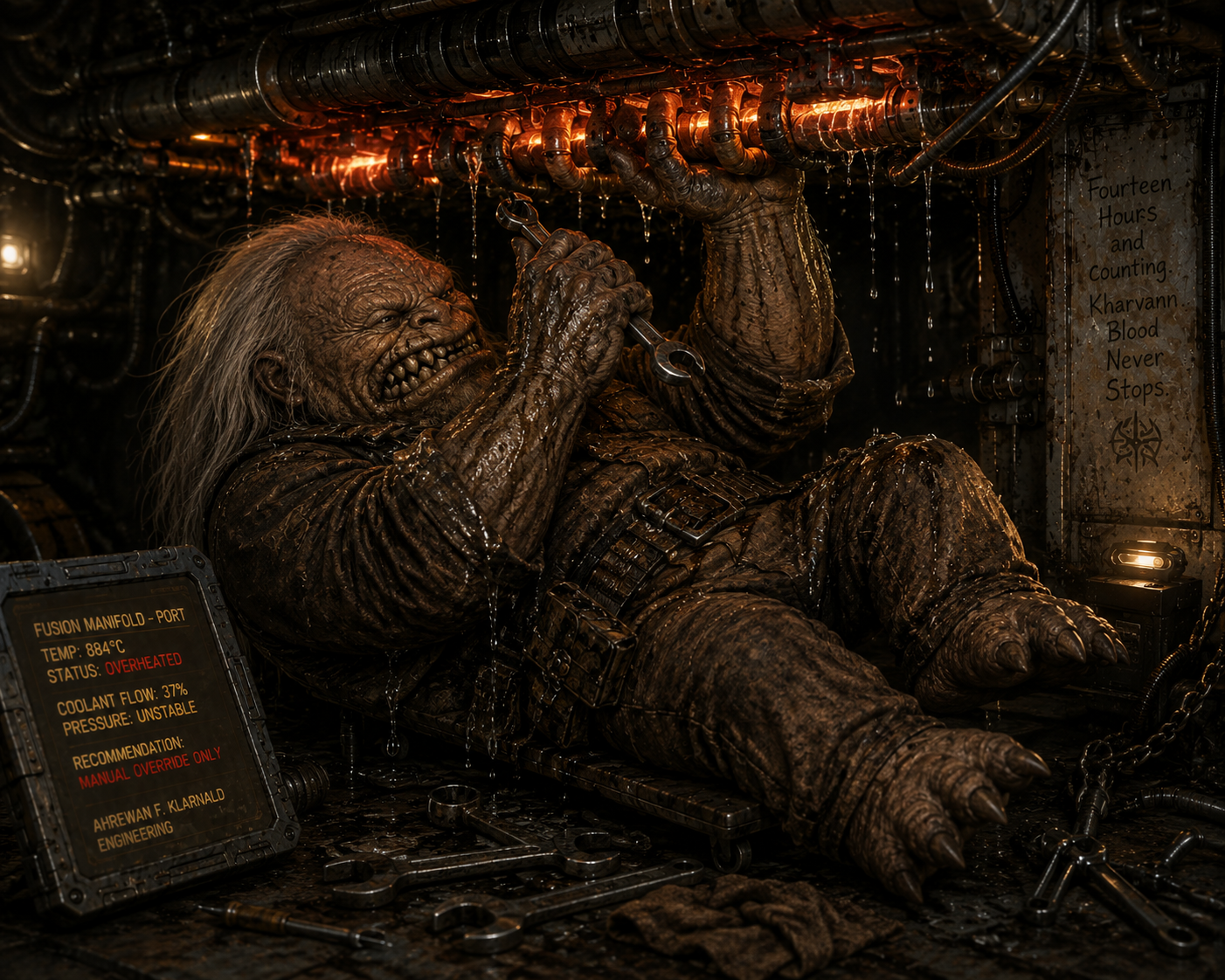
Ahrewan Fontiarv Klarnald
Among the peoples of the Expanse, few understand Labor quite like the Orkra’an.
Other species work because something must be built, repaired, harvested, mined, transported, or earned. The Orkra’an certainly understand all of those reasons, but among their Tribes there is something deeper. Labor is not merely a necessity of civilization. It is woven into their culture so thoroughly that an Orkra’an who has nothing useful to do will often become restless and irritable long before boredom sets in.
Some xenobiologists believe that tendency is literally woven into their biology.
The Orkra’an did not naturally evolve into what they are today. Their distant ancestors were genetically engineered, and while much about those creators has been lost—or deliberately concealed by the Tribes—it seems increasingly likely that the Orkra’an were designed as a labor species. Their muscular physiology, exceptional endurance, tolerance for unpleasant environments, and ability to remain focused on repetitive tasks may all be remnants of that original purpose.
Their creators wanted workers. Instead, over countless generations, the Orkra’an took that imposed purpose and made it their own. Labor became craftsmanship. Craftsmanship became responsibility. Responsibility became honor. An old Orkra’an saying translates roughly as – “What my hands leave undone, another’s hands must carry.” For an Orkra’an, that is reason enough to keep working.
Ahrewan Fontiarv Klarnald was born beneath the surface of Kharvann, the ancestral homeworld of his Orkra’an tribe. Calling Kharvann a world of cities is somewhat misleading. Its settlements descend rather than spread. Vast inhabited tunnel networks penetrate mountains and continental shelves, joining caverns enlarged and reinforced over thousands of years. Industrial complexes lie beside ancestral halls. Geothermal plants descend kilometers toward the mantle. Ancient transit tunnels connect settlements whose original builders have been forgotten.
An Orkra’an child grows up surrounded by things that require maintenance. Doors wear out. Pumps fail. Supports crack. Filters clog. Power conduits corrode. Water must flow. Air must circulate. Nothing simply continues. Someone makes it continue.
Ahrewan learned that lesson before he understood the machinery involved. His family belonged to a respected technical lineage within the Klarnald Tribe, maintaining some of the oldest infrastructure beneath their territory. His first tools were given to him while he was still young enough that his father shortened their handles to fit his hands.
Ahrewan was never a prodigy. That distinction matters to him. There were Orkra’an children who understood machinery more quickly than he did. Others were better mathematicians. Some possessed an almost uncanny ability to visualize complex systems. Ahrewan simply refused to stop.
If he could not understand something, he studied it. If he could not repair something, he tried again. If the second repair failed, he determined why. If that explanation proved wrong, he started over. That stubbornness eventually made him a better engineer than many who had once surpassed him.
It also gave Ahrewan an unusual curiosity about machinery beyond Kharvann. He wanted to see how other peoples solved problems. Human drives. Karian reactors. Sarginian systems when anyone could get close enough to study one. Fringe-built vessels whose components came from six civilizations and somehow continued flying.
So Ahrewan did something comparatively uncommon among his people – he left the tunnels.
Eventually, Ahrewan found his way aboard the aging Riftrunner vessel Far Horizon. The ship was perfect for him, which is another way of saying she was a disaster.
The Far Horizon had been operating long enough that entire sections bore little resemblance to their original specifications. Components from different manufacturers had been adapted together. Replacement parts had themselves been repaired. Conduits ran through spaces where no sane designer would have placed them. Several access panels could only be opened after removing completely unrelated equipment.
Ahrewan loved her almost immediately but he would never say that. He knew how strange that would sound to the crew. None were “of the Tunnels.”
Instead, he called her reactor layout “an insult committed against engineering,” described the atmospheric recyclers as “mechanically dishonest,” and once spent nearly twenty minutes explaining to the captain why whoever had modified the secondary coolant system deserved to be found and physically brought back aboard to repair it properly.
The captain, Mara Veylan, learned quickly that Ahrewan’s complaining was a good sign. Silence meant something was seriously wrong. Captain Veylan eventually began telling people that Ahrewan was one of the finest engineers in the business.
Whenever she said it within earshot, Ahrewan replied “You need to meet more engineers.” He wasn’t being modest.
Orkra’an culture simply has little use for praising someone excessively for doing what they agreed to do. The ship carries people through dangerous places. Therefore, the ship must work. Ahrewan is responsible for making it work. The logic requires nothing further.
There is another side to Ahrewan’s work that even he does not completely recognize. It is how he cares for people. Ahrewan is not cold, but he is uncomfortable expressing strong emotion directly. He rarely tells another person how much they matter to him. Instead, he works. If a crewmate complains that their cabin is cold, they may return several hours later to discover that Ahrewan has recalibrated the environmental vent. If someone mentions that a galley appliance has been malfunctioning, it will probably be repaired before their next meal. When C’Tiar began favoring one leg after an injury, Ahrewan quietly adjusted the resistance on the nearby pressure doors so they opened slightly faster.
He never mentioned doing it. This is affection among the Orkra’an. To work on something that another person needs is to spend a portion of your finite life making theirs better.
There are few more sincere gifts.
When the Urtoran Uyokks Thefiarch eventually joined the Far Horizon, he quickly became fascinated with the Orkra’an engineer. Uyokks was searching for adventure worthy of becoming a great tale. Ahrewan appeared to spend every waking moment preventing their adventures from becoming disasters.
One night Uyokks left Ahrewan repairing a coolant manifold and went to sleep. When he awoke, Ahrewan was replacing a damaged gravitic compensator. Uyokks asked when he had slept.
Ahrewan looked puzzled. “I rested yesterday.” Uyokks still isn’t entirely certain whether Ahrewan was joking.
There is one story about Ahrewan that Uyokks has never heard in full. It happened before the Urtoran joined the crew. Those who were aboard the Far Horizon simply call it the Incident. Captain Veylan refuses to discuss it with outsiders. C’Tiar becomes visibly uncomfortable whenever anyone presses the subject. The remaining crew have learned that there are some memories best left alone.
The Far Horizon was making what should have been a routine Foldspace transition, but something went wrong. No one knows precisely what. The navigation computer registered impossible coordinates. The Foldspace field fluctuated wildly. Stars vanished from every external sensor. Distance ceased producing sensible measurements. Several clocks aboard the ship recorded different elapsed times.
Then the Foldspace drive shut down, and they were no longer in Foldspace. They were somewhere else. The Abyss. What happened next survives among the crew as fragments, sounds where there should have been vacuum, movement beyond windows that showed nothing, or voices coming through disconnected communication systems.
C’Tiar was badly injured during the chaos – Abyss Touched. To this day, Ahrewan refuses to describe exactly what happened to his friend. Engineering began failing, so Ahrewan went to work.
The Far Horizon was never designed to enter the Abyss. What ship is? Its navigation systems could not understand where they were. Its Foldspace drive could not establish a transition geometry. The computer repeatedly rejected every solution Ahrewan attempted. He bypassed the computer. Then the containment system began failing. He bypassed that too.
He crawled through maintenance passages, replaced burned relays, rerouted power, extinguished fires, isolated damaged systems and rebuilt sections of the drive while the laws upon which that drive operated seemed to be coming apart around him. He worked until his hands bled, while alarms screamed, and while something whispered through a communications panel he had personally disconnected from power.
And then something happened. Ahrewan stopped thinking about what he was doing. His hands moved. A conduit was connected where no Orkra’an engineering instructor would have connected it. A regulator was deliberately overloaded. Three unrelated systems were synchronized. Ahrewan entered a sequence of values into the Foldspace controller. He did not calculate them. He remembered them. Not from school. Not from anything he had consciously studied. From somewhere deeper.
The Orkra’an have long whispered about Ancestral Memory. Outsiders generally interpret the term metaphorically — the accumulated wisdom of generations passed from parent to child. It isn’t entirely metaphorical.
Fragments of procedural knowledge appear to have been encoded into the Orkra’an genome by their ancient creators. Most manifestations are subtle. An Orkra’an engineer may instinctively recognize mechanical stresses before instruments detect them. A miner may know where stone will fracture without being able to explain why. A builder may reproduce a structural pattern that has not been formally taught for centuries.
Ahrewan reached something much older. He suddenly understood a machine that had never existed aboard the Far Horizon. And using pieces of the ship around him, he began building part of it. Ahrewan recognized the design and that frightened him more than the Abyss.
Deep beneath Kharvann are tribal repositories containing technologies preserved from the earliest history of the Orkra’an. Some are incomplete. Others cannot be reproduced. A few are understood well enough that the tribal elders have forbidden their construction.
Ahrewan had seen fragments of one such design during his training. He had been told never to speak of it outside the Tribes. Now his hands knew how to finish it. He modified the Far Horizon’s Foldspace drive using principles thousands —perhaps millions — of years older than the ship. For one terrible moment, the machinery began responding to something outside the hull.
Ahrewan saw patterns filling his engineering displays. He has never told anyone what they looked like. Then the drive activated, and reality returned violently. Stars appeared. Navigation reacquired known space. The Far Horizon emerged damaged, partially depressurized, and with C’Tiar gravely injured but alive. Ahrewan had worked them out of the Abyss.
Captain Veylan called it a miracle but Ahrewan simply called it a repair. The crew celebrated him. Ahrewan tolerated this for approximately ten minutes before pointing out that the secondary reactor was overheating and somebody needed to help him move equipment. There was still work to do, always work to do.
But afterward, alone in Engineering, Ahrewan dismantled the modifications he had made. Every component. Every conduit. Every trace. He recorded nothing.The captain believes Ahrewan improvised a way to force the Foldspace drive back into Reality. C’Tiar knows there is more to the story but has never pressed him. Ahrewan intends to keep it that way. Because what saved the Far Horizon was not simply his skill.
It was Orkra’an technology – Forbidden technology. And worse, knowledge of that technology had apparently been placed inside him before Ahrewan Fontiarv Klarnald was ever born.
Since the Incident, Ahrewan works more than he used to. Nobody aboard seems to have noticed the difference. The Abyss can leave behind traces – traces in people, traces in minds, and traces in technology. The Far Horizon is old and that age can be. Something always needs attention. Uyokks damages things with alarming regularity. C’Tiar still has difficulties resulting from the Incident. Captain Veylan keeps accepting jobs that put entirely unreasonable demands upon an elderly vessel.
Ahrewan complains about all of them, then he makes sure they come home. Perhaps that is why Labor is such an emotional concept for the Orkra’an. Their ancestors may have been created to work because someone else required their labor.
Modern Orkra’an work because they have chosen who their labor belongs to. Ahrewan’s belongs to the Far Horizon and the people aboard her. Every repaired conduit says it, every sleepless night says it, every scar on his hands says it. He will probably never tell them. He doesn’t need to.
But sometimes, when Engineering is quiet and the ship is running properly, Ahrewan finds himself staring at the Foldspace drive. Because there is one problem he cannot repair. The knowledge inside him should not exist.
The Orkra’an were apparently created by beings who knew about the Abyss. Those beings placed within their workers the knowledge necessary to manipulate technology capable of escaping it. Which raises a question Ahrewan has been unable to put aside since the Incident – What kind of work were the Orkra’an originally created to do that required them to know the way back from the Abyss?
For now, Ahrewan has no answer. So he tightens the coupling in front of him, checks the pressure reading, reaches for another tool — and keeps working.
New Racial Edge: Ancestral Memory
Requirements: Seasoned, Orkra’an
Fragments of ancient knowledge lie encoded within the Orkra’an genome, remnants of whatever purpose their creators originally intended for them. Most Orkra’an experience this only as unusual intuition—a sense for machinery, structures, materials, or techniques they were never formally taught. Under stress, however, something deeper may surface.
Once per session, the Orkra’an may call upon Ancestral Memory when attempting a task involving construction, repair, engineering, technology, or another form of practical labor. The character may make the appropriate skill roll even if normally Unskilled, ignoring the usual Unskilled penalty. If already trained in the skill, they instead gain a free reroll on the attempt.
At the GM’s discretion, Ancestral Memory may also provide access to an otherwise lost or unknown Orkra’an technique when dramatically appropriate. This does not give the character a complete understanding of the technology or its history. They remember what to do, not necessarily why it works.
Ancestral Memory never provides general factual knowledge, names, historical events, languages, or secrets simply because an ancestor might have known them. It is predominantly procedural: the hands remember what the mind does not.
That last distinction is important because it prevents the Edge from becoming a universal lore button while giving you enormous narrative flexibility.
Ahrewan’s experience aboard the Far Horizon would actually be the extreme expression of this Edge rather than its normal everyday use. Ordinarily it might be:
- knowing precisely where to brace a collapsing support;
- recognizing how an unfamiliar power coupling must be disconnected;
- using a tool whose function the Orkra’an has never seen before;
- instinctively reproducing an obsolete metallurgical technique;
- suddenly knowing the correct sequence for restarting some ancient Orkra’an machine.
But trapped in the Abyss, with C’Tiar injured and the ship dying around him, Ahrewan’s Ancestral Memory reached far deeper than it normally should. His hands reconstructed part of a forbidden technology preserved in the oldest tribal knowledge.
That also suggests a possible second, higher-level Racial Edge later—something like Deep Memory, Memory of the First Hands, or Inheritance of Kharvann—for an Orkra’an who can deliberately reach deeper into those encoded memories. I would not put that capability into the basic Ancestral Memory Edge. The Ahrewan incident should remain extraordinary enough that even other Orkra’an would find it unsettling.
And I especially like one line as the little italic flavor text beneath the Edge:
Your hands remember things you were never taught.
Blood & Suns
Bärin-335
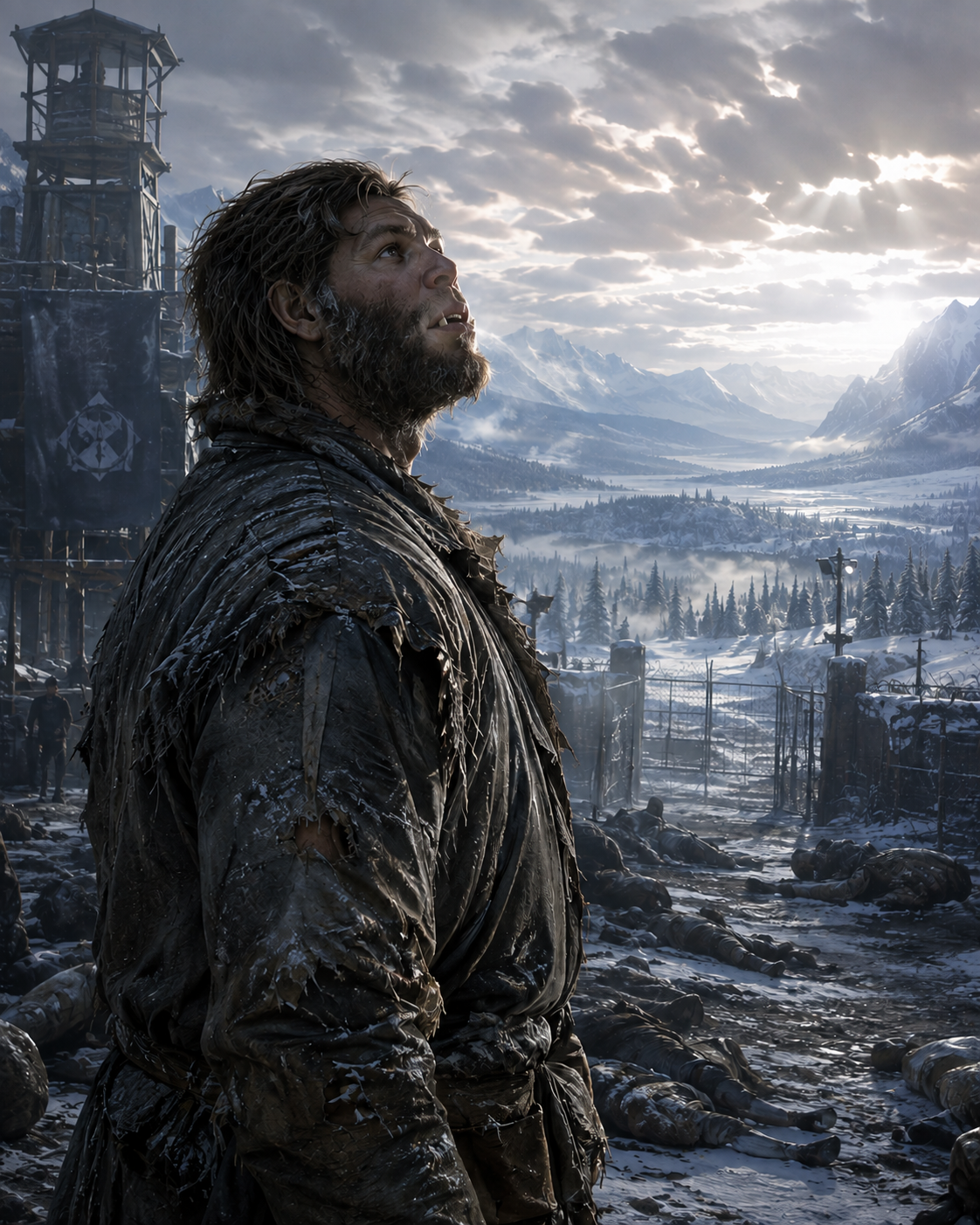
Bärin-335 had always worked. There was no memory before work.
There were fragments, perhaps. Warm bodies pressed together in a nursery pen. The smell of milk substitute. Straw. Disinfectant. Other young Tiervolk crying during examinations. Men in white coats measuring teeth, paws, shoulders, and muscle development. Then there was work.
Bärin-335 was a Tiervolk derived primarily from brown bear genetic stock. The designation told everyone everything that mattered. Bärin identified the genome line. 335 identified the individual. There was no reason for anything else. Names were for people.
At the labor camp, morning began with the lights. The lights meant stand. Standing meant inspection. Inspection meant food if nothing was wrong. Food meant work. Work continued until the lights changed again.
There were quotas for everything. Loads carried. Ore shifted. Machinery cleared. Snow removed. Equipment dragged through passages too narrow for the vehicles intended to move it. Bärin-335 learned that being strong meant receiving heavier work. The guards liked strong Tiervolk. Strong Tiervolk survived longer. Bärin-335 had once regarded that as something close to good fortune.
He knew how to work in temperatures that made human guards retreat into heated stations. He knew how to wrap damaged fingers so they could still grip. He knew which pains could be ignored and which meant a limb would stop functioning. He knew how much food another Tiervolk needed before weakness became dangerous. He knew how to lean into a load so the shoulders took the weight instead of the spine.
He knew how to work. He did not know what freedom was. When Faust and her team came to the camp, Bärin-335 initially thought another work detail had arrived. He smelled them before he understood what he was seeing. Humans. Mostly.
They smelled like the guards, but not exactly. Sweat. Cloth. Gun oil. Dust. Cold air. Something rugged and unfamiliar beneath all of it. They moved differently too. Guards walked through the Tiervolk compounds without watching one another. These people watched everything. Then they started killing the guards.
Bärin-335 froze.
There had been fights before. Guards occasionally fought other guards. Prisoners sometimes attacked guards. Those things had rules Bärin-335 understood. This did not. Wölfin-98 reacted first. The wolf-stock Tiervolk saw armed strangers attacking the guards and did what conditioning, fear, and instinct demanded. He attacked the strangers. One of them shot him.
Bärin-335 expected blood. Instead, Wölfin-98 collapsed twitching into the snow. Alive. That confused Bärin-335 more than the gunfire. They did not kill him. Why?
The strangers shouted at the Tiervolk to remain down. Some shouted that they were there to help. One yelled a word repeatedly. Freedom. Bärin-335 did not know the word. A guard stumbled toward him, bleeding from the side of his head. The man pointed toward the strangers and screamed an order. Bärin-335 understood the order. Attack!
That was comforting. Orders were simple. For a moment, he nearly obeyed. His muscles tightened. His claws extended. The stranger nearest him turned, weapon rising. Something stopped Bärin-335. Not thought. Thought told him to obey. Something older objected.
Something buried beneath conditioning, breeding, drugs, electric prods, shouted commands, and generations of engineered submission suddenly recognized an opportunity his conscious mind could not. The gate was open. The guards were dying. There was no chain around his neck. And every animal knows an open cage when it smells one.
Bärin-335 turned on the guard. He did not kill him. He simply refused to obey. It was the first free decision Bärin-335 had ever made.
Faust personally escorted Bärin-335 from the camp. That did not mean Bärin-335 trusted her. During the journey to the Monolith facility, Bärin-335 repeatedly asked when they would arrive at the new work site. Faust tried explaining that there wasn’t one. Bärin-335 assumed she had misunderstood.
“What work?”
“None.” Bärin-335 stared at her.
“What work?”
“You don’t have to work.” Bärin-335 became agitated.
Faust eventually stopped trying to explain. The counselors would later tell him that this was probably wise.
The Monolith rehabilitation staff had experience with liberated political prisoners, chemically conditioned civilians, escaped Ünters, abused Übers, child soldiers, and people who had spent decades beneath the Schnuller veil. The Tiervolk presented problems they had never encountered. Most had never been free.
Some were descendants of captive populations that had not experienced freedom for generations. The Reich had not simply imprisoned them. It had created a population whose language and social structures revolved around commands, tasks, quotas, punishments, feeding schedules, breeding assignments, and work.Monolith could open the gates in an afternoon. Getting the camp out of the prisoners would take considerably longer.
Bärin-335 adapted better than many. Some of the Wölfins were particularly difficult. They organized themselves into work packs without being told. When counselors separated them into private rooms, several became distressed. When given meals without completing a task first, some refused to eat. Bärin-335 ate. He saw little sense in wasting food. But freedom baffled him.
The first morning at the Monolith facility, Bärin-335 woke before the lights automatically brightened. He waited.No bell sounded. He waited longer. Eventually he opened his door. A counselor found him standing in the corridor.
“What are you supposed to be doing?” she asked. Bärin-335 immediately relaxed, finally.
An instruction. “Work.”
“No. I mean, what are you trying to do?” Bärin-335 didn’t understand the distinction. The counselor tried something else. “What do you want to do?”
He stared at her. She repeated the question. Bärin-335 became increasingly uncomfortable.
“What work?”
“No work. What do you want?“
He had no answer. Wanting was not part of labor.
The staff eventually discovered that removing work entirely was a mistake. Labor was not merely something inflicted upon Bärin-335. It was the only structure he possessed. So they gave some of it back, but differently. Bärin-335 helped unload supplies. When the containers were finished, he immediately looked for another assignment. A Monolith quartermaster thanked him and Bärin-335 waited. The quartermaster thanked him again. Bärin-335 remained standing there.
“You can go.”
“Where?”
“Anywhere.” That was not an answer. The quartermaster pointed toward the recreation area.
“Go there.” Bärin-335 went. The next day he returned to the loading bay without being ordered. The quartermaster frowned.
“You don’t have to do this.”
“I know.”
That made the man stop. It was one of the first times Bärin-335 had said those words.
I know.
He picked up another container.
“I work.”
“Why?”
Bärin-335 struggled with the question. The container was heavy. He adjusted it against his shoulder.
Finally he answered. “Want.” The quartermaster smiled. Bärin-335 did not understand why.
Progress came in tiny pieces. He learned that his room belonged to him. He learned to knock before entering someone else’s. He learned that food was not a reward. He learned that medical treatment was not an inspection for continued usefulness. He learned that when a physician said this may hurt, the physician was warning him rather than threatening him.
He learned that no was a word he could say to someone wearing a uniform. That lesson took months. The first time he actually did it, Bärin-335 immediately lowered his head and waited to be struck. Nothing happened. The Monolith counselor simply said, “All right.”
Bärin-335 cried afterward. He could not explain why. The counselors could.
Eventually they approached the question of his designation. One counselor carefully explained that Bärin-335 could choose a name. He did not understand. She explained what names were. He understood those. Guards had names. Scientists had names. Faust had a name. She explained that he could have one too.
“Why?”
“Because you’re a person.” Bärin-335 stared at her for a very long time. Then he became angry. It was one of the few sessions he walked out of. Several days later he returned.
“Bärin-335 is mine.” The counselor nodded.
“If that’s what you want.”
“They gave it.”
“Yes.”
“But mine now.”
She smiled. “Yes.”
He remained Bärin-335. Not because the Reich had designated him that way. Because he had chosen to keep it. There was a difference.
Months later, Faust visited the facility. She found Bärin-335 outside helping construct additional living quarters for the growing number of liberated Tiervolk. Bärin-335 carried lumber across one shoulder. Faust watched him for a while before finally asking the obvious question.
“They’ve got you working?”
Bärin-335 shook his head. “No.”
Faust looked at the lumber. Bärin-335 had learned enough human expressions by then to recognize the confusion.
“I work.”
“Why?”
Bärin-335 looked toward the unfinished building. Several recently liberated Tiervolk were nearby. One was a young Wölfin who still became frightened whenever someone closed a door. Another was a Schwein who hoarded food beneath his mattress. Two counselors were helping a Fuchsin learn to read. The building would house more of them.
Bärin-335 shifted the lumber. “Because I want.”
Faust smiled. Bärin-335 understood why this time. He went back to work. For most of his life, labor had been something taken from him – his strength, his time, his body, his sweat, his pain. Freedom had not ended his labor. Freedom had done something far more extraordinary.
It had made the labor his.