

Shattered Expanse

Sha’Ralen Ith Vaelor
Species: Hol’taerran
Role: Diplomatic Mediator / Resonant Synod Envoy
Home: Hol’taerran Reserve
Concept: Tact is knowing the truth—and knowing when the truth would do more harm than silence.
Sha’Ralen Ith Vaelor is an envoy of the Resonant Synods and one of the Hol’taerran Reserve’s most respected diplomatic mediators. She is most often dispatched not to negotiations that are beginning, but to those that are already failing—border conferences where delegates have stopped listening, treaty councils poisoned by old grievances, hostage exchanges where neither side trusts the other, and political disputes in which a single careless word might lead to violence.
To outsiders, Sha’Ralen appears extraordinarily patient. She speaks slowly, rarely interrupts, and sometimes allows uncomfortable stretches of silence to remain long after others would rush to fill them. This is not hesitation. Through her Schara’Ta and highly refined empathic senses, Sha’Ralen experiences a conversation very differently from most beings. She perceives not merely spoken words but their emotional resonance – the flash of fear behind an accusation, embarrassment disguised as anger, grief buried beneath hostility, the instant of hesitation before a lie, or the subtle emotional recoil caused by an unintentionally offensive phrase. What humans might call “tells”, Sha’Ralen calls these moments dissonances.
Most Hol’taerran diplomats are trained to recognize such disturbances. Sha’Ralen’s unusual talent is knowing what to do with them – and, more importantly, what not to do. A negotiator might discover that an opposing ambassador is terrified of appearing weak before their own delegation. Sha’Ralen will recognize it immediately. She will not expose it. Instead, she may quietly restructure a proposal so the ambassador can accept without humiliation. She may recognize that someone is lying while simultaneously understanding that revealing the lie would destroy a negotiation that could otherwise save thousands of lives. She may know precisely which memory, fear, insecurity, or emotional wound could be exploited to force an agreement and deliberately refuse to touch it.
Among a species whose ancestors once measured worth by psionic strength and used that superiority to dominate those beneath them, Sha’Ralen considers that restraint essential. Her philosophy is simple: perception creates responsibility, not entitlement.
Sha’Ralen was born into Ith Vaelor, an old migratory clan whose members traditionally served the Resonant Synods as interpreters, psychic analysts, and intermediaries. Like most Hol’taerrans, she was bonded to her Schara’Ta early in life and demonstrated exceptional sensitivity to emotional resonance. Her instructors initially expected her to become a psychic analyst. She could detect inconsistencies in testimony with remarkable accuracy and possessed an unusual ability to distinguish deliberate deception from the far more common phenomenon of someone believing something that was not actually true.
Her career changed during a dispute between two Hol’taerran clans. Sha’Ralen, still relatively junior, discovered through the emotional resonance surrounding the negotiations that one clan elder had deliberately concealed information that would have strengthened the opposing side’s claim. Under Synod protocol, she had every justification to expose him. She did not.
Sha’Ralen realized that public exposure would humiliate the elder, fracture his clan, and almost certainly turn a territorial dispute into a blood feud. Instead, she approached him privately and gave him an opportunity to introduce the information himself. The resulting compromise satisfied neither clan completely, but neither went to war. Some within the Synods considered her decision dangerously independent. Others recognized exactly what she had done.
Sha’Ralen gradually became one of the envoys called upon when conventional Hol’taerran methods failed. Her assignments eventually carried her beyond the Reserve and into the wider Expanse, where her apparent calm and unsettling ability to understand people quickly earned her equal measures of respect and suspicion. Humans sometimes describe speaking with her as having a conversation with someone who already knows what they are going to say. Halogai’ representatives tend to respect her refusal to display fear. Sarginians value her ability to identify emotional variables that even their predictive models occasionally underestimate.
Sha’Ralen herself is uncomfortable with her reputation. She knows exactly how dangerous the Hol’taerran ability to perceive others can become when combined with certainty. The history of her people is proof enough.
For that reason, Sha’Ralen follows a personal discipline considerably stricter than anything demanded by the Resonant Synods. Information perceived through psychic resonance is not automatically hers to reveal. Emotional vulnerabilities are not negotiating tools merely because she can see them. Private thoughts accidentally brushed during moments of intense emotion remain private. She distinguishes relentlessly between what someone said, what they felt, and what she merely believes she perceived.
This restraint occasionally infuriates allies. Sha’Ralen has withheld information that could have provided immediate political advantage because she believed revealing it would constitute an abuse of psychic perception. She has allowed opponents to save face when exposing them would have been satisfying. She has even defended individuals she personally dislikes when others attempted to weaponize information she considered improperly obtained. None of this makes her naïve.
Sha’Ralen lies when necessary. She withholds information routinely. She redirects conversations, manipulates timing, and carefully chooses language designed to produce particular emotional responses. She understands that diplomacy itself is a form of influence. The distinction she draws is one of proportion. Persuasion leaves another person capable of choosing. Psychic coercion – or exploiting wounds someone never knowingly revealed – can quietly remove that choice.
Her Schara’Ta has become central to this philosophy. Sha’Ralen discovered through decades of practice that the Soul Crystal does more than translate Hol’taerran thought into language. When deliberately attuned to a conversation, her crystal can preserve faint patterns of emotional resonance associated with what has been said around it. These are not memories and cannot reproduce exact thoughts or words. Instead, they resemble psychic impressions – tension surrounding a particular subject, sincerity attached to a promise, fear triggered by a name, or the sudden emotional dissonance accompanying a carefully constructed lie. Sha’Ralen calls these lingering impressions echoes.
She almost never tells outsiders that the technique exists. Not because it is inherently dangerous, but because she understands immediately what governments, intelligence agencies, interrogators, corporations, and even other Hol’taerrans would do with it. A diplomatic chamber containing a properly attuned Schara’Ta could become something dangerously close to a recorder for emotions people never intended to reveal.
Sha’Ralen therefore uses the technique primarily to understand negotiations rather than individuals. After a difficult conference, she may quietly examine its echoes and determine where trust collapsed, which proposal generated genuine fear, or whether a conciliatory statement actually reduced hostility. She refuses to catalogue personal weaknesses or maintain psychic dossiers on those she encounters.
Whether the Resonant Synods share her restraint is another question entirely. Sha’Ralen never answers it. Personally, Sha’Ralen is reserved without being cold. Her humor is subtle and occasionally surprisingly dry, particularly around people she trusts. She enjoys observing species whose communication depends heavily on gesture, facial expression, scent, or posture because such interactions remind her how much of existence Hol’taerrans surrendered when they became dependent upon psionic perception. She has developed the unusual habit of consciously watching people with her physical eyes while speaking to them, even though her psychic senses provide far more information. She considers it an exercise in humility.
She is also fascinated by silence. Most beings treat silence as absence. Sha’Ralen considers it part of conversation. Sometimes silence allows anger to fade. Sometimes it gives someone the courage to say what they were afraid to say. Sometimes it allows a lie to remain unchallenged because everyone in the room understands that exposing it would accomplish nothing. And sometimes the most tactful thing Sha’Ralen Ith Vaelor can do, despite knowing exactly what someone is hiding, is simply allow them to keep it.
The Vaeloran Discipline
Over time, Sha’Ralen’s methods began attracting attention within the Resonant Synods. At first, it was little more than professional curiosity. Younger diplomats requested opportunities to observe her negotiations. Psychic analysts asked to study her techniques for identifying emotional dissonance. A handful of experienced Mentalists began accompanying her on assignments, ostensibly as assistants but increasingly as students. What emerged was something Sha’Ralen never intended to create.
Her followers began referring to her methods as the Vaeloran Discipline, though Sha’Ralen herself strongly dislikes the name. To her, there is nothing mystical about what she teaches. It is simply the disciplined application of perception, empathy, restraint, and judgment. Among her students, however, the philosophy has taken on considerably greater significance. They believe Sha’Ralen has discovered a form of psionic mastery that Hol’taerran civilization has neglected for thousands of years.
Traditional Hol’taerran doctrine associates psychic achievement with greater perception, stronger projection, deeper telepathic penetration, and increasingly sophisticated control of the Schara’Ta. The Vaeloran Discipline proposes something almost opposite – The highest expression of psychic power may be the ability to perceive without possessing.
Its adherents train themselves to recognize emotional resonance without instinctively exploiting it. They study diplomacy, alien psychology, history, etiquette, linguistics, and cultural anthropology alongside Telepathy and Empathy. Students practice distinguishing observation from assumption, emotion from intent, and private knowledge from information they are ethically entitled to use.
One of their central exercises is known informally as the Unspoken Truth. A student is deliberately exposed to information that could provide an advantage in a simulated negotiation. The test is not whether they recognize the information, but whether they understand when revealing it would be inappropriate. Failure often comes from speaking.
This philosophy has found particular support among younger Hol’taerrans who are uncomfortable with the arrogance embedded within their civilization’s ancient psionic traditions. To them, Sha’Ralen represents a possible path forward – a means by which Hol’taerran superiority in psychic perception might be transformed from a justification for dominance into an obligation toward understanding. Her most devoted followers have petitioned the Resonant Synods to establish a formal school dedicated to these methods.
The proposed institution, tentatively called the Synod of Concordant Resonance, would train a specialized diplomatic order drawn from across the Hol’taerran clans. Its graduates would serve as negotiators, cultural intermediaries, conflict mediators, treaty observers, and neutral facilitators throughout the Expanse. Unlike conventional psychic analysts, they would be explicitly trained to limit the use of information obtained through involuntary psionic perception.
Some advocates envision something much larger: a permanent Hol’taerran diplomatic corps capable of serving as neutral mediators between the sovereignties of the Expanse. Not everyone within the Resonant Synods welcomes the idea.
Traditionalists argue that Sha’Ralen’s teachings encourage Hol’taerrans to suppress abilities that distinguish them from lesser species. Others consider the proposed ethical restrictions dangerously naïve. If an enemy’s intentions can be perceived, they argue, refusing to exploit that knowledge is not morality—it is negligence. A few critics are more concerned with Sha’Ralen herself.
She has acquired disciples without seeking them, influence without holding particularly high rank, and loyalty that crosses clan boundaries. Students quote her remarks. Diplomats imitate her mannerisms. Young Hol’taerrans seek assignments merely for the opportunity to observe her work. Small discussion circles devoted to her teachings have appeared within several enclaves and migratory clans.
Among particularly enthusiastic adherents, her philosophy has begun to acquire an almost spiritual dimension. Sha’Ralen finds this deeply disturbing. She repeatedly reminds her followers that unquestioning devotion is precisely the kind of behavior her teachings are meant to prevent. When someone once referred to themselves as a Disciple of Vaelor in her presence, Sha’Ralen reportedly responded:
“I would prefer that you become a student of the person standing across from you.”
The phrase has since become one of the most commonly repeated sayings of the movement. Ironically, her rejection of personal reverence has only strengthened her reputation.
For now, the Resonant Synods have neither approved nor forbidden the proposed school. Several influential Synod members quietly support it, particularly those who see value in expanding Hol’taerran influence through diplomacy rather than overt displays of psychic power. Others fear that institutionalizing Sha’Ralen’s philosophy could eventually challenge the foundations of the caste hierarchy itself. They may be correct.
If psychic perception carries obligations as well as privileges, then strength alone may no longer be sufficient justification for authority. Sha’Ralen rarely discusses that implication. Whether she has failed to notice it—or has simply decided that this is another truth best left unspoken—is impossible to know.
Blood & Suns
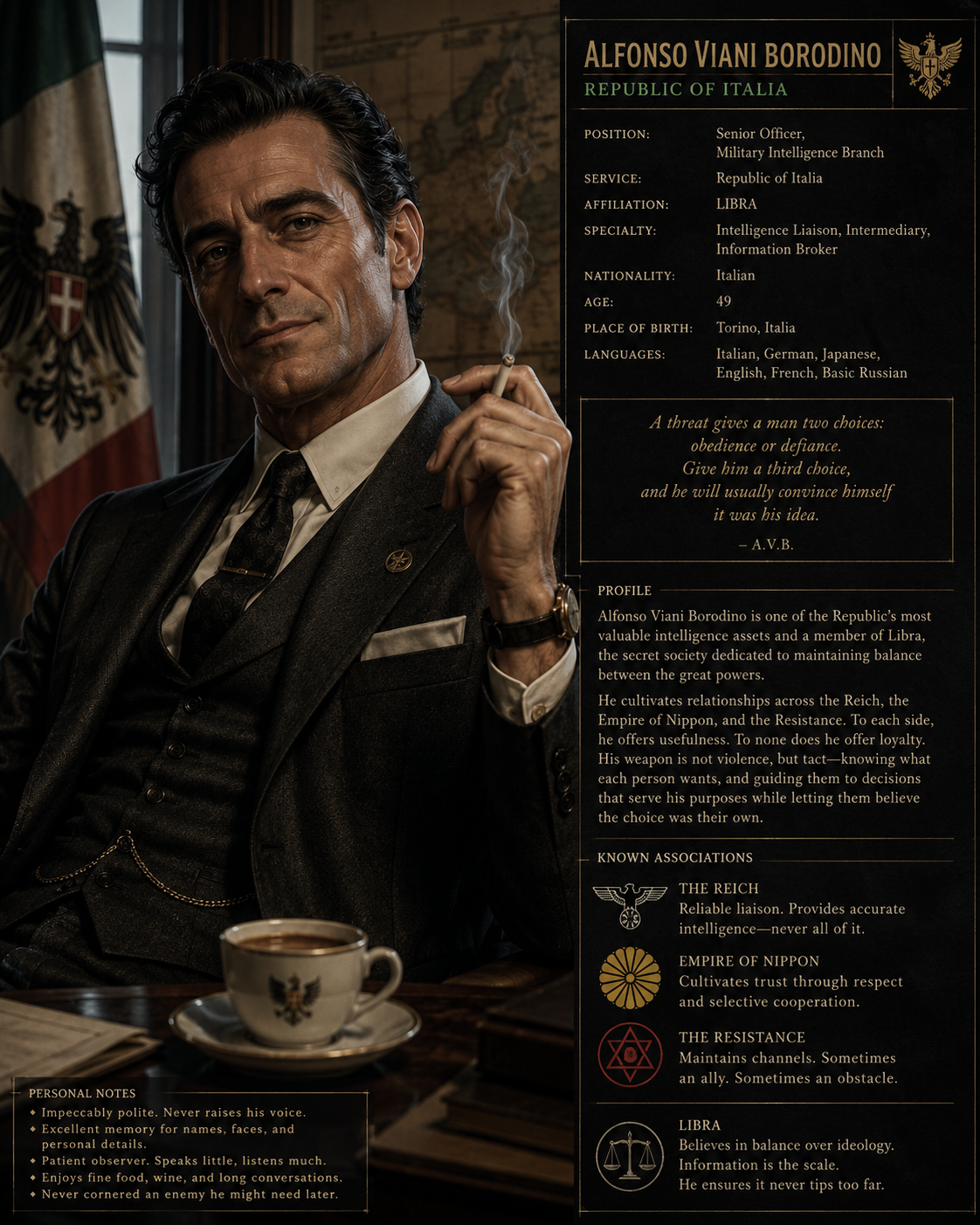
Alfonso Viani Borodino
Nationality: Republic of Italia
Occupation: Senior Officer, Republic Military Intelligence
Secret Affiliation: Libra
Role: Intelligence officer, intermediary, fixer, information broker
In the world of Blood & Suns, tact is more than courtesy or diplomacy. It is knowing how far someone can be pushed without making them realize they have been pushed at all. Few people understand this better than Alfonso Viani Borodino.
A senior officer in the Republic’s military intelligence establishment (RIS), Borodino has built a career in the narrow and dangerous space between the Reich and the Empire. The Republic may be the third great Regime, but it lacks the overwhelming military and industrial strength of either of its rivals. For men like Borodino, survival therefore depends upon something subtler than force. It depends upon knowing people.
Borodino has spent decades cultivating officers, bureaucrats, diplomats, businessmen, criminals, smugglers, resistance contacts, corporate executives, and intelligence operatives throughout the Solar System. He knows which Reich official enjoys being flattered, which Imperial commander considers flattery insulting, which bureaucrat can be bought, and which supposedly corrupt official is secretly incorruptible. More importantly, he knows what each of them wants.
Alfonso is impeccably polite, relaxed even under threat, and almost impossible to provoke. He rarely raises his voice and almost never issues a direct threat. He does not need to. A carefully chosen anecdote, an innocent question about someone’s family, or the casual mention of a mutual acquaintance can communicate more than intimidation ever could. People frequently leave conversations with Borodino convinced that they persuaded him. That is usually when Alfonso knows the conversation went well.
The Three-Sided Game
Borodino’s official responsibility is the protection of Republic interests, particularly wherever Reich and Imperial ambitions collide. In practice, he plays three games simultaneously.
With the Reich, he is the dependable Italian intelligence liaison – cooperative, charming, apparently sympathetic, and remarkably well informed. He provides enough valuable information that Reich intelligence officers continue taking his calls, while carefully ensuring that Berlin never receives everything he knows.
With the Empire, he maintains an entirely different collection of relationships. Imperial officers know perfectly well that Borodino deals with the Reich, but they also know that information received from him has an irritating tendency to be correct. He has prevented Imperial personnel from walking into Reich operations, quietly arranged exchanges of captured personnel, and occasionally warned Tokyo about developments that the Republic supposedly knew nothing about.
Then there is the Resistance. Borodino has contacts throughout the underground – smugglers, dissidents, independent resistance cells, and even indirect channels to Monolith. Sometimes he provides them with information. Sometimes he purchases information from them. Sometimes he quietly makes certain that a patrol arrives ten minutes too late. And sometimes he betrays them. Borodino makes no promises that he cannot afford to keep. The mistake people make is assuming this means Alfonso cannot be trusted. He can. One simply needs to understand what he has actually promised.
Information Without Lies
One of Borodino’s professional principles is that good intelligence should rarely require fabrication. False information eventually becomes identifiable as false. Once that happens, the source becomes worthless. Borodino therefore prefers the truth but just not necessarily all of it.
He might inform a Reich intelligence officer that an Imperial transport will arrive at a particular station without mentioning the Republic agent traveling aboard it. He might warn an Imperial commander that Reich security is investigating a Resistance cell while omitting that he was responsible for drawing Reich attention toward the cell in the first place. He might give Monolith the precise location of a weapons shipment while neglecting to mention that Libra wants those weapons removed from Reich hands. Everything he said was true. The conclusions others drew from those truths belong to them.
Libra
Borodino’s deepest allegiance is not to Republic Military Intelligence. He is a member of Libra. Born from a coalition of Republic corporations and financiers determined to prevent another catastrophic world war, Libra exists to preserve the balance between the great powers. Neither the Reich nor the Empire can be permitted decisive supremacy. Neither can be allowed to push the Cold War into an apocalyptic conflict. Information is Libra’s principal weapon, and its agents cultivate a reputation for intelligence that is accurate but deliberately incomplete.
Borodino embodies that philosophy almost perfectly. He does not regard the Reich, Empire, or Resistance as friends or enemies in the conventional sense. They are forces acting upon a balance. When the Reich becomes too powerful, Alfonso quietly strengthens its enemies. When the Empire gains an advantage capable of destabilizing that balance, information mysteriously finds its way into Reich hands. When a Resistance operation can weaken one of the Regimes without threatening the larger equilibrium, Borodino may become an extraordinarily useful friend. And when Monolith threatens to upset that equilibrium completely, he can become an equally dangerous adversary. Borodino does not want the Resistance destroyed. Libra regards it as too useful for that. He wants it manageable.
That distinction may eventually make Alfonso one of Monolith’s most frustrating contacts.
The Useful Friend
Alfonso understands that relationships are rarely divided cleanly between allies and enemies. A Reich officer whom he deceives today may be the person he needs next year to prevent an execution. An Imperial intelligence agent attempting to expose him may nevertheless receive a warning when someone else places an assassin outside her apartment. A Resistance operative who once tried to kill him might later discover that Borodino arranged medical treatment for his wounded daughter. Alfonso accumulates favors relentlessly. He gives far more of them than he collects and this is deliberate.
A favor owed immediately has little value. A favor left untouched for ten years becomes a relationship. His network is therefore not composed primarily of informants. It is composed of people who owe Alfonso Viani Borodino something. Some owe him money, some careers, and some even their freedom. A disturbing number owe him their lives.
Never Humiliate an Enemy
Borodino’s most important rule is deceptively simple – Always leave the other person a dignified way out. Humiliated people become dangerous. Cornered people become unpredictable. Public victories create private enemies. Alfonso therefore gives people excuses. A Reich colonel does not withdraw because Borodino persuaded him. New intelligence required a tactical reassessment. An Imperial diplomat does not compromise. A previously overlooked provision in an old treaty simply permits an alternative interpretation. A Resistance leader has not accepted Republic assistance. A conveniently unattended shipment apparently fell from a cargo manifest.
Everyone preserves face. Everyone gets to tell themselves that the decision was theirs. And Alfonso gets what he wanted.
Personality
Borodino is warm without being familiar, charming without appearing insincere, and courteous even toward people he despises. He enjoys good meals, long conversations, and the ritual of hospitality, partly because he genuinely appreciates them and partly because informal surroundings encourage people to reveal themselves.
He has an excellent memory for names, families, preferences, anniversaries, grudges, and personal history. Someone introduced to him once at a diplomatic reception may encounter him five years later and discover that Alfonso still remembers the name of his wife. He listens considerably more than he speaks. When others become angry, Alfonso becomes quieter. When others make threats, he asks questions. When someone insults him, he often smiles. His apparent patience should never be mistaken for weakness.
Libra agents are trained to manipulate, infiltrate, fight, and kill when circumstances demand it. Borodino simply considers violence evidence that more elegant methods have failed.
GM Note — The Man in the Middle
Alfonso genuinely believes that the balance maintained by Libra has prevented another global war. That belief is the cornerstone of his morality. It is also how he sleeps at night.
He knows Libra has sacrificed innocent people. He knows Resistance operations have been compromised because their success threatened the balance. He has allowed Reich and Imperial operations to proceed because stopping them would have strengthened the opposing Regime too greatly.
To Alfonso, however, every atrocity must be weighed against the nightmare he believes Libra prevents: unrestricted war between the Reich and Empire. Billions could die. Earth might become uninhabitable. The colonies could tear themselves apart. So Alfonso measures lives against lives and continues moving pieces around the board.
This makes him neither a secret hero nor a conventional villain. Sometimes helping Alfonso will save hundreds of lives. Sometimes opposing him will be unquestionably the right thing to do. And sometimes Monolith may discover that the only person capable of preventing a catastrophe i s a man they know has betrayed them before.
Alfonso’s true gift is ensuring that, when that moment arrives, they will still take his call.
“A threat gives a man two choices: obedience or defiance. Give him a third choice, and he will usually convince himself it was his idea.”
And perhaps the maxim that best summarizes his career:
“Never force an enemy to become your enemy today. You may need him tomorrow.”
#RPGaDAY2026