

Shattered Expanse
Theral Varesh
Creshian Historian, Archaeologist, and Cultural Reconciliation Scholar
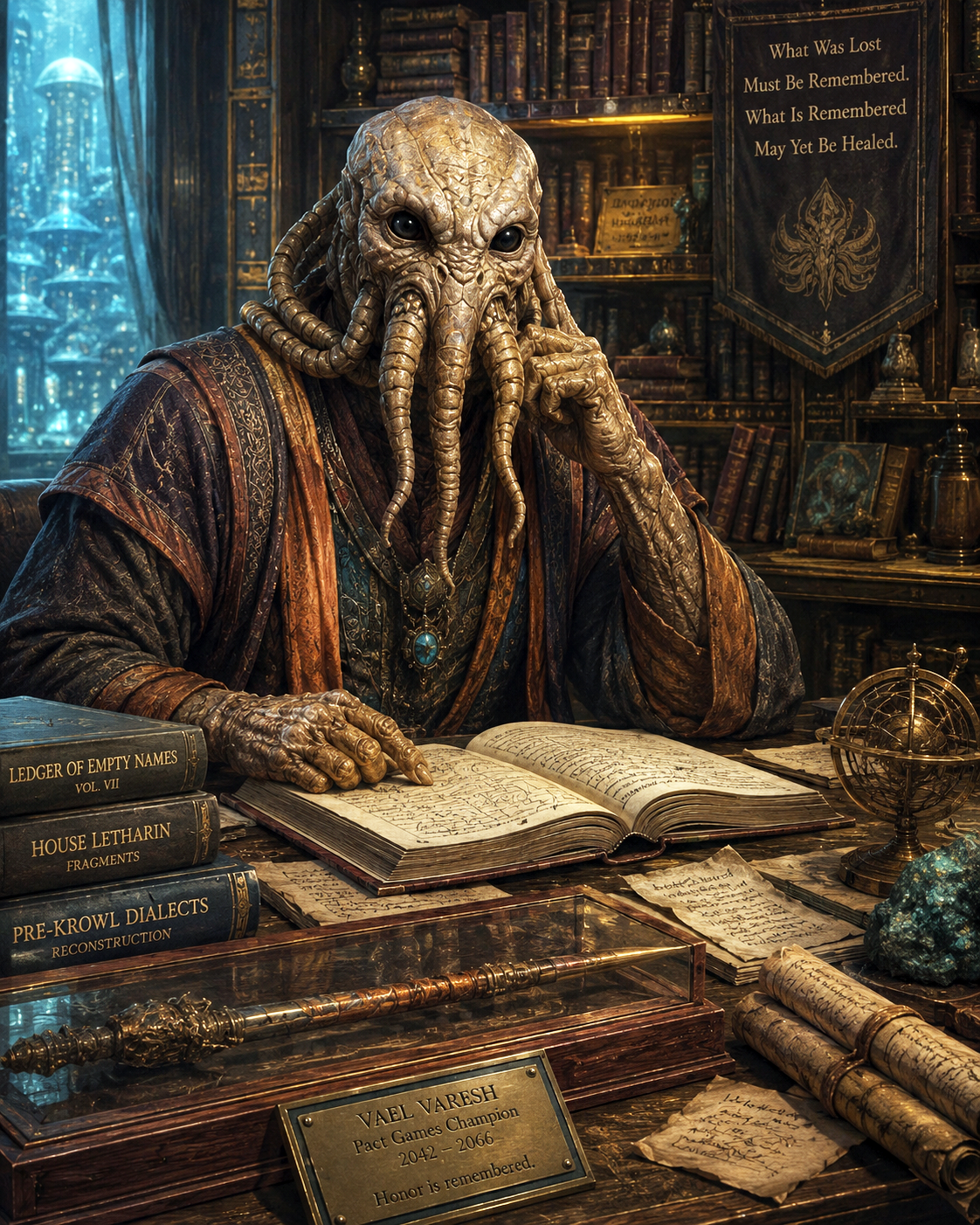
Of all the peoples of the Shattered Expanse, few understand loss as intimately as the Creshians. They were once the masters of a vast interstellar civilization, only to see it torn apart by the Krowl and their diabolical creation – the Ecreshians. The Creshians ultimately destroyed the Krowl, but victory came too late to save their empire. Worlds were lost, populations vanished, Houses disappeared, and entire branches of Creshian history were erased during centuries of warfare and the technological dark ages that followed.
Theral Varesh has devoted his life to understanding everything his people lost—and whether the greatest wound inflicted upon them can ever truly be healed.
Theral was born on Cresh into an old but relatively minor House whose surviving records stretched back to the reconstruction period following the ancient wars. Like many Creshian families, the Varesh could trace their ancestry much farther than they could actually document it. Family traditions spoke of estates, colonies, military commands, and ancestral honors from the old Creshian Empire, but little evidence remained to prove any of it. For the young Theral, these gaps were initially little more than curiosities. He wanted to know who those people had been, where they had lived, and why so much of their story had disappeared.
His older brother, Vael Varesh, was considerably less interested in the distant past. Vael became a gladiator. Strong, charismatic, and deeply committed to traditional Creshian concepts of honor, Vael believed wholeheartedly in the Pact and the gladiatorial traditions that had grown around it. He did not hate the Ecreshians. Indeed, he argued that the arenas were one of the reasons he did not have to. The ancient hatred between their peoples was real, and pretending otherwise was dangerous. Ritualized combat gave that hostility somewhere to go. Better, Vael believed, for willing warriors to face one another beneath agreed rules than for Creshian and Ecreshian fleets to settle their differences over inhabited worlds.
Vael became successful enough to earn recognition beyond his own House. Theral attended many of his matches and, despite his discomfort with the violence, took pride in his brother’s accomplishments. Then Vael entered the arena for the last time. His opponent was an experienced Ecreshian gladiator. The match was sanctioned, the rules were observed, and neither combatant violated the Pact. During the fight Vael suffered catastrophic injuries and died. There was no murderer for Theral to hate. There was no crime to prosecute. There was no Pact violation demanding vengeance.
The Ecreshian had done exactly what both societies expected him to do, just as Vael had willingly entered the arena knowing precisely what might happen. Everyone told Theral that his brother had died honorably. Theral discovered that he found very little comfort in honor.
The Question
Vael’s death changed the direction of Theral’s life. He found himself returning repeatedly to a simple question: Why are we still doing this?
The answer seemed obvious to everyone else. The Krowl had genetically altered captured Creshians into the Ecreshians and deliberately embedded hostility toward their progenitors into them. Centuries of genocidal warfare had, in turn, embedded hatred of the Ecreshians deeply within Creshian culture. The Pact acknowledged that neither side could simply wish those impulses away. The gladiatorial tradition therefore provided a controlled outlet for something that might otherwise erupt into another war.
Theral gradually came to regard that explanation as an admission of defeat. The Krowl were extinct. The Creshians had destroyed them ages ago. Their worlds were ruins, their empire gone, and their civilization existed primarily as an archaeological subject. Yet the weapon they had created was still functioning.
Every time a Creshian and an Ecreshian entered an arena because their peoples required an outlet for their ancient hatred, the Krowl achieved another small victory. Vael had not merely died fighting an Ecreshian. In Theral’s mind, his brother had been killed by a weapon fired thousands of years before either gladiator had been born.
Keeper of the Lost
Theral threw himself into historical study.
What began as an attempt to understand the origins of the Creshian-Ecreshian conflict expanded into a career recovering the history of the old Creshian civilization. He became an archaeologist, historian, linguist, and eventually one of the foremost specialists in pre-Krowl Creshian culture.
He traveled extensively through former Creshian territories, investigating abandoned ocean colonies, forgotten stations, dead worlds, and ruins dating from the destruction of the old empire. He recovered fragments of royal archives, reconstructed portions of extinct dialects, identified lost settlements, and returned the remains of ancient Creshian dead to Houses that had wondered about their fate for generations. His successes earned him considerable respect. They also taught him something terrible. There simply was not enough left.
Entire Creshian cultures had disappeared. Some Houses survived only as names on damaged records. Works of literature existed only as references in other works. Ancient ceremonies continued to be performed even though no one remembered precisely what portions of them originally meant. There were colonies whose existence could be proven but whose locations were gone, and worlds carrying modern names because no surviving record preserved what the Creshians who first settled them had called them.
Theral began compiling these absences into a private historical database he called the Ledger of Empty Names.
It catalogued lost cities, vanished colonies, extinct Houses, forgotten languages, missing vessels, destroyed works of art, unidentified ruins, and individuals whose traces Theral encountered during his expeditions. Theral established one unusual rule for the Ledger. Nothing was ever deleted. When something thought lost was rediscovered, its entry remained exactly where it had always been. Theral simply added a single notation: RETURNED. There are far fewer such marks than he would like.
Before the Hatred
Eventually, Theral realized that the Ledger contained another absence far more important than any lost city. Modern Creshian identity had been shaped profoundly by the Krowl wars. Honor, vigilance, strength, loyalty, the Pact, and even the gladiatorial traditions through which Creshians understood their relationship with the Ecreshians had developed beneath the shadow of that ancient catastrophe. Theral began asking a much more difficult question: Who were the Creshians before they learned to hate the Ecreshians? That question now lies at the center of his research.
Theral searches the oldest surviving Creshian archives for cultural behaviors predating the Krowl conflict. He studies ancient art, family structures, philosophies, religious traditions, and political institutions. More controversially, he examines recovered Krowl genetic records in an attempt to determine precisely what was changed when the first Ecreshians were created.
He has even begun quietly interviewing Ecreshians. Theral compares Creshian and Ecreshian instincts, language structures, emotional responses, rituals, and social behaviors, searching for characteristics that survived their divergence. He believes those similarities may ultimately prove more important than their differences.
Somewhere beneath thousands of years of genetic manipulation, warfare, propaganda, resentment, and ritualized violence, Theral believes there remains something shared. Finding it has become his life’s work.
A Better Pact
Theral is not an idealist who believes Creshians and Ecreshians can simply forgive one another. He knows too much history for that. The hostility engineered into the Ecreshians is real. Creshian resentment is equally real, even if its origins are cultural rather than artificial. Generations have lived and died beneath those influences. Neither can simply be discarded without fundamentally changing the societies built around them.
Theral instead seeks another mechanism for managing—and perhaps eventually diminishing—the hatred. He has investigated behavioral therapy, neurological treatments, genetic correction, psionic intervention, shared cultural rituals, childhood exchange programs, and controlled forms of cross-species social conditioning. Some possibilities he considers promising. Others frighten him because they come dangerously close to repeating the Krowl mistake: changing a people because someone else has decided what they ought to be.
His ultimate goal is not to make Creshians and Ecreshians love one another. It is much more modest. He wants them to someday no longer need the arena.
That position has earned Theral enemies among both peoples. Creshian traditionalists accuse him of dishonoring those who died preserving their civilization. Some Ecreshian authorities regard his research into their engineered psychology as an attempt to eliminate Ecreshian identity. Powerful interests surrounding the Pact Games have little desire to see the largest sporting tradition in Creshian-Ecreshian space questioned.
Theral nevertheless remains an unwavering supporter of the Pact itself. He believes destroying the Ecreshians would represent the ultimate triumph of the Krowl. The Ecreshians were not the architects of the ancient atrocity. They were its victims as surely as the Creshians were. One people lost an empire. The other lost the right to determine what kind of people they would become. Theral refuses to decide which loss was greater.
The Brother He Cannot Return
For all his scholarship, Theral’s work remains deeply personal. Vael’s arena weapon rests in a simple preservation case in Theral’s study among artifacts thousands of years older. There is no memorial plaque beside it and no explanation of its significance. Visitors occasionally assume it is simply another historical artifact.
Theral rarely corrects them. He still attends the Pact Games on occasion. He understands their purpose and acknowledges that they may have prevented conflicts that would otherwise have killed millions. But he no longer cheers.
He watches. Every time a Creshian and Ecreshian enter the arena, Theral sees two descendants of the same ancient tragedy being asked to carry it forward another generation. When someone describes the Games merely as entertainment, his usually patient demeanor disappears.
“My brother did not die because an Ecreshian hated him. He died because we decided hatred was permanent.”
Theral has otherwise remained remarkably warm despite his experiences. He enjoys good meals, long conversations, archaeological anecdotes, and arguments over obscure historical interpretations. Younger scholars often expect the famous Keeper of the Lost to be melancholy and instead encounter an inquisitive Creshian with a dry sense of humor and seemingly endless patience. His grief surfaces in subtler ways.
Theral never says that the ancient Creshian Empire fell. He says that the Creshians lost it. When outsiders describe the Creshians as an ancient civilization, he occasionally corrects them:
“We are the descendants of one.”
And when young Creshians romanticize the old empire, Theral reminds them that they know far less about it than they imagine.
“You cannot inherit what you do not remember. We did not rebuild the old Creshian Empire. We built something new from what survived.”
That distinction matters deeply to him. Theral has spent much of his life recovering things that were lost. That experience has taught him that recovery and restoration are not the same thing. A recovered artifact cannot recreate the people who made it. An ancient recording cannot restore a dead culture. A rediscovered city does not bring its inhabitants home.
And nothing Theral discovers will ever return Vael. He has accepted that. What he has not accepted is the idea that loss must simply be endured and repeated. For Theral, remembering the dead carries an obligation to the living. If the Creshians truly wish to honor everything their civilization lost, they must ensure that future generations inherit something more than grief, resentment, and an ancient enemy’s hatred.
When confronted by those who insist that the Creshian-Ecreshian conflict can never truly end, Theral Varesh asks the same quiet question:
“How much more are you willing to lose?”
Blood & Suns
Monolith Agent Codename: WIDOW
Codename: Widow
Real Name: Classified
Affiliation: Monolith
Ancestry: Ünter Human
Homeworld: Earth
Role: Field Operative / Infiltration Specialist
Status: Active, Psychological Observation Recommended
This world defined by loss. Families disappear into labor camps. Soldiers vanish into wars that have continued for generations. Entire peoples have lost their nations, histories, languages, and sometimes even the knowledge that those things once existed.
For a Monolith agent, however, there is another kind of loss that is rarely discussed. They have lost the veil.
Every citizen raised beneath the Regimes has lived under some degree of chemical and psychological manipulation. Schnuller and Oshaburi conditioning suppress anxiety, reinforce obedience, dull inconvenient emotions, and make an unbearable existence seem normal. Monolith strips that away.
Freedom means feeling everything again. Widow has begun to wonder whether that was entirely a gift.
The Missing Man
Until recently, Widow belonged to a four-person Monolith Cell operating inside the Reich. One of those agents was Codename Finch. Officially, Finch was simply another member of her Cell. They worked together for nearly three years, surviving raids, extraction operations, surveillance missions, and several assignments Widow still refuses to discuss. Unofficially, they were lovers.
Monolith strongly discourages romantic relationships between members of the same operational Cell. The reason is practical rather than moral. Attachment creates leverage. It compromises judgment. An agent may abandon an objective to save someone they love, hesitate when that person is endangered, or break under interrogation if threatened with their suffering.
Widow and Finch knew the rules. They simply believed they were better than the rules. For almost two years they hid the relationship from their Handler and the other members of their Cell. Their meetings were brief. They rarely slept in the same location twice. They never used their real names with one another. For people who had surrendered almost everything about their old identities to Monolith, the relationship became one small thing that belonged entirely to them.
Then Finch disappeared. During a recent operation, the Cell became separated during extraction. Widow escaped with the remaining agents. Finch did not. When she demanded to know what had happened, her Handler gave her the standard response. “Finch is gone.”
Was he killed? “Gone.”
Captured? “Gone.”
Did Monolith recover his body? “Stop asking.”
Widow understands why. Compartmentalization keeps Monolith alive. A captured agent might still be alive somewhere in a Reich interrogation facility. An extraction attempt could expose a Cell, a Handler, or an entire resistance network. Even confirmation of his death might reveal information Monolith cannot safely provide. She understands all of this. Understanding has not made it hurt less.
The Empty Space
Widow has discovered something frightening about grief. It does not remain politely contained. She finds Finch everywhere. A chair across a briefing table. The sound of someone adjusting a weapon strap. A particular brand of synthetic coffee. A joke someone almost tells correctly. An empty bunk.
There are moments when she reaches for a communicator before remembering there is no one on the other end. The worst moments come when she sleeps. Monolith’s deprogramming taught her how to recognize conditioned thoughts. She knows the difference between her own memories and implanted behavioral responses. But grief does not care about training. Neither does addiction.
Beneath the Veil
Widow remembers the Schnuller and it’s euphoric effect. She remembers sitting inside her tiny apartment after a twelve-hour work shift while the household unit released its evening aerosol. She remembers the warmth spreading through her chest. The slowing of her thoughts. The disappearance of anger. The strange comfort of hearing the evening broadcast and believing, for just a little while, that everything was exactly as it should be.
She now knows it was all chemicals and subliminal conditioning. She now knows how the Regime manufactured contentment and reinforced obedience. She knows it was slavery. However, deep in her psyche, it is sometimes she misses it. Of course, that is the part she will never tell her Handler. She does not want the slavery of the Reich back. She does not want to chemically and psychologically induced obedience, nor the constant propaganda. She simply wants to remember what it was like not to hurt.
There are nights when Widow would give almost anything to sit beneath a Schnuller again and let someone else decide what she should think. Just for an hour. Just long enough to stop wondering whether Finch died calling her name.
The Dangerous Thought
Widow once believed Monolith had freed her but now she understands freedom differently. Freedom does not make suffering disappear, it merely allows you to understand why you are suffering. The Regime offered her ignorance and Monolith offers truth – regardless of how harsh it is. Finch made the truth worth enduring and now he’s is gone. And somewhere inside Widow remains the memory of a switch that could make all of this easier.
That is her loss. Not merely the man she loved, nor merely the life she once lived. She has lost the ability to pretend the world is all right—and now, for the first time since her deprogramming, a part of her wishes she could have it back.
What Happened to Finch?
Widow has deliberately not been told whether Finch is alive or dead. The Handler knows only slightly more than she does. Finch failed to reach the extraction point and disappeared inside Reich-controlled territory. Intelligence collected afterward suggests someone matching his description was taken alive, but Monolith has been unable to confirm whether the prisoner was actually Finch.
The Directorate has ordered the matter closed. There will be no rescue operation and no investigation by Widow’s Cell. There will be no additional information provided to her. This is partly operational security. It is also a test.
Monolith’s psychological staff are watching Widow carefully because grief sometimes awakens old dependency patterns in deprogrammed agents. She has already begun displaying minor behaviors associated with Schnuller withdrawal: ritualized breathing, fixation on old broadcast melodies, irritability, insomnia, and periods of emotional numbness.
None are currently severe enough to remove her from active service. What Monolith does not know is that Widow recently stood outside a functioning Schnuller distribution station for almost twenty minutes.
She could have walked away immediately. She did not. She watched citizens enter. And for twenty minutes, she envied them.
Personal Log – Codename: WIDOW
Monolith Internal / Unauthorized Personal Record
I keep thinking about the way they said it. Finch is gone. Not dead. Not captured. Not missing. Just gone.
I asked what that meant. My Handler looked at me for a long time before repeating it. “Finch is gone.” That is apparently supposed to be enough.
Maybe for an agent it should be. We lose people. We all knew that before we took our codenames. We knew it when they put us through the Red Rooms. We knew it when they burned our old identities and told us that the people sitting beside us were not friends, not family, not anything except members of a Cell.
Assets. Resources. People you trust with your life but never enough to tell them your real name. Finch knew my real name. I knew his. That was our first mistake.
I don’t remember when it stopped being just sleeping together. Maybe it was never just that. At first it was convenient. Two people scared and tired and pretending neither of us needed anyone. We joked that if Monolith found out, they would separate the Cell.
Eventually we stopped joking about it. We became careful instead. Different rooms. Different arrival times. Never touching when anyone could see us. Never looking at each other for too long during briefings. It became another operation.
We were very good at operations. Apparently not good enough. I keep replaying the extraction. There was gunfire behind us. Someone was shouting. Finch was supposed to be three meters behind me. Then he wasn’t. I didn’t see him fall. That is the problem.
If I had seen him die, maybe this would be different. There would be an image. A moment. An ending. Instead there is a blank space. And Monolith has filled it with one word. Gone.
I haven’t told anyone about the cravings. I don’t know if craving is even the right word. I don’t want the Schnuller. I know what it is. I know what they put into us. I know what those drugs did to my head. I know the broadcasts weren’t harmless. I know the calm wasn’t real. I know all of it.
That’s the problem. I know everything now. Before Monolith, I would come home from work, lock the door, sit beneath the unit and wait for the evening cycle. There was a little hiss when it started. I hadn’t thought about that sound in years. Now I think about it every night.
Hiss. Then warmth. Not pleasure exactly. Just… less. Less anger. Less fear. Less thought. The walls didn’t feel so close. Work tomorrow didn’t seem so terrible. The patrols outside weren’t something to worry about.
People disappeared and somehow you could convince yourself there was probably a reason. Everything made sense. Because they made it make sense. I hated them when I learned the truth. I hated what they did to me. I still hate them. But tonight I remembered what it felt like to hurt less. And for the first time since the Red Room, I missed it. That scares me more than anything.
I walked past a public conditioning station today. I didn’t mean to. That is a lie. I knew exactly where it was. There were six people waiting outside. A woman in a factory uniform. An old man. Two boys who looked too young to have jobs. A soldier. Someone else I don’t remember.
They looked tired. Then the door opened. The woman went inside. I stood across the street watching. I knew what would happen. She would sit down. The system would authenticate her. There would be the sound. That little hiss. And for a while the world would become easier. I hated her for it. Then I envied her. I stood there for twenty minutes.
Black Star breathing. Count four. Hold two. Exhale six. Name five things you see. Four things you hear. Three things you can touch. All the exercises they taught us. All the things that are supposed to remind us that our thoughts belong to us.
My thoughts belonged to me. That was exactly the problem. I wanted them to belong to someone else. Just for an hour. I wanted someone to tell me Finch wasn’t important. I wanted someone to tell me I didn’t love him. I wanted someone to tell me the mission mattered more. I wanted someone to make me believe it.
I didn’t go inside. I need to write that down. I did not go inside. Eventually I walked away. That should feel like a victory. It doesn’t. Because tomorrow I could go back. And tomorrow Finch will still be gone. Maybe he’s dead. Maybe he’s alive. Maybe he’s sitting in a Reich interrogation room right now. Maybe they’re using a Schnuller on him. Maybe he already told them everything. Maybe he’s calling my codename. Maybe he’s calling my real name. Maybe he hates me for leaving him. Maybe there was nothing I could have done. Monolith tells us uncertainty keeps the network safe.
I understand that. I understand compartmentalization. I understand acceptable losses. I understand why they won’t tell me anything. I understand all of it. I wish I didn’t. That may be what I have lost more than anything else.
Before Monolith, there were things I didn’t have to understand. Someone else decided what was true. Someone else decided what mattered. Someone else decided what I should feel. Freedom means nobody does that anymore. Freedom means Finch is gone and nobody can make that sentence hurt less. I used to think freedom was waking up. Nobody told me that once you’re awake, you have to stay awake. Even when you desperately want to close your eyes.