

The Koressi
The Forgotten Natives of Vesperion III
Homeworld: Vesperion III, Vesperion Binary System
Classification: Indigenous Sapient Species
Current Status: Severely diminished population, primarily inhabiting the northern regions of Vesperion III.
Background
Long before the arrival of the human colonists who would eventually become the Terraxians, Vesperion III was home to an indigenous reptilian species known as the Koressi.
The arrival of humanity proved catastrophic for the native population. Warfare between the expanding human settlements and the Koressi devastated their civilization, but human weapons were not their only enemy. Diseases introduced by the colonists spread through the indigenous population, contributing to a demographic collapse from which the species has never recovered.
Today, the Koressi are believed to be approaching extinction. Their surviving communities are concentrated primarily in the northern regions of Vesperion III, far from the more densely populated Terraxian territories and the powerful southern city-states such as Varkesh.
Despite their greatly reduced numbers, the Koressi have retained their martial traditions, including a distinctive form of mounted warfare.
Physical Characteristics
The Koressi are reptilian humanoids distinguished by their four functional arms, arranged in two pairs. This anatomy gives them a particular advantage in mounted combat, allowing them to control their mounts with their upper arms while simultaneously operating weapons with their lower pair.
The Kordari Riders
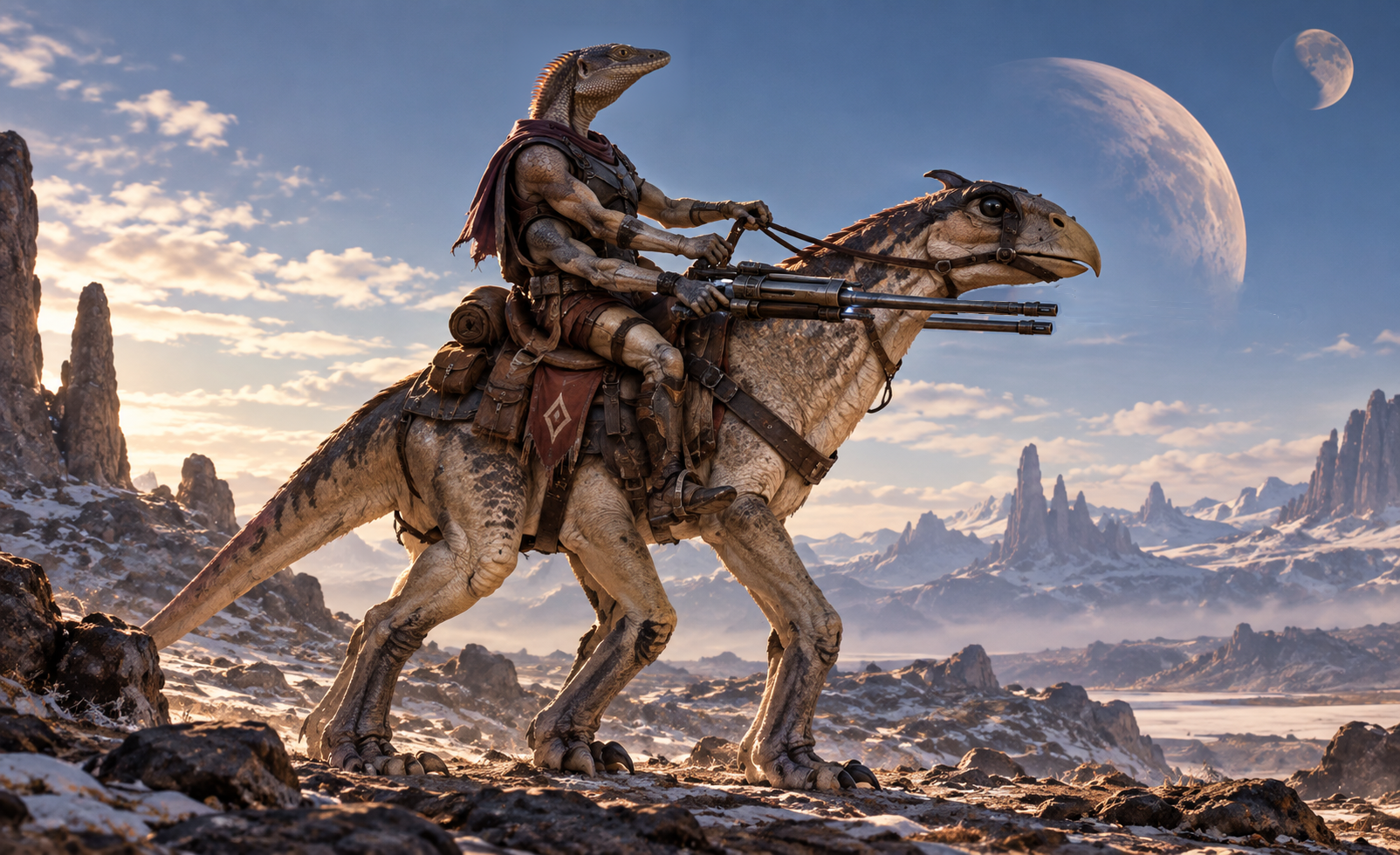
The Koressi maintain a mounted fighting tradition known as the Kordari Riders. Their cavalry utilizes a domesticated variant of a native reptilian animal called the Kordari. These mounts are large, six-legged creatures with powerful limbs, long balancing tails, and distinctive beaked heads.
The Kordari Riders combine traditional mounted warfare with advanced weaponry. Their saddles incorporate twin forward-facing blaster cannons mounted along the neck of the animal. A typical rider operates the reins with their upper arms while their lower arms control the paired cannons. This allows them to maneuver and engage enemies simultaneously without surrendering control of their mount.
Their equipment reflects the broader aesthetic of Vesperion III: a mixture of practical armor, traditional cavalry equipment, and modern energy weapons.
For Shattered Expanse, I’d start with a Koressi Rider as a standard adversary (Extra), with an optional Wild Card upgrade for a tribal champion or war leader.
Given the Koressi’s history on Vesperion III, they make interesting adversaries without necessarily being villains. A Koressi patrol defending its ancestral territory could easily come into conflict with Terraxian soldiers, off-world explorers, or even the Ashen Talons.
Koressi Rider
Extra
Native of Vesperion III
Four-armed reptilian cavalry warrior
Koressi Riders are experienced hunters and territorial defenders, commonly encountered in the sparsely populated northern reaches of Vesperion III. They frequently employ Kordari mounts, six-legged reptilian beasts adapted to the planet’s harsh terrain. Their four arms allow them to control their mounts while simultaneously operating weapons.
Attributes: Agility d8, Smarts d6, Spirit d6, Strength d8, Vigor d8.
Skills: Athletics d8, Fighting d8, Notice d8, Riding d8, Shooting d8, Stealth d6, Survival d8.
Pace: 6; Parry: 6; Toughness: 8 (2); Size: 0.
Hindrances
Outsider (Major): Koressi are generally distrusted or treated with hostility by Terraxian settlements.
Special Abilities
Four Arms: Koressi possess two pairs of functional arms. They may hold and manipulate multiple objects simultaneously. They may ignore the Unstable Platform penalty when firing a one-handed weapon while controlling a Kordari mount with another pair of arms. This does not grant additional actions or eliminate Multi-Action Penalties.
Natural Armor +2: Thick reptilian scales provide Armor +2.
Claws: Str+d4 damage.
Low-Light Vision: Koressi ignore penalties for Dim and Dark illumination.
Gear
- Tribal armor and harness.
- Short-barreled blaster pistol (Range 12/24/48, Damage 2d6+1, AP 2).
- Hunting spear (Str+d6, Reach 1).
- Kordari mount (when encountered as cavalry).
Optional: Koressi Tribal Champion
Wild Card
For an experienced Koressi war leader, use the Rider statistics above with the following adjustments:
| Trait | Adjustment |
|---|---|
| Fighting | d10 |
| Shooting | d10 |
| Spirit | d8 |
| Vigor | d10 |
| Parry | 7 |
| Toughness | 9 (2) |
| Edges | Combat Reflexes, Level Headed |
| Bennies | 2 (GM Wild Card) |
| Wounds | 3 |
Tactics: Koressi rarely seek prolonged engagements against heavily equipped opponents. Riders favor mobility, flanking attacks, and the use of difficult terrain, particularly when defending ancestral hunting grounds. A champion may coordinate several mounted warriors while Koressi Flyers provide reconnaissance from above.
Design note: This is a proposed SWADE adversary profile rather than a confirmed extraction from your setting draft. I’ve kept the Koressi’s four arms useful without giving them four independent attacks per turn.
Koressi Flyers, The Winged Nobility
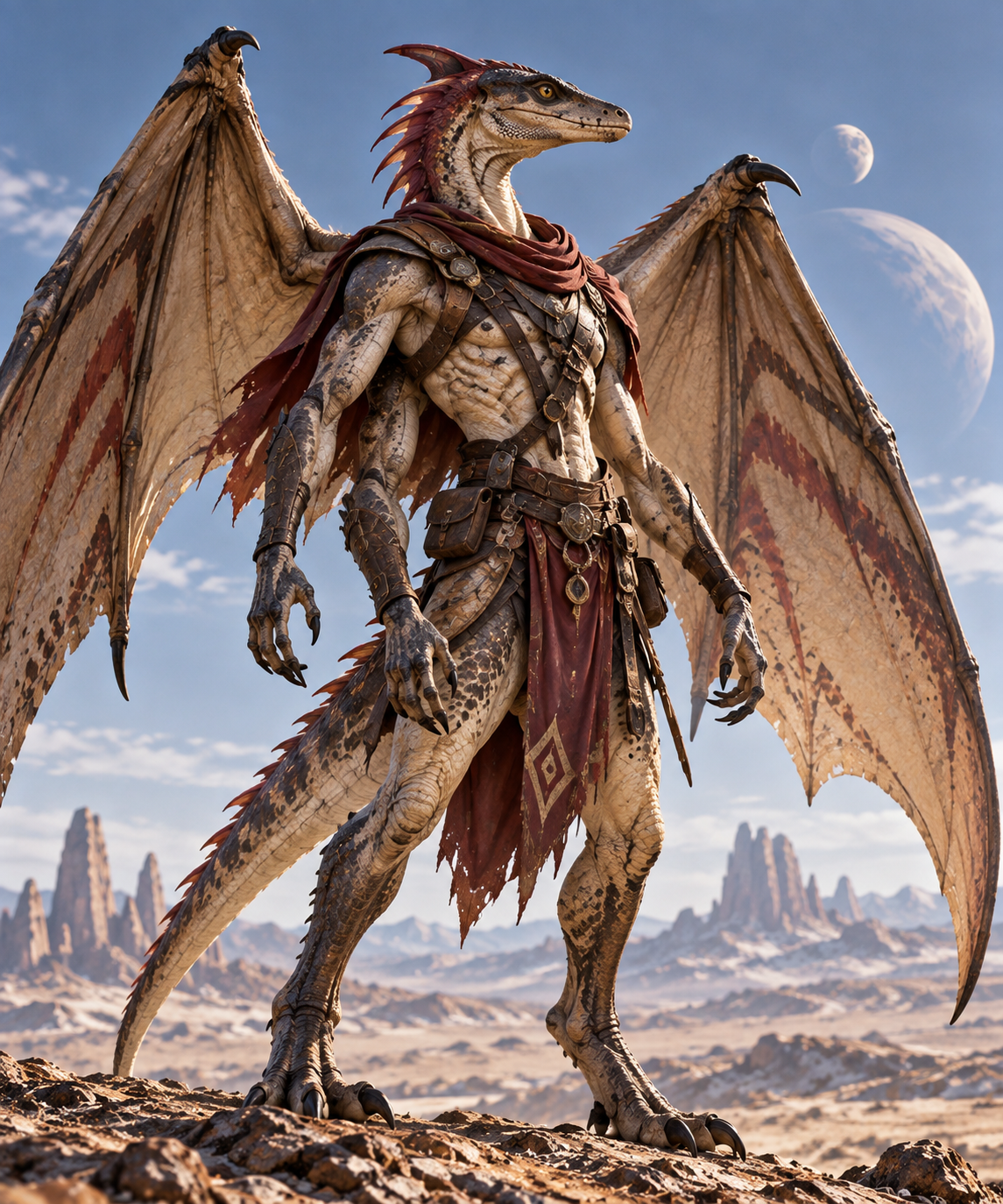
The Divine Birthright of Vesperion III. Among the Koressi of Vesperion III, few events are celebrated with greater reverence than the birth of a winged child. Occurring in approximately one out of every ten births, these rare individuals, commonly called Flyers, are regarded as living manifestations of divine favor. Their wings are not considered a genetic variation or evolutionary adaptation by traditional Koressi society, but rather a blessing bestowed upon the child by the gods themselves.
While all Koressi possess four functional arms, only Flyers develop the large membranous wings that distinguish them from the rest of their species. These appendages grant them the ability to take flight, but their significance extends far beyond their practical advantages.
To be born with wings is to be born noble.
The Blessing of Wings
When a Flyer is born, the event is cause for celebration throughout the settlement. The child’s family, regardless of its previous social standing, is immediately elevated to the village’s ruling nobility. Even the poorest hunting family may find itself transformed into royalty overnight, its household becoming the center of religious and political life.
The winged child is raised with the expectation that they will eventually assume a significant leadership position within the community. Depending on the settlement’s traditions, this might be as a chieftain, spiritual leader, war commander, or successor to an existing ruler.
The family enjoys the privileges associated with the child’s divine status, but its authority is derived entirely from the blessing. They are not necessarily considered inherently superior; rather, they have been entrusted with the responsibility of raising someone chosen by the gods.
This creates an unusual form of nobility. Unlike hereditary monarchies, Koressi royal status is not guaranteed to pass from one generation to the next. A ruling family may produce several wingless offspring before another Flyer is born, while an otherwise unremarkable commoner household might suddenly find itself elevated above generations of established leadership.
The gods, according to Koressi tradition, do not concern themselves with bloodlines.
They choose whom they will.
Riders and Flyers
Koressi society is consequently divided into two principal social castes.
Riders — The Common Caste
Born without wings, Riders constitute approximately ninety percent of the Koressi population. They form the foundation of society, serving as hunters, warriors, artisans, laborers, and mounted defenders of their settlements.
Their name derives from the traditional use of Kordari mounts, although not every Rider is necessarily a cavalry warrior.
Flyers — The Noble Caste
Born with wings, Flyers represent approximately ten percent of the population. Their birth is interpreted as a divine blessing, granting them noble status and the expectation of future leadership. They are raised as rulers, protectors, and spiritual representatives of their communities.
Importantly, being a Rider does not necessarily mean living in poverty or servitude. Riders may accumulate wealth, earn considerable respect, become accomplished warriors, and exercise authority within their professions. However, traditional Koressi society generally reserves its highest positions of leadership for those born with wings. A Rider might command a hunting party, but a Flyer is expected to lead the village.
The Burden of Divine Favor
There is another side to this blessing. A Flyer does not choose to become royalty. The expectations are placed upon them from the moment their wings are recognized, long before they can understand the responsibilities awaiting them.
Their upbringing is consequently quite different from that of ordinary Koressi children. While Riders are encouraged to develop practical skills and eventually pursue their own place within the community, Flyers receive extensive instruction in leadership, religious traditions, diplomacy, warfare, and the history of their people. Failure carries considerable consequences.
A winged Koressi who proves cowardly, selfish, or incapable of leadership presents a difficult theological problem for a society that believes the gods personally selected them.
Some villages may interpret such failures as trials of faith. Others may blame the child’s family for failing to nurture the divine blessing properly. And some Flyers may grow to resent the very wings that elevated them above their peers.
A Diminishing Nobility
The arrival of human colonists on Vesperion III and the subsequent devastation of the Koressi population have placed considerable strain on this ancient social structure.
With surviving Koressi communities increasingly isolated in the planet’s northern territories, the loss of even a single Flyer can represent a significant political and spiritual crisis.
A settlement without a winged leader may turn to an elderly Rider to administer its affairs while awaiting the next blessed birth. Others may seek the protection of a neighboring village whose Flyer has already reached maturity.
This has also given rise to a troubling practice among some desperate communities: the political exchange of winged children through arranged marriages, fostering agreements, and inter-village alliances.
What was once regarded as a blessing to an individual family has, in certain circumstances, become a means of ensuring a settlement’s survival.
The Koressi gods may choose their nobility, but their followers have become increasingly concerned with where those chosen children are born.
The Unfolding
Although noble from birth, a Flyer does not formally assume their place among the ruling caste until completing this ceremony. The community gathers beneath an elevated stone platform or natural cliff, where the young Koressi must spread their wings and take flight before the assembled villagers.
For the Koressi, this represents far more than a test of physical ability. It is the moment their gods’ blessing is publicly acknowledged. It also gives us a wonderful cultural expression:
“Wings are given at birth. Nobility is proven in flight.”
That saying introduces a subtle distinction between being born blessed and demonstrating oneself worthy of the responsibilities that accompany the blessing.
Koressi Flyer
Wild Card
Noble Warrior
Winged Koressi of Vesperion III
Koressi Flyers are revered members of their species, born with great membranous wings that their people consider a blessing from the gods. Occurring in approximately one in ten births, these individuals are raised as nobility and groomed for positions of military, political, or spiritual leadership.
Unlike their wingless Rider counterparts, Flyers can dominate a battlefield from above, employing aerial mobility to harass enemies, scout hostile territory, and protect their communities. Many eventually become commanders of Koressi hunting parties or warbands.
This profile represents an adult Flyer trained for combat rather than a dedicated priest or elderly ruler.
Attributes: Agility d10, Smarts d6, Spirit d8, Strength d8, Vigor d8
Skills: Athletics d10, Fighting d8, Intimidation d8, Notice d8, Persuasion d6, Shooting d8, Stealth d6, Survival d8.
Pace 6. Parry 6. Toughness 8 (2)
Flight: Pace 12 (Flying)
Edges: Command, Combat Reflexes.
Hindrances: Code of Honor (Major), Outsider (Major; among Terraxians).
Special Abilities
Flight: Flyers possess large, leathery wings that allow them to fly at Pace 12. They may use Running normally while airborne. Flight requires sufficient space to spread their wings.
Four Arms: Koressi possess two pairs of functional arms, allowing them to manipulate several objects simultaneously. A Flyer may wield weapons while using its other arms to carry equipment or manipulate objects. This does not grant additional actions or eliminate Multi-Action Penalties.
Natural Armor +2: Thick reptilian scales provide Armor +2.
Claws: Str+d4 damage.
Low-Light Vision: Koressi ignore penalties for Dim and Dark illumination.
Divine Authority: Among traditional Koressi communities, Flyers are recognized as members of the noble caste. They gain +2 to Persuasion rolls when dealing with Koressi who recognize their authority. This bonus does not apply to outsiders or hostile Koressi who reject their claim to leadership.
Weapons & Equipment
| Weapon | Range | Damage | AP |
|---|---|---|---|
| Koressi Blaster Pistol | 12/24/48 | 2d6+1 | 2 |
| Hunting Spear | Reach 1 | Str+d6 | — |
| Claws | Melee | Str+d4 | — |
Additional Gear: Tribal armor and harness, ceremonial ornaments indicating noble status, survival equipment.
Combat Tactics
Koressi Flyers rarely engage in prolonged ground combat unless defending a settlement or protecting injured members of their community. Their preferred strategy is to remain airborne, exploiting their mobility to identify vulnerable targets and coordinate the movements of Rider warriors below.
A Flyer may initiate combat with a ranged attack before diving toward an isolated opponent, using its spear or claws to finish the engagement. When commanding a group, Flyers typically remain above the battlefield, directing their warriors and intervening when necessary.
Their greatest vulnerability is their wings. Confined spaces, dense vegetation, and environments that prevent flight can significantly reduce their tactical advantages.
Variant: Koressi Flyer Warrior (Extra)
For a less experienced Flyer or when using several Flyers in the same encounter, remove Wild Card status and make the following adjustments:
- Agility d8, Spirit d6.
- Athletics d8, Intimidation d6.
- Remove the Command Edge.
- Retain Flight and all racial abilities.
Design Note: I have made the standard Flyer a Wild Card because of its noble status and expected leadership role, but not every winged Koressi needs to be one. Younger Flyers or those without significant combat experience can easily be represented as Extras.