

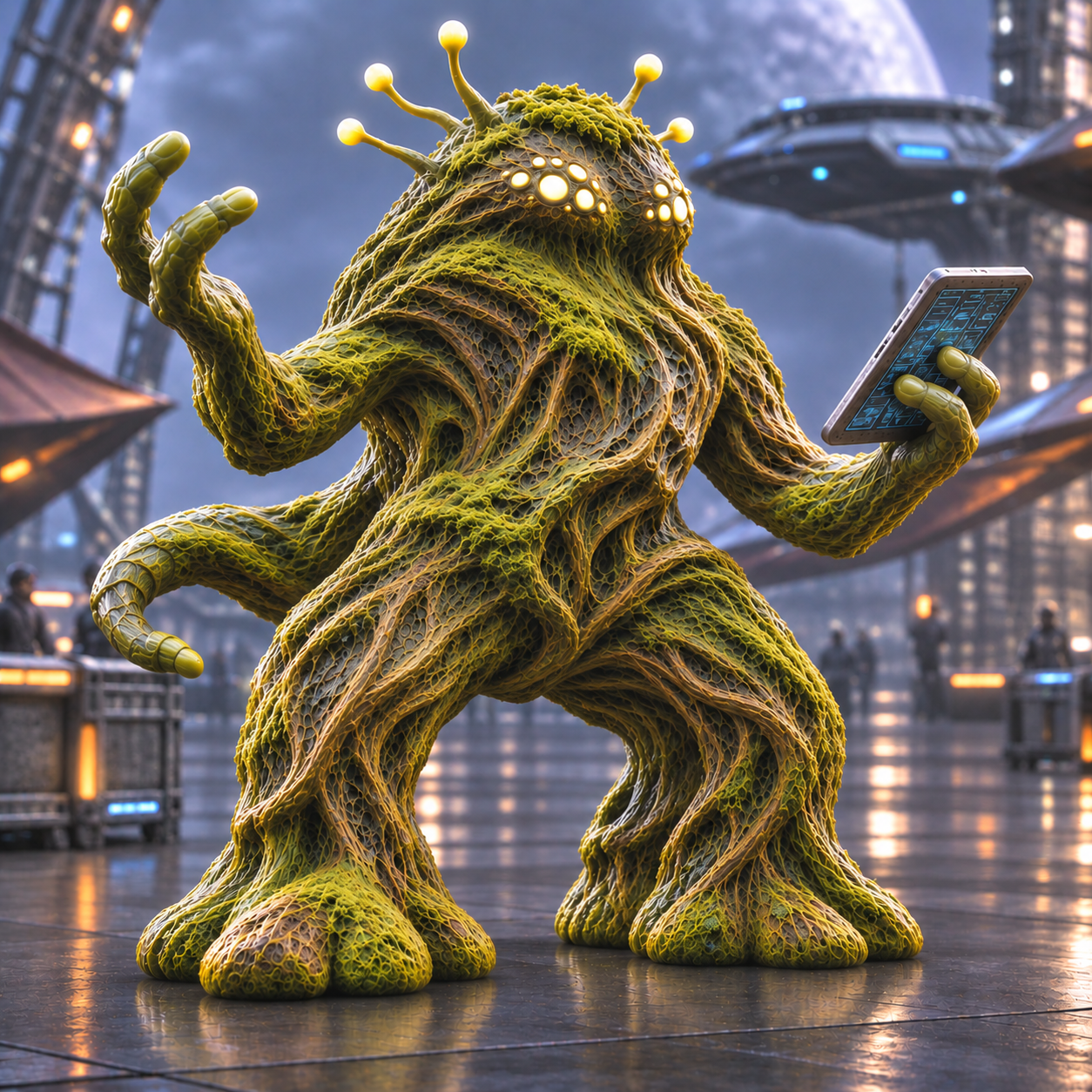
Drazods
The Patient Ones of the Fringe
The Drazods are an intelligent, plant-based species inhabiting the Fringe regions of the Shattered Expanse. Possessing dense, fibrous bodies covered in moss-like vegetation, the Drazods are renowned for their remarkable ability to alter their physical appearance, their extraordinary patience, and their unusual philosophical outlook. Although their movements are generally slow and deliberate, their considerable physical strength and ability to blend into natural environments make them far more capable than their seemingly passive nature might suggest.
Unlike most intelligent species, Drazods possess no fixed skeletal structure or permanent arrangement of limbs. Their bodies consist of interconnected botanical tissues capable of reorganizing themselves through a biological process known as morphogenesis. This allows them to extend and retract functional appendages, alter their external appearance, and imitate natural vegetation with remarkable accuracy.
Their most distinctive adaptation is Botanical Mimicry, the ability to disguise themselves as trees, shrubs, and other forms of vegetation. This evolutionary trait originally developed as a defense against predators but has since become an integral part of their civilization, influencing everything from their architecture and philosophy to their approach to exploration and interpersonal relationships.
Drazods are generally peaceful, thoughtful, and intellectually curious. Their communities place little importance upon material wealth, political power, or social status, preferring to measure individual achievement through wisdom, originality, and the ability to contribute meaningful ideas to philosophical discourse.
They are also notorious for their peculiar sense of humor, particularly their fondness for elaborate wordplay, logical contradictions, and jokes that other species frequently find incomprehensible.
Despite their apparent tranquility, Drazods are neither helpless nor timid. Their powerful fibrous musculature provides considerable strength, and their ability to remain concealed for extended periods makes them exceptionally effective observers, scouts, and occasional ambush predators.
Physical Characteristics
| Characteristic | Average |
|---|---|
| Height | 1.3 meters |
| Width | 1 meter |
| Mass | 65 kilograms |
| Lifespan | 250 years |
| Reproduction | Hermaphroditic, budding |
| Body Temperature | 30°C |
| Physiology | Botanical, fibrous, moss-like |
| Metabolism | Photosynthetic with supplemental nutrient absorption |
Physical Appearance and Biology
Drazods are compact, dense botanical organisms whose bodies resemble a combination of moss, algae, and interwoven plant fibers. Their outer surfaces are generally dry and textured rather than wet or gelatinous, with intricate networks of structural filaments forming a flexible but surprisingly resilient exterior.
Their coloration varies according to ancestry, environment, and nutritional conditions. Most display combinations of green, olive, brown, yellow, and gray, although individuals from unusual environments may possess reddish, violet, or pale blue pigmentation.
Their bodies contain no conventional bones. Instead, structural support is provided by dense networks of contractile botanical fibers reinforced by internal fluid-filled chambers. These structures allow Drazods to redistribute their tissues, alter their physical proportions, and generate considerable muscular force.
Although their average height is approximately 1.3 meters, this measurement represents their typical upright configuration rather than a fixed anatomical limitation. Individual Drazods may temporarily become taller, shorter, wider, or more compact through controlled morphogenesis.
Their most recognizable features are clusters of photosensitive organs distributed across the upper portions of their bodies. These organs frequently appear as small, softly luminous nodules embedded within their fibrous tissues.
Additional sensory structures may extend from their bodies as flexible stalks, allowing them to detect environmental changes and monitor their surroundings.
Drazods generally maintain two arms and two legs when interacting with humanoid civilizations, although this arrangement is primarily a matter of convenience. They can produce additional appendages or retract existing ones according to their immediate needs.
Despite their relatively small stature, Drazods are remarkably strong. Their dense structural fibers can exert considerable force, particularly when concentrated into a small number of powerful limbs.
However, their movements are generally slower than those of most humanoid species. Their bodies require time to redistribute internal fluids and coordinate the contraction of their complex fibrous structures.
Botanical Metabolism
Drazods obtain nourishment primarily through photosynthesis, converting solar radiation into usable metabolic energy through specialized tissues distributed throughout their bodies.
Unlike conventional plants, however, their intelligence, mobility, and ability to alter their physical configuration require substantial energy.
While adequate sunlight can sustain their basic metabolic needs, prolonged physical exertion, extensive morphogenesis, and recovery from serious injuries may require additional nutrients.
Drazods absorb water, dissolved minerals, and organic compounds through specialized feeding tissues. These nutrients supplement their photosynthetic metabolism and provide the raw materials necessary for cellular growth and regeneration.
Their bodies also exchange atmospheric gases through distributed respiratory surfaces, eliminating the need for conventional lungs.
Consequently, Drazods are particularly sensitive to environmental conditions that interfere with these processes.
Prolonged exposure to extremely dry environments can cause dehydration and cellular damage, while extended periods without suitable light or supplemental nutrition gradually deplete their energy reserves.
Most Drazods prefer environments with moderate humidity, reliable water sources, and regular access to sunlight.
Solar Nourishment
Under favorable conditions, a Drazod can satisfy most of its nutritional requirements through several hours of exposure to suitable sunlight.
During these periods, the organism may remain almost completely motionless, extending portions of its body to maximize the surface area exposed to incoming radiation.
A Drazod resting in direct sunlight may appear to be a natural growth of moss or vegetation, particularly when its limbs are retracted.
Although artificial illumination can support limited photosynthetic activity, conventional lighting generally lacks the intensity and spectral composition necessary to sustain a Drazod indefinitely.
Specialized solar chambers aboard starships can reproduce the conditions required for proper nourishment.
Solar Regeneration
One of the Drazods’ most remarkable biological abilities is their capacity to accelerate cellular regeneration through exposure to sunlight.
Their photosynthetic tissues do more than produce metabolic energy. They also stimulate specialized regenerative processes that repair damaged fibers, restore injured cellular structures, and replace lost botanical material.
Minor injuries may heal with surprising speed when the individual receives adequate sunlight, moisture, and nutrients.
More serious wounds require extended periods of recovery, during which the Drazod may remain largely motionless while concentrating its available energy upon cellular repair.
A severely injured Drazod will often instinctively seek a sheltered location with reliable sunlight and water.
Once there, it may adopt a compact botanical configuration, resembling a moss-covered stump or dense shrub while its tissues gradually regenerate.
This behavior can make wounded Drazods extraordinarily difficult to locate.
Solar regeneration does not make the species immortal. Although Drazods can recover from injuries that might permanently disable other organisms, their regenerative capabilities gradually decline with advanced age.
Their natural lifespan averages approximately 250 years.
Morphogenesis
Drazods possess an extraordinary ability to reorganize their bodies through a biological process known as morphogenesis.
Their tissues contain interconnected networks of contractile fibers and fluid-filled cellular chambers that can expand, compress, and rearrange themselves under conscious control.
This allows a Drazod to extend temporary limbs, retract unnecessary appendages, and modify its overall physical configuration.
A Drazod performing delicate technical work might produce several slender manipulators capable of handling small instruments.
Another might concentrate its available tissues into two powerful arms for lifting heavy objects or forcing open damaged machinery.
Additional appendages do not increase the organism’s total strength. Instead, they redistribute its existing structural fibers across a greater number of limbs.
Consequently, a Drazod with several manipulators may possess greater flexibility but less force in each individual appendage.
Morphogenesis is limited by the organism’s total body mass and available biological material.
Drazods cannot create additional mass, imitate complex machinery, or transform themselves into unrelated animal species.
Their abilities are expressions of botanical growth and structural adaptation rather than unrestricted shapeshifting.
Botanical Mimicry
The Drazods’ most distinctive adaptation is their ability to alter their external appearance to resemble natural vegetation.
Through controlled cellular growth, pigmentation changes, and the rearrangement of their fibrous tissues, a Drazod can imitate trees, shrubs, moss-covered stumps, and other botanical formations.
When assuming a botanical disguise, the Drazod retracts its limbs into its central body and redistributes its tissues to create an appropriate silhouette.
Its outer surface may develop bark-like ridges, dense mossy coverings, rootlike extensions, and branchlike structures.
These transformations can be remarkably convincing, particularly when the Drazod remains motionless.
A Drazod disguised as a small tree might extend its body vertically, forming a thick central trunk and spreading fibrous appendages into branchlike formations.
Another might flatten itself against a rocky surface, becoming nearly indistinguishable from a patch of moss or lichen.
The disguise is most effective when the organism adopts a form compatible with its surroundings.
A Drazod hiding in a dense forest can reproduce the general appearance of nearby vegetation, while one operating in an arid environment might imitate a hardy succulent or other appropriate plant.
However, Drazods cannot precisely duplicate every botanical species, nor can they create structures requiring substantially more biological material than their bodies contain.
Evolutionary Origins
Botanical Mimicry evolved as a defensive adaptation among the Drazods’ distant ancestors.
Their homeworld’s ancient ecosystems contained numerous predators capable of detecting movement, vibration, and chemical signatures.
Rather than developing exceptional speed or powerful defensive weapons, ancestral Drazods survived by becoming nearly indistinguishable from the surrounding vegetation.
Individuals capable of maintaining convincing disguises for extended periods were more likely to survive and reproduce.
Over generations, this ability became increasingly sophisticated.
Eventually, the emergence of intelligence allowed Drazods to consciously control their transformations, selecting configurations appropriate to particular environments and circumstances.
Modern Drazods retain an instinctive tendency to become motionless and adopt protective botanical forms when confronted with danger.
Camouflage and Concealment
Botanical Mimicry is particularly effective because Drazods can continue perceiving their surroundings while transformed.
Their sensory organs remain functional even when concealed beneath layers of fibrous tissue.
A Drazod disguised as a tree can monitor nearby movement, detect chemical changes in the atmosphere, and recognize vibrations transmitted through the ground.
This makes them exceptionally effective observers.
Some Drazod explorers have reportedly remained concealed for days while studying unfamiliar wildlife or monitoring potentially dangerous situations.
Their camouflage is less effective when they are moving or when their surroundings lack suitable natural features.
Nevertheless, a patient Drazod can remain hidden in environments where most other species would require sophisticated technological camouflage.
Senses and Perception
Drazods possess a distributed sensory system fundamentally different from that of most intelligent species.
Rather than relying upon conventional eyes, ears, and noses, their bodies contain numerous sensory receptors embedded throughout their outer tissues.
Clusters of photosensitive cells detect light, movement, and changes in illumination.
Although Drazods do not perceive their surroundings in precisely the same manner as humanoid species, their distributed visual receptors provide a broad awareness of nearby activity.
Their perception emphasizes shapes, contrast, and movement rather than detailed color recognition.
Chemical receptors distributed across their surfaces provide an exceptionally sensitive sense of smell.
A Drazod can frequently recognize familiar individuals through distinctive chemical signatures, even when those individuals are concealed from view.
Their bodies are also highly sensitive to vibration and physical contact.
Specialized sensory fibers detect movement through the ground and surrounding structures, allowing Drazods to recognize approaching creatures or machinery.
These sensory systems remain functional regardless of the organism’s current physical configuration.
Emotional Perception
Drazods are particularly sensitive to chemical changes associated with emotional and physiological responses.
They can sometimes recognize subtle variations in an individual’s scent caused by fear, stress, excitement, or anxiety.
Experienced Drazods learn to interpret these signals alongside speech, posture, and other behavioral cues.
This ability can make them unusually perceptive during negotiations and social interactions.
However, it does not provide infallible lie detection.
An individual who is frightened while telling the truth may produce similar chemical responses to someone deliberately attempting deception.
Drazods generally recognize these limitations, although other species occasionally attribute almost supernatural perceptive abilities to them.
Communication and Language
Drazod communication combines sound, chemical signals, physical contact, and changes in body configuration.
Their vocal structures consist of specialized vibrating membranes and resonant chambers that can be formed within their bodies.
By adjusting the size and shape of these chambers, Drazods can produce an extraordinary range of sounds, from deep resonant tones to high-pitched vibrations.
Their voices may change considerably depending upon their current physical configuration.
Among themselves, Drazods also communicate through subtle chemical emissions and changes in the arrangement of their external tissues.
A slight shift in surface texture or pigmentation may convey emotional information that other species would express through facial expressions.
The positioning of appendages and the degree to which an individual expands or contracts its body can also communicate social intentions.
Drazods interacting with other civilizations generally rely upon spoken language, although their unusual vocal structures sometimes produce distinctive accents and resonances.
Reproduction and Development
Drazods are hermaphroditic organisms that reproduce through a specialized process of budding.
Mature individuals possess the biological structures necessary to exchange genetic material with compatible partners.
Following successful genetic exchange, either individual may develop an offspring.
The developing Drazod begins as a small bud emerging from the parent’s body.
Initially, the bud remains connected to the parent’s nutrient-conducting tissues, receiving nourishment and essential cellular materials while its own biological structures develop.
Over time, the offspring grows into a compact organism possessing increasingly sophisticated sensory networks, structural fibers, and photosynthetic tissues.
Eventually, the young Drazod separates from its parent and begins functioning independently.
This developmental process may take several years.
Young Drazods possess limited morphogenetic abilities. Their tissues gradually develop the structural complexity necessary to produce additional appendages and assume convincing botanical disguises.
The ability to perform sophisticated Botanical Mimicry generally emerges during adolescence and improves through experience.
Drazod communities frequently participate collectively in raising offspring, placing considerable importance upon intellectual development, curiosity, and the cultivation of independent thought.
Society and Philosophy
Drazod civilization places extraordinary importance upon intellectual achievement, philosophical inquiry, and the pursuit of understanding.
Material wealth and political authority are generally regarded as practical necessities rather than measures of personal success.
A Drazod’s reputation is more likely to depend upon the originality of their ideas, the clarity of their reasoning, and their willingness to reconsider established assumptions.
Their communities are frequently small and loosely organized, with individuals maintaining considerable personal independence.
Many Drazods prefer solitude, particularly during extended periods of contemplation or artistic creation.
However, they also possess a strong tradition of public philosophical gatherings.
These assemblies may last for days or weeks as participants examine competing interpretations of scientific, ethical, or metaphysical questions.
Disagreements are generally regarded as opportunities for intellectual advancement rather than personal conflicts.
The Philosophy of Adaptation
The Drazods’ extraordinary ability to alter their physical appearance has profoundly influenced their philosophical traditions.
To them, adaptation represents more than a biological survival mechanism. It is a fundamental principle of existence.
Many Drazod philosophers argue that understanding the universe requires recognizing the relationships between living things and their environments.
An organism that cannot adapt to changing circumstances will eventually perish, regardless of its strength or intelligence.
This principle extends beyond physical survival.
Drazods frequently apply the concept of adaptation to intellectual and social relationships, arguing that wisdom requires the willingness to reconsider established beliefs.
A rigid philosophy that cannot accommodate new information is considered fundamentally flawed.
One traditional Drazod teaching expresses this principle:
“The tree that refuses to bend will eventually break.”
However, Drazod philosophers are equally careful to distinguish adaptation from surrender.
Changing one’s position in response to new understanding is regarded as wisdom. Abandoning one’s principles merely to avoid difficulty is not.
These distinctions provide endless opportunities for philosophical debate.
The Drazod Sense of Humor
Despite their thoughtful and deliberate nature, Drazods possess an extraordinarily peculiar sense of humor.
Their comedy frequently involves wordplay, logical contradictions, unexpected interpretations of familiar concepts, and elaborate practical jokes involving Botanical Mimicry.
Drazods particularly enjoy humor that challenges assumptions or exposes inconsistencies in conventional reasoning.
A joke may involve an apparently serious philosophical argument that gradually becomes increasingly absurd before reaching an unexpected conclusion.
Others employ physical transformations as part of the performance.
A Drazod might remain disguised as a tree throughout an extended conversation, only to reveal itself at the precise moment when its appearance becomes relevant to a particularly elaborate pun.
Their humor can be difficult for other species to appreciate.
Drazods frequently find jokes amusing long after their companions have grown tired of hearing them.
They also enjoy collecting unfamiliar jokes from other civilizations, particularly those involving puns or unexpected double meanings.
Their enthusiasm for humor has made them popular among certain entertainers, although audiences unfamiliar with Drazod sensibilities may find their reactions baffling.
Recreation and Communal Life
Drazod recreational activities reflect their botanical physiology and philosophical interests.
One of their most popular forms of relaxation involves immersion in warm, mineral-rich water containing carefully prepared aromatic compounds.
These communal bathing environments provide hydration, nourishment, and opportunities for social interaction.
Certain botanical extracts produce mild euphoric or intoxicating effects when absorbed through Drazod tissues.
Such substances are frequently incorporated into ceremonial gatherings, artistic performances, and philosophical discussions.
Their communities also maintain elaborate gardens containing plants selected for their chemical properties, structural patterns, and aesthetic qualities.
Because Drazods perceive the world through chemical and tactile sensations as well as visual information, their gardens are designed to provide complex multisensory experiences.
A particularly celebrated garden might feature carefully arranged vegetation, aromatic growths, flowing water, and carefully cultivated habitats intended to encourage contemplation.
Architecture and Technology
Drazod settlements are frequently designed to resemble natural botanical environments.
Their cities incorporate extensive gardens, living structures, interconnected root systems, and carefully cultivated vegetation.
Buildings are often constructed around existing trees and geological formations rather than replacing them.
Open plazas and transparent structures provide access to sunlight, while carefully controlled irrigation systems maintain the humidity necessary for healthy Drazod physiology.
To an unfamiliar visitor, a Drazod settlement may resemble an enormous botanical preserve rather than a conventional city.
The distinction between architecture and living vegetation is frequently difficult to recognize.
Some structures incorporate genetically engineered plants that grow into predetermined configurations, producing naturally formed walls, platforms, and enclosed spaces.
Because Drazods can disguise themselves as vegetation, visitors may occasionally mistake resting citizens for decorative plants.
Their furniture is similarly unconventional.
Rather than employing conventional chairs and beds, Drazod structures frequently contain platforms, recessed chambers, and specialized surfaces designed to accommodate a variety of physical configurations.
Their technology emphasizes adaptability, modular construction, and environmental compatibility.
Equipment intended for Drazod use generally incorporates flexible interfaces and controls accessible to temporary appendages.
Solar Chambers
Starships and space stations designed for Drazod occupants frequently contain specialized solar chambers.
These facilities reproduce the spectral composition and intensity of natural sunlight, allowing Drazods to nourish themselves and recover from injuries while traveling through space.
Solar chambers may also provide carefully controlled humidity, atmospheric composition, and nutrient delivery.
In medical facilities, these environments serve as specialized recovery chambers where injured Drazods can concentrate their metabolic resources upon cellular regeneration.
Such facilities are particularly important during extended interstellar voyages, when access to natural sunlight may be limited.
Relations with Other Civilizations
Drazods are generally regarded as peaceful, thoughtful, and somewhat eccentric inhabitants of the Fringe.
Their philosophical traditions encourage curiosity about unfamiliar cultures, making them enthusiastic participants in diplomatic exchanges and scientific expeditions.
However, their deliberate approach to decision-making can frustrate species accustomed to rapid action.
The Zukri provide a particularly interesting cultural contrast.
Both civilizations appreciate intellectual sophistication, but their priorities differ considerably.
Zukri society emphasizes commercial relationships, institutional continuity, and the accumulation of valuable information.
Drazods generally regard material wealth as secondary to intellectual understanding.
Drazods may admire the intricate structures of Zukri society while questioning the importance placed upon financial obligations.
The Zukri, in turn, may appreciate Drazod analytical abilities while finding their prolonged philosophical discussions commercially impractical.
The Gazagorans represent another contrast.
Their emphasis upon rapid movement, martial discipline, and decisive action differs sharply from the Drazods’ preference for contemplation.
Nevertheless, individual members of the two species may develop strong friendships based upon mutual respect and complementary abilities.
Drazods are also frequently encountered aboard independent exploration vessels, where their unusual physiology and analytical perspectives can prove exceptionally valuable.
Drazods as Adventurers
Although Drazod society generally favors contemplation over conflict, individuals occasionally leave their communities to explore the wider Expanse.
Some seek answers to philosophical questions that cannot be resolved through discussion alone.
Others pursue scientific discoveries, artistic inspiration, or firsthand experience with unfamiliar civilizations.
A few simply become dissatisfied with the slow pace of traditional Drazod society.
Their unusual physical capabilities make them surprisingly versatile adventurers.
A Drazod can produce additional manipulators to perform complicated tasks, assume compact configurations to navigate confined environments, or employ its considerable strength when physical force becomes necessary.
Their Botanical Mimicry makes them particularly effective scouts and observers in natural environments.
A Drazod exploring an unfamiliar world may remain disguised as local vegetation while studying dangerous wildlife or monitoring hostile settlements.
Their ability to absorb sunlight and regenerate damaged tissues also provides considerable advantages during prolonged expeditions.
However, their relatively slow movement and dependence upon suitable environmental conditions can create challenges.
Drazods frequently approach dangerous situations with a combination of careful analysis and unconventional problem-solving.
They may spend considerable time discussing the ethical implications of a particular course of action before eventually adopting a solution that other species would never have considered.
Their companions sometimes find this behavior frustrating, particularly when immediate action appears necessary.
Nevertheless, Drazods can be remarkably loyal associates whose patience, intellectual curiosity, and unusual abilities provide valuable advantages during difficult expeditions.
The following ancestry traits represent the Drazods’ unusual botanical physiology, natural shapeshifting abilities, and dependence upon sunlight. These proposed rules are intended for use with SWADE and the Science Fiction Companion and should be reviewed against the final Shattered Expanse ancestry creation guidelines.
Botanical Physiology (0)
Drazods are intelligent botanical organisms rather than conventional animals. They breathe through specialized tissues distributed across their bodies and absorb water and dissolved nutrients through their outer surfaces.
They require suitable atmospheric conditions and moisture to survive but otherwise follow normal rules for environmental hazards unless specified by another ancestry ability.
Botanical Mimicry (+2)
A Drazod can alter its physical appearance to resemble vegetation appropriate to its surroundings, including shrubs, small trees, moss-covered stumps, and similar natural formations.
Transforming requires an action.
While motionless and maintaining a suitable disguise, the Drazod gains +2 to Stealth rolls in environments containing appropriate vegetation.
In particularly dense vegetation, the Game Master may increase this bonus to +4 when circumstances strongly favor the disguise.
The transformation cannot imitate animals, intelligent species, manufactured objects, or vegetation substantially larger than the Drazod’s available body mass.
Morphogenesis (+2)
A Drazod can extend and retract functional appendages through conscious control of its cellular structures.
The Drazod may form up to four functional manipulators, allowing it to hold and operate multiple objects.
Additional manipulators do not grant extra actions or attacks, and normal Multi-Action penalties still apply.
The Drazod may redistribute its tissues to form larger, more powerful appendages, although doing so does not increase its Strength beyond its normal limits.
Solar Nourishment (+1)
A Drazod exposed to at least four hours of adequate sunlight per day does not require conventional food.
It must still obtain sufficient water and essential minerals.
Specialized artificial lighting capable of reproducing suitable solar radiation can satisfy this requirement.
Without adequate sunlight or supplemental nutrients, the Drazod suffers the normal effects of starvation.
Solar Regeneration (+3)
While exposed to sufficient direct sunlight, a Drazod may attempt a natural healing roll once every 12 hours rather than once every five days.
These rolls follow the normal rules for natural healing, including applicable modifiers.
Solar Regeneration does not function while the Drazod is deprived of suitable light.
This is an unusually powerful ancestry benefit and may require adjustment during final racial balancing.
Dense Structural Fibers (+2)
Drazods begin play with a d6 Strength instead of a d4.
Their dense networks of contractile botanical fibers provide considerable physical power despite their relatively small stature.
The normal racial maximum for Strength remains unchanged.
Chemical Sensitivity (+1)
Drazods possess exceptionally sensitive chemical receptors distributed throughout their bodies.
They gain +2 to Notice rolls involving odors, airborne chemical signatures, or similar detectable substances.
This ability may also help recognize physiological signs of fear, stress, or anxiety, although it does not automatically determine whether another character is lying.
Deliberate Movement (−2)
Drazods move more slowly than most humanoid species.
Their base Pace is 4 instead of 6, and their running die is reduced to d4.
Environmental Dependency (−2)
Drazods require regular access to moisture and suitable environmental conditions.
Prolonged exposure to extremely dry environments can damage their tissues and interfere with normal metabolic functions.
The Game Master may require Vigor rolls to resist Fatigue during extended exposure to severe dehydration or unusually arid conditions.
Protective environmental equipment can prevent these effects.
Ancestry Summary
| Trait | Value |
|---|---|
| Botanical Physiology | 0 |
| Botanical Mimicry | +2 |
| Morphogenesis | +2 |
| Solar Nourishment | +1 |
| Solar Regeneration | +3 |
| Dense Structural Fibers | +2 |
| Chemical Sensitivity | +1 |
| Deliberate Movement | −2 |
| Environmental Dependency | −2 |
| Total | +7 |
Design Note: This is a preliminary ancestry package rather than a finalized balanced SWADE build. Its +7 net value is substantially above the usual +2 racial ability budget. Solar Regeneration and Morphogenesis, in particular, would need adjustment or compensating drawbacks before the ancestry is approved for standard character creation.
The Drazods offer an unusual combination of physical strength, adaptability, natural camouflage, and accelerated healing. Their deliberate movement and environmental requirements provide meaningful limitations, while their philosophical outlook and peculiar humor offer considerable roleplaying opportunities.
The Drazods are living proof that survival does not always favor the fastest or the strongest. Sometimes, the greatest advantage belongs to those who understand when to change, when to wait, and when to become part of the world around them.
Rebalance my ancestry traitsStrengthen my Drazod cultural identityReduce my repeated biology sections