

Yothax
The Free Spirits of the Open Land
The Yothax are a hardy, spacefaring marsupial species native to the remote frontier regions of the Shattered Expanse. Recognized by their long ears, powerful hind legs, muscular tails, and distinctly humanoid upper bodies, the Yothax are renowned for their extraordinary jumping abilities, rugged independence, and remarkable capacity to survive in hostile environments.
Their civilization developed upon an arid world of immense deserts, rocky escarpments, scattered grasslands, and isolated settlements separated by vast stretches of unforgiving wilderness. These conditions produced a people who value self-reliance, practical knowledge, personal freedom, and the ability to endure hardship without surrendering their sense of humor.
Although Yothax are often characterized as stubborn, irreverent, and occasionally reckless, they possess a deeply rooted tradition of hospitality and mutual responsibility. Their communities may be fiercely independent, but few Yothax would willingly abandon a traveler stranded in the wilderness.
They are also formidable fighters. Their extraordinary jumping abilities allow them to cross difficult terrain, rapidly close distances, and launch devastating attacks from unexpected directions. However, unlike some warrior civilizations, the Yothax do not regard violence as an achievement in itself. Fighting is a practical necessity, undertaken to defend one’s home, protect companions, or settle conflicts that cannot be resolved through other means.
To the Yothax, respect is earned through actions rather than inherited through ancestry or bestowed by authority. An individual who survives adversity, honors their commitments, and proves dependable when circumstances become desperate is worthy of admiration, regardless of wealth, profession, or social standing.
This philosophy has made the Yothax particularly well suited to life along the Fringe, where independent explorers, prospectors, mercenaries, and Riftrunners frequently encounter them.
Physical Appearance and Biology
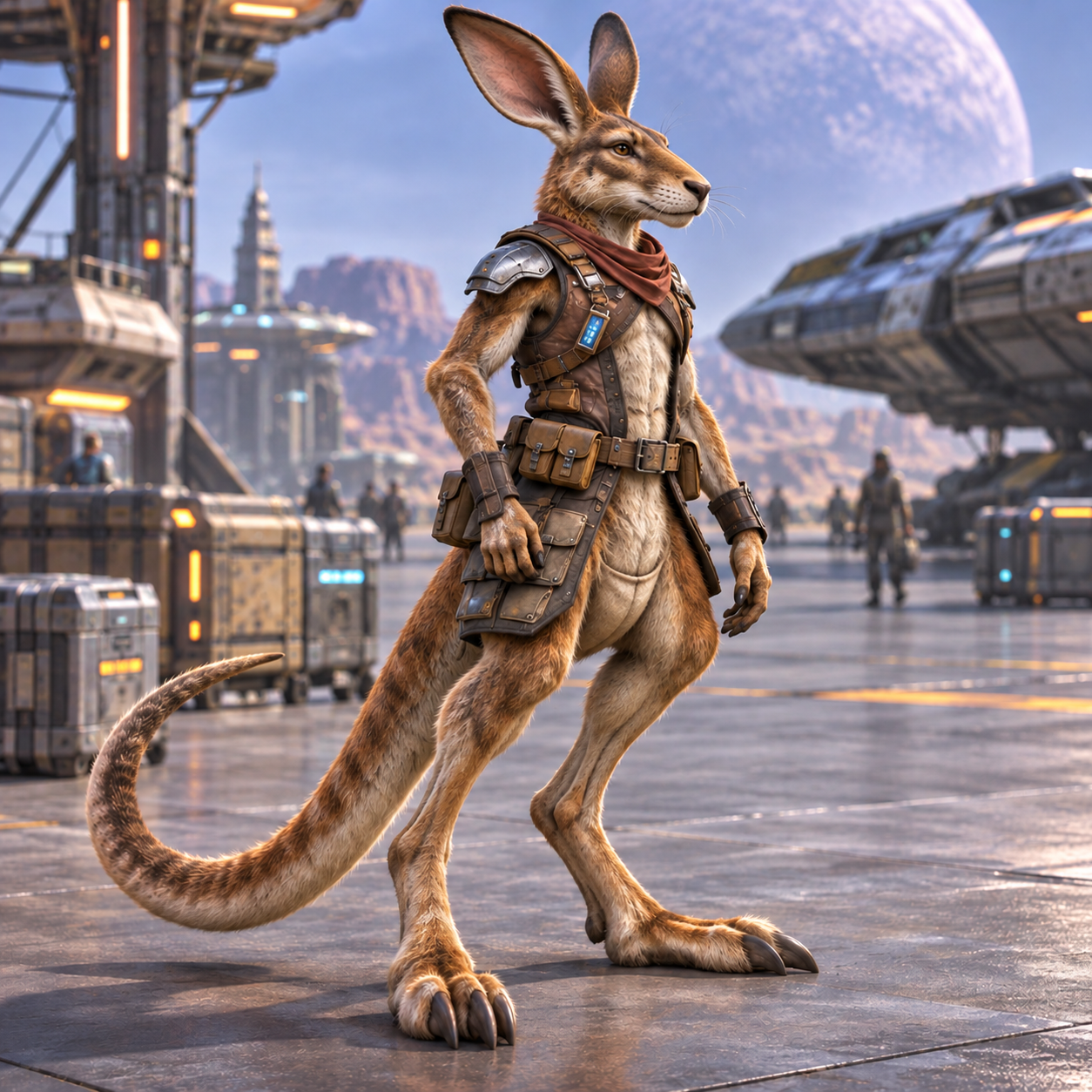
Yothax are tall, athletic mammalian humanoids whose appearance combines characteristics reminiscent of ancient Terran jackrabbits and kangaroos. Their bodies possess relatively broad shoulders, muscular torsos, long arms, and powerful digitigrade hind legs adapted for extraordinary jumping performance.
Most adult Yothax stand approximately 1.8 to 2.1 meters tall when fully upright, although their natural posture is slightly forward-leaning. Their weight varies considerably depending upon build and physical conditioning, generally ranging from 75 to 110 kilograms.
Their heads are elongated and distinctly marsupial, featuring pronounced muzzles, expressive eyes, powerful jaws, and exceptionally long ears. Their facial structures are somewhat more angular than those of Terran rabbits, giving them a rugged appearance.
Their bodies are covered in short, dense fur, typically displaying combinations of sandy brown, reddish tan, dusty gray, and cream. Darker markings frequently appear around the eyes, ears, shoulders, and extremities. These natural colors provide effective camouflage within the arid landscapes of their homeworld.
Their arms are proportionally similar to those of humans, with well-developed shoulders and dexterous hands capable of operating sophisticated machinery, weapons, and other equipment. Unlike their distant evolutionary ancestors, modern Yothax possess considerable upper-body strength and can perform most tasks associated with conventional humanoid anatomy.
Their hind legs are their most remarkable anatomical feature. Exceptionally powerful thigh muscles, reinforced skeletal structures, and elongated tendons allow them to store and release tremendous amounts of elastic energy.
Their large feet possess thick, resilient pads and strong claws that provide traction across rocky or unstable terrain.
Extending from the base of the spine is a long, muscular tail that serves as a counterbalance during movement. Although primarily adapted for stability, the tail is sufficiently flexible and powerful to grasp large objects, brace against surfaces, and deliver forceful blows.
Yothax are warm-blooded mammals with a marsupial reproductive system. Females possess a protective abdominal pouch in which their young complete the earliest stages of development.
Their average lifespan is approximately 110 to 130 years, although individuals living under favorable conditions may survive considerably longer.
Senses and Environmental Adaptations
The Yothax evolved in an environment where detecting distant threats and conserving precious resources were essential to survival.
Their large, mobile ears provide exceptionally sensitive directional hearing. A Yothax can independently orient each ear toward different sound sources, allowing them to monitor their surroundings with remarkable precision.
This sensitivity is particularly useful in open environments where sound travels considerable distances. Experienced Yothax trackers can recognize subtle disturbances in the wilderness, including approaching animals, shifting rocks, and the movement of distant vehicles.
Their ears also serve an important thermoregulatory function. Extensive networks of blood vessels allow excess body heat to dissipate efficiently, helping the Yothax remain active in hot environments.
Their eyesight is comparable to that of most humanoid species, although their visual perception is particularly effective at recognizing movement across open terrain.
Their sense of smell is moderately developed, assisting with the identification of food, water, and environmental hazards.
Water Conservation
Yothax possess highly efficient biological mechanisms for conserving water. Their kidneys can produce exceptionally concentrated waste, while their digestive systems recover considerable moisture from consumed food. They also tolerate temporary dehydration better than many humanoid species, although they are not immune to its effects.
These adaptations allow Yothax to travel considerable distances between reliable water sources. However, their survival depends upon experience and preparation rather than biological resilience alone. Yothax travelers are taught from childhood to recognize environmental warning signs, locate hidden water reserves, and avoid unnecessary exertion during extreme heat.
Reproduction and Development
Yothax reproduce sexually and possess conventional male and female reproductive sexes. Females give birth to relatively undeveloped offspring following a comparatively short gestation period. The newborn instinctively moves into the mother’s protective abdominal pouch, where it continues developing while receiving nourishment.
Young Yothax remain dependent upon the pouch during their earliest developmental stages, gradually emerging as their muscles, sensory organs, and coordination improve. Their powerful hind legs develop progressively throughout childhood. Youngsters begin practicing controlled jumping at an early age, initially making short, awkward hops before developing the balance and strength required for more ambitious leaps.
Jumping competitions are common among Yothax children, serving as both recreation and physical training. Although family structures vary considerably between communities, Yothax parents generally place great importance upon teaching their offspring practical survival skills. Children are encouraged to develop independence while remaining mindful of their responsibilities to others.
A traditional Yothax upbringing frequently includes wilderness navigation, equipment maintenance, basic first aid, and the ability to recognize environmental dangers. By adulthood, most Yothax possess at least a working familiarity with the skills necessary to survive outside established settlements.
Springing and Movement
The Yothax’s extraordinary jumping ability is one of their defining biological characteristics. Their hind legs contain powerful muscle groups and specialized tendons capable of storing considerable elastic energy during movement. When released, this energy propels the Yothax forward or upward with remarkable force.
Unlike most humanoid species, which rely primarily upon running for rapid terrestrial movement, Yothax can employ a distinctive bounding gait that allows them to cover substantial distances across suitable terrain. Their muscular tails provide balance during these movements, allowing them to adjust their orientation and stabilize themselves upon landing.
The Great Leap
A healthy adult Yothax can perform impressive standing jumps without requiring a running start. Their jumping ability is particularly useful when navigating rocky landscapes, crossing ravines, or moving between elevated surfaces.
Experienced Yothax can judge distances and landing conditions with extraordinary accuracy, allowing them to traverse terrain that would require climbing equipment or specialized vehicles for many other species. However, jumping is not without limitations.
Repeated maximum-distance leaps are physically demanding, and unstable landing surfaces can create considerable danger. The Yothax’s natural ability is also affected by gravity. Lower-gravity environments permit considerably greater jumping distances, while high-gravity worlds place additional stress upon their muscles and skeletal structures.
The Bounding Charge
Yothax warriors developed a distinctive combat technique known as the Bounding Charge. This maneuver employs a powerful leap to rapidly close the distance between combatants, allowing the Yothax to strike with the momentum generated by its movement.
A skilled fighter may use this technique to cross obstacles, bypass defensive positions, or attack an opponent from an unexpected direction. Bounding Charges are particularly effective in broken terrain, where conventional movement may be restricted.
However, experienced Yothax fighters recognize the dangers of committing to a poorly judged leap. An opponent who anticipates the attack may exploit the moment when the Yothax lands. Consequently, the technique emphasizes timing, positioning, and surprise rather than reckless aggression.
The Prehensile Tail
The Yothax tail is a powerful and versatile appendage that plays an essential role in their physical coordination. Its primary function is balance. During rapid movement, jumping, and sudden changes in direction, the tail acts as a counterweight, allowing the Yothax to maintain stability and control.
However, the tail also contains specialized musculature that permits limited grasping and manipulation. A Yothax may use its tail to brace against a surface, secure a large object, or maintain its position while climbing.
The tail is strong enough to support a considerable portion of the individual’s weight for short periods, although prolonged suspension can cause fatigue. In combat, a Yothax may deliver a forceful tail strike or use the appendage to disrupt an opponent’s balance. Unlike a fully functional hand, the tail lacks the fine motor control necessary to operate sophisticated machinery or manipulate small objects. Its effectiveness lies in strength, balance, and leverage rather than dexterity.
The Yothax Homeworld
The Yothax homeworld is a predominantly arid planet characterized by enormous deserts, rugged mountain ranges, rocky escarpments, seasonal grasslands, and scattered regions of more abundant vegetation. Much of the planet experiences prolonged dry seasons interrupted by unpredictable periods of intense rainfall. These environmental conditions have shaped nearly every aspect of Yothax civilization.
Permanent settlements developed around reliable water sources, fertile valleys, and locations where valuable mineral deposits could be exploited. Between these population centers lie vast regions of sparsely inhabited wilderness. Historically, travel across these territories required extensive preparation, careful navigation, and detailed knowledge of local environmental conditions.
Even with modern transportation technology, the planet’s remote interior remains dangerous. Sudden storms, extreme temperature fluctuations, unstable terrain, and long distances between settlements continue to claim the lives of inexperienced travelers. The Yothax regard their homeworld with considerable affection, despite its harshness.
Its wilderness is not merely an obstacle to civilization but an essential part of their cultural identity. Many Yothax believe that a person who has never experienced the open country cannot fully appreciate the meaning of independence.
Society and Culture
Yothax society developed from scattered communities whose survival depended upon resourcefulness, cooperation, and the ability to adapt to unpredictable circumstances. Rather than establishing a rigid hereditary monarchy, their civilization gradually evolved into a collection of independent settlements, regional governments, and loosely associated territories. Local authority is generally practical rather than ceremonial.
Community leaders are expected to demonstrate competence, fairness, and the ability to make difficult decisions under pressure. An individual who possesses an impressive title but lacks practical experience may receive little respect from ordinary Yothax. Conversely, an experienced mechanic, wilderness guide, or settlement defender may possess considerable influence despite holding no formal political office.
Individualism and Independence
Personal independence is among the most important values in Yothax society. Individuals are expected to take responsibility for their decisions, develop useful skills, and avoid unnecessary dependence upon others. However, this emphasis upon self-reliance does not imply a rejection of cooperation.
Yothax recognize that even the most capable individual may eventually encounter circumstances beyond their ability to manage alone. Their communities therefore maintain strong traditions of mutual assistance, particularly during environmental disasters and other emergencies.
A Yothax may resent being ordered to help someone but willingly volunteer for a dangerous rescue mission. This distinction between voluntary responsibility and imposed obligation is central to their cultural outlook.
The Code of the Open Land
Although Yothax communities possess different laws and traditions, most recognize an informal code of conduct known as the Code of the Open Land. This code originated among the early travelers and frontier settlements of their homeworld. Its principles emphasize hospitality, personal responsibility, and the obligations shared by those who inhabit dangerous environments.
Water Is Shared
Water is regarded as a fundamental necessity that should not be denied to someone facing genuine danger. Refusing essential water to a stranded traveler is considered a serious violation of Yothax tradition.
A Promise Is a Bond
An individual’s word carries considerable importance. Promises made under difficult circumstances are expected to be honored, particularly when the safety or survival of others depends upon them.
Every Traveler Deserves a Chance
Travelers seeking temporary shelter are generally offered basic hospitality. This does not require unquestioning trust, but it establishes an expectation that strangers should not be abandoned merely because they are unfamiliar.
Respect Must Be Earned
Wealth, ancestry, and political titles do not automatically command admiration. Respect is earned through competence, reliability, courage, and personal conduct.
No One Survives Alone Forever
Even the most independent wanderer must occasionally depend upon others. Recognizing when assistance is necessary is considered a sign of wisdom rather than weakness. Although not every Yothax follows these principles consistently, the Code remains an influential part of their cultural identity.
The Frontier Spirit
Yothax civilization retains a strong frontier tradition even in its most technologically advanced settlements. Their communities frequently emphasize practical engineering, mechanical repair, wilderness exploration, and resource management. Many Yothax take considerable pride in maintaining their own vehicles, tools, and equipment.
Improvisation is widely admired, particularly when it produces a reliable solution under difficult circumstances. A Yothax mechanic who repairs a damaged transport using improvised components may earn greater admiration than an engineer who simply replaces the entire system. This practical approach extends into their technological culture.
Yothax vehicles and equipment are generally designed for durability, ease of maintenance, and operation in harsh environments. Although they possess sophisticated scientific institutions and advanced manufacturing capabilities, their technological traditions favor reliability over unnecessary complexity.
The Wanderers
A significant portion of Yothax culture revolves around individuals known as Wanderers. These travelers spend considerable portions of their lives moving between settlements, exploring remote territories, transporting goods, or pursuing personal ambitions. Some operate as independent merchants or prospectors. Others serve as wilderness guides, couriers, surveyors, or explorers.
Wanderers occupy an important place in Yothax folklore, where they are frequently portrayed as resourceful individuals who overcome extraordinary challenges through ingenuity and determination. However, the romantic image of the Wanderer differs considerably from the reality. Life beyond established settlements is often dangerous, lonely, and physically demanding. Experienced Wanderers generally possess little patience for inexperienced adventurers who underestimate these difficulties.
Warriors of the Open Country
Yothax military traditions developed primarily from the need to defend isolated settlements, protect vital resources, and respond rapidly to threats across difficult terrain. Their warriors emphasize mobility, situational awareness, and the effective use of natural cover. Rather than relying exclusively upon heavily fortified positions, Yothax frontier militias frequently employ mobile patrols and small units capable of operating independently.
Their extraordinary jumping abilities provide considerable tactical advantages. A Yothax combatant can cross obstacles, reach elevated positions, and rapidly reposition during engagements. Their powerful tails also assist with balance and close-quarters fighting.
Yothax soldiers generally favor durable firearms, compact carbines, survival knives, and equipment suitable for extended operations in harsh environments. Their martial traditions place considerable emphasis upon marksmanship, fieldcraft, and the ability to operate without immediate logistical support.
Courage and Recklessness
Yothax culture admires courage but generally distinguishes it from unnecessary recklessness. An individual who risks their life to protect others may be celebrated as a hero. Someone who deliberately endangers companions merely to demonstrate bravery is more likely to be regarded as a fool.
Nevertheless, younger Yothax occasionally confuse daring with competence. Their natural athleticism and cultural admiration for independence can encourage risky behavior, particularly among those eager to establish their reputations. Experienced Yothax warriors often regard patience and preparation as the most important lessons a young fighter can learn.
Personality and Humor
Yothax are generally straightforward, practical, and informal in their interactions. They tend to distrust excessive ceremony, elaborate political maneuvering, and individuals who rely upon authority rather than competence. Their speech is frequently direct, occasionally blunt, and often accompanied by dry humor.
Yothax enjoy storytelling, particularly tales involving dangerous journeys, improbable escapes, mechanical disasters, and encounters with unusual creatures. Exaggeration is a recognized element of their storytelling traditions, although the best storytellers maintain just enough plausibility to keep their audiences uncertain. Their humor is often sarcastic and self-deprecating.
A Yothax who narrowly survives a catastrophic vehicle accident might describe the experience as an inconvenient mechanical problem. Another who encounters a particularly dangerous predator might remark that the creature seemed somewhat unfriendly. This tendency to understate serious situations can be confusing to outsiders. However, among the Yothax, humor serves an important social function.
It helps individuals cope with adversity, acknowledge shared hardships, and maintain perspective when circumstances become difficult.
Government and Political Organization
Modern Yothax civilization consists of numerous regional governments, independent settlements, and loosely associated political territories. Although some population centers possess sophisticated administrative institutions, the species generally resists excessive centralization of political authority. Local autonomy remains a powerful cultural expectation.
Regional councils frequently coordinate infrastructure development, environmental management, interstellar commerce, and collective defense. However, these institutions are expected to justify their authority through practical results. Political leaders who become overly authoritarian or disconnected from the needs of ordinary communities may encounter substantial resistance.
Yothax political disagreements can be loud, confrontational, and occasionally chaotic. Nevertheless, their governmental traditions generally emphasize negotiation and compromise rather than permanent political divisions. Their historical experience has taught them that communities facing environmental hardship cannot afford endless internal conflict.
Technology and Space Travel
Yothax technological development reflects their longstanding emphasis upon exploration, mechanical reliability, and survival in hostile environments. Their spacecraft are frequently designed for durability and ease of maintenance, particularly those intended for operation along the Fringe.
Independent Yothax captains often favor vessels capable of landing on poorly developed worlds, carrying substantial supplies, and functioning without extensive support infrastructure. Their engineering traditions emphasize modular components and systems that can be repaired using commonly available materials. Yothax explorers and prospectors are frequently encountered aboard small independent vessels operating beyond established commercial routes.
Their natural jumping abilities are less useful in microgravity, but their powerful tails and strong lower bodies can provide advantages when navigating irregular surfaces or working in low-gravity environments.
However, specialized equipment is often necessary to accommodate their unusual leg anatomy and tail structure. Standard humanoid seating, pressure suits, and vehicle controls may require modification.
Relations with Other Civilizations
The Yothax maintain generally cooperative relationships with other civilizations, although their independent nature occasionally creates diplomatic complications. They are particularly comfortable among Riftrunners, explorers, prospectors, and independent merchants. Their practical outlook and willingness to accept difficult assignments have made them valuable participants in frontier expeditions.
Gazagorans
Yothax frequently respect the Gazagorans for their martial discipline, courage, and determination. However, the two species sometimes disagree over the importance of formal warrior traditions. Where Gazagorans may regard combat as an expression of personal honor and disciplined achievement, Yothax generally approach fighting as a practical necessity. These differences can produce both rivalry and mutual admiration.
Zukri
The elaborate commercial institutions of the Zukri frequently frustrate Yothax accustomed to straightforward agreements. A Yothax may regard an extensively negotiated contract as unnecessarily complicated, preferring a simple arrangement based upon clearly understood obligations. The Zukri, in turn, may consider Yothax business practices insufficiently structured. Nevertheless, the two species frequently establish successful commercial relationships when their respective expectations are clearly defined.
Drazods
The contemplative Drazods provide an interesting contrast to the practical and action-oriented Yothax. Their prolonged philosophical discussions can test Yothax patience, particularly when immediate action appears necessary. However, the two species share an appreciation for independence and possess considerable respect for those who demonstrate wisdom through experience. Their contrasting perspectives can make them effective companions during exploration missions.
The Human Confederation
Yothax attitudes toward the Human Confederation vary considerably. They generally appreciate the opportunities provided by interstellar commerce and cooperation but remain wary of political institutions that impose extensive restrictions upon independent settlements.
The commercial traditions of the Cydrani Combine may appeal to entrepreneurial Yothax, while the martial values of the Laconid Clans can inspire respect. However, Yothax frequently find the highly regulated administrative practices of the Meridian Directorate frustrating.
Yothax as Adventurers
Yothax are particularly well suited to careers involving exploration, wilderness survival, security, transportation, and independent commerce. Their extraordinary jumping abilities allow them to navigate difficult terrain, while their powerful tails provide additional balance and physical versatility. Their environmental adaptations make them capable of enduring harsh conditions that might incapacitate less resilient species.
Yothax adventurers frequently possess practical technical skills, reflecting a cultural expectation that individuals should be capable of maintaining their own equipment. Many become Riftrunners, prospectors, scouts, mercenaries, or independent starship operators. Others pursue scientific careers, particularly in geology, planetary exploration, environmental engineering, and other disciplines involving fieldwork.
Although Yothax often possess a reputation for stubbornness, they can be exceptionally loyal companions. An individual who earns a Yothax’s trust may discover a dependable ally willing to endure considerable hardship on their behalf. Their greatest weakness is frequently their reluctance to accept assistance or acknowledge personal limitations. A Yothax may continue attempting to solve a problem independently long after cooperation would provide a more practical solution. Nevertheless, their determination, resourcefulness, and willingness to confront adversity make them valuable members of any expedition.
The following ancestry traits represent the Yothax’s marsupial physiology, extraordinary jumping ability, environmental adaptations, and independent frontier traditions. The package is designed as a proposed net +2 ancestry build for SWADE.
Racial Abilities
Powerful Leaper (+2)
Yothax possess exceptionally powerful hind legs capable of propelling them considerable distances. They double their normal horizontal and vertical jumping distances. This benefit also applies when determining the additional distance achieved with a successful Athletics roll to jump. Their jumping ability is subject to environmental conditions, including gravity and available landing surfaces.
Prehensile Tail (+1)
Yothax possess a strong, partially prehensile tail capable of grasping and supporting objects. The tail may hold or brace an object, assist with climbing, or perform simple physical tasks that do not require fine manipulation. It cannot operate sophisticated devices, wield firearms, or provide an additional action. A Yothax may also strike with its tail as a natural weapon, inflicting Strength damage.
Keen Hearing (+1)
Yothax possess exceptionally sensitive directional hearing. They gain +2 to Notice rolls involving hearing. This ability does not improve other forms of perception.
Desert Adaptation (+1)
Yothax are naturally adapted to hot, arid environments. They gain +2 to Vigor rolls made to resist environmental heat and dehydration. This ability does not eliminate their need for water or protect them against all environmental hazards.
Independent Spirit (+2)
Yothax possess a strong cultural tradition of self-reliance and resistance to coercion. They gain +2 to Spirit rolls made to resist Intimidation. This bonus does not apply to other Tests, Fear checks, or supernatural mental effects unless the Game Master determines that the effect specifically relies upon intimidation.
Racial Hindrances
Unusual Physiology (−1)
The Yothax’s powerful digitigrade legs, elongated feet, and muscular tail make some equipment designed for conventional humanoids difficult to use. Armor, pressure suits, and other fitted equipment must be appropriately modified to accommodate their anatomy. Unmodified equipment may be uncomfortable, ineffective, or impossible to use, at the Game Master’s discretion.
Stubborn (Minor) (−1)
Yothax are culturally inclined toward independence and may resist advice or assistance even when cooperation would be beneficial.
They begin play with the Stubborn (Minor) Hindrance, reflecting their reluctance to abandon a chosen course of action or accept unnecessary interference.
Outsider (Minor) (−1)
Yothax are sometimes regarded as unruly, confrontational, or insufficiently respectful of established authority. They begin play with the Outsider (Minor) Hindrance when interacting with societies where their direct manner and independent traditions are poorly understood.
Reckless (Minor) (−2)
Some Yothax possess an unfortunate tendency to rely upon their natural athleticism and personal resilience when confronting dangerous situations. They begin play with a proposed Reckless (Minor) racial Hindrance, representing a cultural inclination toward unnecessary risks and overconfidence. This is a custom Hindrance for Shattered Expanse and would require final definition before publication.
Ancestry Summary
| Trait | Value |
|---|---|
| Powerful Leaper | +2 |
| Prehensile Tail | +1 |
| Keen Hearing | +1 |
| Desert Adaptation | +1 |
| Independent Spirit | +2 |
| Unusual Physiology | −1 |
| Stubborn (Minor) | −1 |
| Outsider (Minor) | −1 |
| Reckless (Minor) | −2 |
| Total | +2 |
Rules Development Note: These are proposed Shattered Expanse ancestry traits, not a fully rules-verified SWADE build. In particular, the custom Reckless Hindrance, the point values assigned to several abilities, and the interaction between Powerful Leaper and standard jumping rules should be reviewed before publication. The final ancestry should also avoid making every Yothax character personally reckless merely because their culture celebrates daring.
The Yothax in Shattered Expanse
The Yothax embody the spirit of independence that defines life along the Fringe. They are explorers, survivors, mechanics, wanderers, and warriors who have learned that the universe rarely provides easy answers or comfortable circumstances. Their civilization values practical knowledge, personal responsibility, and the willingness to help others when circumstances become desperate. Although their stubbornness and irreverent attitudes can create difficulties, their courage, loyalty, and resourcefulness make them formidable companions. To the Yothax, freedom is not simply the absence of authority. It is the responsibility to make one’s own decisions and accept the consequences. And when the road ahead becomes dangerous, they are often the first to leap into the unknown.
“The world’s a big place. Best get moving before it leaves you behind.”
— Traditional Yothax saying