

Weekly: Emotion. Daily: Full of Woe
Shattered Expanse
Raaklor Gokdil
The Truth No One Will Buy
Species: Tor’Drani
Clan: Asira’Donja — Keepers of Deep Space
Occupation: Trader, Explorer, Information Broker, Occasional Con-Artist
Current Status: In RISE custody
Raaklor Gokdil has regrets. Most of them are small. He regrets buying twelve crates of supposedly authentic Skaniis fire-brandy that turned out to be industrial cleaning solvent with spices added to it. He regrets gambling away half the profits from the Mikalos expedition before the cargo had even cleared customs. He regrets promising two different lovers on two different worlds that each was the only one he had ever truly cared about. He particularly regrets that they eventually met. Such things are part of life.
A trader makes poor investments. An explorer follows the wrong beacon. A gambler backs the wrong card. A lover says something foolish. A merchant misjudges a customer. A con-artist occasionally discovers that his mark is considerably smarter than anticipated. Raaklor has always regarded regret as the price one pays for having interesting stories and he has many interesting stories.
Unfortunately, he may have finally acquired one that will kill him.
It began in the Rift-finger Nebula. Raaklor had spent months probing the nebula’s unstable Foldspace currents, following fragmentary sensor readings and old Asira’Donja navigation tales that most respectable astrogators dismissed as spacer mythology. Respectability has never interested Raaklor very much. Eventually, he found something – a Foldspace route.
Not merely another shortcut between known systems, but a navigable corridor through a region previously thought too unstable for regular passage. If his calculations were correct, the route could bypass several established trade corridors and shave days—or even weeks—from certain voyages. That made it very valuable.
Raaklor did what Raaklor always did when he discovered something valuable. He found someone willing to pay too much for it. That someone was Reavis Integrated Systems & Enterprises. RISE wanted the route. Raaklor wanted RISE credits. Terms were negotiated, verification protocols established, and a transfer arranged.
For all his exaggerations, manipulations, questionable cargo manifests, strategically omitted information, and creative interpretations of local commercial law, Raaklor intended to honor the agreement. The coordinates belonged to RISE, the deal had been made. Then someone else arrived.
Raaklor remembers very little about what happened. That frightens him more than remembering would. His ship had dropped from Foldspace at an isolated rendezvous point. The navigation package containing the complete route data was secured. No other vessel appeared on sensors.
Then there was someone aboard. Raaklor remembers light. He remembers being thrown across the compartment with such effortless force that for several seconds he could not breathe. He remembers looking upward and seeing wings. Everything after that exists in pieces – a hand; a voice that may not have actually been a voice; a sensation that something impossibly old had looked through him rather than at him. Then nothing.
When Raaklor regained consciousness, the navigation package was gone and so were the coordinates. There were no signs of forced entry, no recognizable weapon signatures, no docking records, and no ship on the passive sensor logs. Raaklor knew what he had seen. Everyone in the Expanse knows the stories. A Herald of Sargo.
That realization should have made things easier. It did not.
Raaklor wishes the Herald had beaten him – done physical damage. He understands violence. Pain fades, broken bones mend. Fear becomes another story told over drinks. What the Herald left behind is harder to explain.
Raaklor cannot remember its face clearly, but sometimes he dreams about it. In the dreams, he desperately wants to see the face again. That is the part he hates most.
The encounter was terrifying. He remembers being utterly powerless before the thing. Every instinct screamed at him to flee, hide, fight, surrender – anything. Yet beneath the terror was something else. Awe. Beauty. Recognition. Perhaps none of those words are correct.
When the Herald was near him, Raaklor experienced something so intense that ordinary emotions have seemed dull ever since. For a few moments he felt as though something vast had become aware of him. Not Raaklor Gokdil the trader, the liar, the explorer, gambler, lover, thief, navigator, or fool. Him. Whatever existed underneath all those things.
Then it left. Sometimes Raaklor wakes terrified that the Herald will return. Sometimes he wakes devastated that it hasn’t. He regrets seeing it. He regrets losing it. He regrets wanting to see it again. That contradiction is slowly eating him alive.
RISE does not believe him. Raaklor cannot entirely blame them. From their perspective, the situation is painfully simple. A Tor’Drani information broker with a questionable reputation discovered an extremely valuable Foldspace route. RISE purchased exclusive rights to it. Before delivery, the information mysteriously disappeared. Raaklor claims an agent of one of the most mysterious civilizations in the Expanse materialized aboard his ship, stole precisely the information RISE had purchased, erased nearly every trace of its presence, and departed.
Raaklor has heard better lies. Most of them were his. There is a bitter irony in discovering that after spending a lifetime becoming very good at making lies sound truthful, he has become incapable of making the truth sound believable. And this time, he is telling the truth.
RISE security took him quietly. There was no dramatic arrest. No public accusation. No bounty notice. Raaklor simply disappeared. He awoke in a room designed specifically to make prisoners understand that nobody outside knew where they were.
For the first several hours, he remained Raaklor Gokdil. He joked with the guards. Complimented the restraints. Asked whether RISE offered refreshments to unwilling guests. Attempted to sell one interrogator investment rights in a mining venture that did not exist. Humor has gotten Raaklor through gunfights, shipwrecks, bad debts, angry spouses, customs inspections, and at least one attempted execution. Then someone told him who was coming to speak with him.
Tarsus Greydrake. Raaklor stopped joking. He knew the name. Everyone who does serious business in the Expanse knows the name. And everyone who knows Greydrake knows the other name. The Reaver.
Raaklor sat alone afterward and began reviewing his life. It was a surprisingly long list – every crooked deal, every person he had cheated, every promise he had phrased carefully enough that he could later claim he had technically kept it, every friend abandoned because helping them had become inconvenient, every lover left wondering whether any of it had been real, every treasure pursued simply because somebody told him it could not be found, and every time he had mistaken recklessness for freedom.
For perhaps the first time in his life, Raaklor did not regret a particular decision. He regretted the path made from all of them. Because now, when his life may depend upon someone believing his word, Raaklor Gokdil has discovered exactly how much his word is worth.
There is something almost comical about his predicament, Raaklor knows it. Under different circumstances, he would probably find it hilarious. The great Raaklor Gokdil—merchant, explorer, seducer, gambler, navigator, and occasional liberator of improperly guarded property—is finally going to be punished for cheating someone. Except he didn’t cheat them. Of all the crimes for which the universe might finally demand payment, it chose the one he didn’t commit.
That thought makes him laugh occasionally. It is not a happy laugh. His emotional control has deteriorated badly since the Herald encounter. He shifts between terror, anger, melancholy, defiance, and strange moments of almost religious longing. The polished merchant persona still appears whenever another person enters the room, but maintaining it is becoming harder.
When left alone, Raaklor talks to himself. Sometimes he rehearses what he will tell Greydrake. Sometimes he apologizes to people who aren’t there. Sometimes he curses the Herald. Sometimes he asks it to come back.
Raaklor’s greatest regret is not accepting the RISE deal, not discovering the Foldspace route, not even encountering the Herald. His deepest regret is realizing that he built the circumstances that made the truth unbelievable. For years, Raaklor treated reputation like another commodity. Trust could be borrowed. Charm could replace honesty. A clever explanation could repair almost anything. Now he desperately needs someone to trust him.
And there is nothing left in the account. That is what frightens him as footsteps finally approach outside the interrogation chamber. The door opens. Raaklor straightens himself. His ears rise. His breathing steadies. His old smile almost returns. A human enters.
Raaklor has never met Tarsus Greydrake before, but he knows immediately who he is. Greydrake sits across from him without speaking. Raaklor looks at the man. For once in his life, he has no clever opening.
Finally he says: “Mr. Greydrake, before we begin, I would like to tell you something that is going to make this considerably worse.”
Greydrake waits. Raaklor swallows. “I am telling the truth.” And somehow, those are the most frightening words Raaklor Gokdil has ever spoken.
Blood & Suns
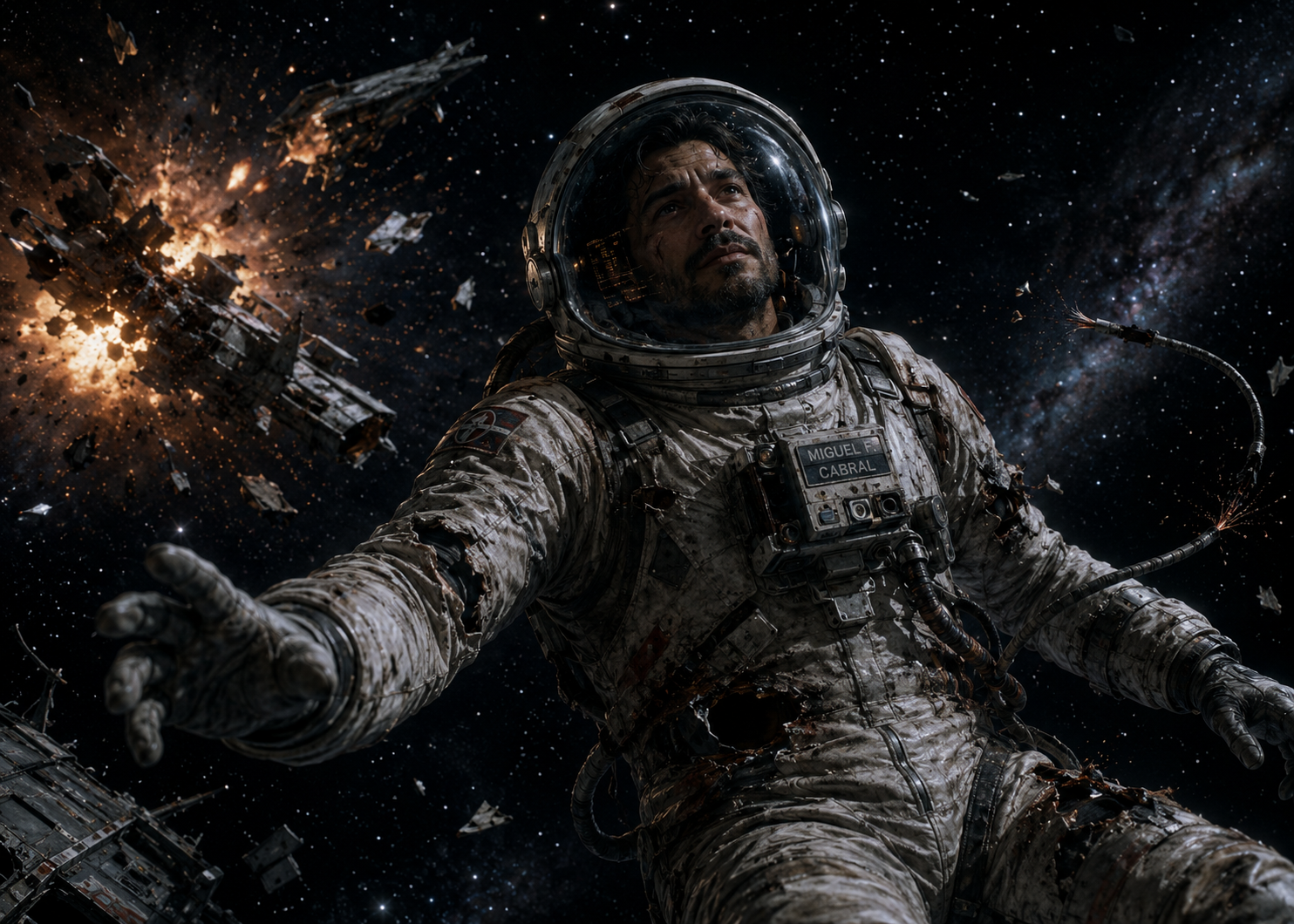
The alarm had been blinking for almost a minute. SUIT PRESSURE LOSS. Miguel Fonseca Cabral had tried sealing the damaged line twice. The first patch peeled away almost immediately. The second held for eleven seconds. He watched the pressure indicator continue its slow descent.
“Well, shit!.” His voice sounded strangely intimate inside the helmet. There was nobody else to hear it.
Miguel turned his head toward the remains of the ship and smiled. There wasn’t much of one anymore. The explosion had broken its spine first. He had watched the forward section separate from the engineering compartments, followed by a brilliant eruption from somewhere deep inside the hull. The flash had illuminated his visor so brightly that it automatically polarized.
He had laughed when it happened. He was still smiling. Months of preparation, three false identities, two dead drops, a bribed dockworker and a frightened engineer who had finally decided that whatever the Reich was building frightened him more than Monolith did. And six people aboard a ship where none of them belonged. Five were in the lifeboat now, Miguel hoped.
He checked the transponder again. Nothing. Too much interference, too much debris, or perhaps they were already too far away. Good, they were supposed to be.
The explosives had been discovered seven minutes before the planned evacuation. Someone had needed to stay behind and keep the security crew from reaching the charges. Miguel had volunteered. He remembered the look on Sofia’s face when the lifeboat hatch closed.
She had known, they all had. There hadn’t been time for speeches. Miguel hadn’t wanted one anyway. He could have stayed aboard. For a while, he had intended to. Then, with twenty-three seconds remaining on the timer, Miguel had looked at the emergency airlock. Twenty-two. Why not? Twenty-one. Dying for something didn’t require being stupid about it.
He had thrown himself through the airlock with six seconds remaining. Now he floated among the consequences. A section of armor plating rotated lazily several hundred meters away. Beyond it were thousands of glittering fragments. Somewhere among them were the remains of a weapon the Reich had spent years developing.
Perhaps they could build another. Regimes were very good at building terrible things. But it would take time, years, perhaps. People would live during those years. Maybe people Miguel would never meet. That was enough.
His suit chimed again and he looked at the oxygen estimate. Miguel swallowed. He wanted to live. The realization came with surprising violence.
He wanted someone to find him. He wanted the lifeboat to turn around. He wanted to hear Sofia shouting at him for being an idiot. He wanted coffee. Real coffee, not the recycled filth aboard Monolith safehouses. He wanted another night drinking with Paulo. He wanted to see an ocean again.
He wanted gravity. God, he wanted gravity. Miguel looked outward – there was no outward. There was no up, no down, no horizon. Nothing beneath his boots. Nothing above his head. He was falling forever in a place where falling meant nothing. Stars surrounded him.
For his entire life someone had been explaining where he belonged, which district, which occupation, which class, which papers, which authorities, which laws, or which flag. The Reich drew lines across continents and worlds and declared everything inside them theirs.
Miguel laughed again. His oxygen estimate dropped another minute.
“Look at this,” he whispered. Infinity stared back.
All those uniforms, those banner, those speeches about permanence, and the universe didn’t even know they existed. His eyes filled with tears. Miguel wasn’t sure whether he was laughing or crying anymore. Probably both.
He thought of the lifeboat, and hoped Sofia wouldn’t blame herself. He hoped Paulo wouldn’t tell everyone that Miguel had stayed because he wanted to be a hero. He hadn’t. He had stayed because somebody had to. That was all.
Another warning appeared. Miguel silenced it. He didn’t need the suit telling him what was happening. He was terribly afraid. His heart hammered. His hands trembled. Every instinct demanded air, rescue, gravity, another morning.
But beneath the fear was something else. Miguel searched for regret, genuinely searched, and found none. The ship and weapon was gone. His people had escaped. Somewhere, sometime, someone might live because tonight the Reich had failed.
Miguel Fonseca Cabral floated alone beneath no sky, falling toward no ground, surrounded by more stars than any tyrant could ever possess.
He smiled. “No regrets.” There was no one to hear him and that was all right.
Then one of the stars moved. Miguel blinked. For a moment he thought it was his vision. His oxygen was low enough now that he couldn’t entirely trust what his eyes were telling him. The point of light moved again.
No. Not a star. An engine. Miguel stared. Far away, almost indistinguishable from the debris field, two tiny lights burned against the darkness. The lifeboat.
“Don’t.” The word came out before he could stop it.
The lifeboat couldn’t come back for him. It wasn’t supposed to be able to. The emergency launch sequence committed it to an escape trajectory specifically so frightened survivors couldn’t turn around and fly straight back into whatever catastrophe they had just escaped. That was the entire point.
Miguel watched the lights. One disappeared. Then the other brightened. Attitude thrusters. The lifeboat was turning. Miguel began laughing.
“No. No, no, no. What the hell are you doing?” His voice broke halfway through the sentence. Someone aboard had figured it out. Sofia. Paulo. One of those magnificent idiots had overridden something that wasn’t supposed to be overridden. The two engine lights stabilized and then brightened.
They were coming toward him. Miguel looked at his pressure gauge and then at the oxygen estimate. Then back at those two impossibly small lights. The numbers were bad. He had no idea whether they could reach him in time.
Miguel raised one trembling hand toward the approaching lights as though someone aboard might somehow see him waving across the kilometers between them. For the first time since leaving the ship, tears rolled freely down his face. He wanted to live. God, how he wanted to live.
And apparently, somewhere out there in the infinite darkness, someone else wanted him to live too. Miguel Fonseca Cabral floated beneath no sky, falling toward no ground. But he was no longer alone. Two tiny lights burned among the stars. And they were getting brighter.