

Weekly: Emotion. Daily: Far to go
Shattered Expanse
Uyokks Thefiarch
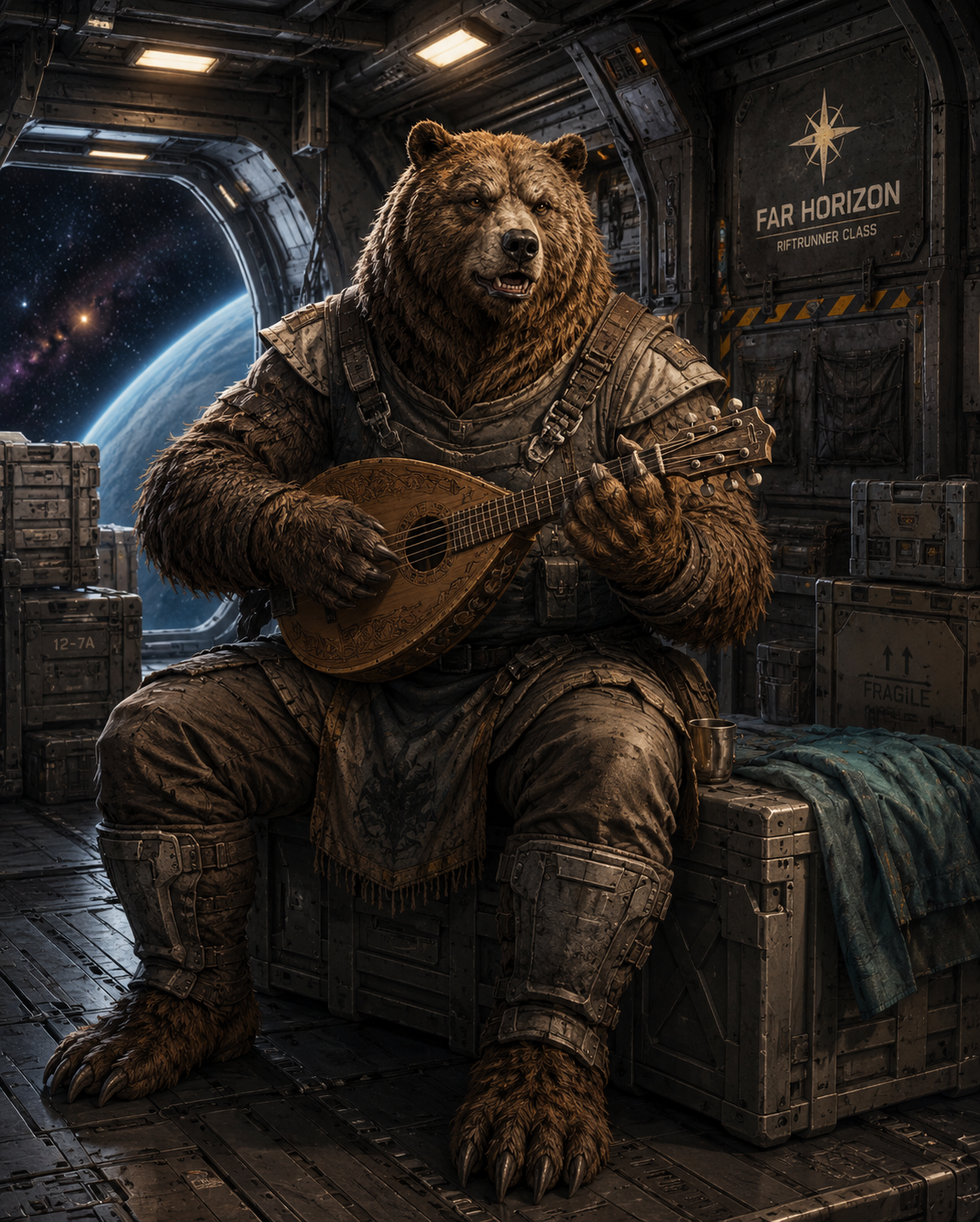
Urtoran Riftrunner, Cargo Handler & Aspiring Warrior-Bard
Uyokks Thefiarch is hungry. Not for food. Not for wealth. Not even, precisely, for fame. Uyokks is hungry for a tale worth telling.
Among the Urtoran, the Warrior Bard is an ancient cultural ideal. Strength without wisdom is brutality. Wisdom without action is merely contemplation. A life well lived should produce deeds worth remembering, and those deeds should eventually become stories, poems, and songs carried forward by those who remain. Uyokks intends to have a very long song.
Unfortunately, after a year aboard the Riftrunner vessel Far Horizon, he has accumulated approximately three verses. And two of them concern cargo.
When Uyokks left the Urtoran Holds, he imagined the Fringe as an endless frontier of unexplored worlds, forgotten civilizations, desperate battles, strange peoples, ancient ruins, and mysteries lurking beyond every Foldspace jump.
He had heard the stories of Riftrunners. Everyone had. They were the wanderers who traveled where governments hesitated to send ships. They crossed uncertain Fold routes, dealt with isolated colonies, carried supplies beyond established trade corridors, discovered forgotten settlements, stumbled across alien ruins, and occasionally returned to the Core with stories no sensible person believed.
Uyokks wanted to become part of one of those stories.
He found passage aboard the Far Horizon almost by accident. The captain needed someone capable of working the cargo deck, assisting with shipboard maintenance, and moving freight without requiring expensive loading machinery. An Urtoran seemed ideal. Uyokks certainly possessed the strength. What neither Uyokks nor the captain had adequately considered was his size.
The Far Horizon had not been constructed with Urtoran anatomy in mind. Uyokks spent his first several weeks aboard learning which doorways required him to duck, which corridors forced him to turn sideways, which chairs should never under any circumstances be trusted, and exactly how gently an Urtoran must close a Human-sized sanitation compartment door if he wishes to continue having one.
The crew adapted as well. A bunk was rebuilt. One section of the galley was reinforced. Several cargo-deck controls were fitted with larger interfaces. There remains a dent above the entrance to engineering that nobody mentions. Eventually the Far Horizon became home. That was when Uyokks discovered the terrible truth about Riftrunners.
Most Riftrunning is boring.
The crew traveled between the Core and Fringe repeatedly. They transported agricultural machinery, medical supplies to an isolated colony, delivered sealed diplomatic containers they were specifically instructed not to open, hauled replacement reactor components, and transported six crates of industrial sealant. Once, they carried several thousand kilograms of processed fungal protein.
Nothing attacked them. Nobody betrayed them. No ancient civilization awakened. No forgotten distress signal led them toward a dying star. The fungal protein arrived precisely on schedule. The captain considered that particular voyage an outstanding success. Uyokks considered it one of the darkest periods of his adult life.
His crewmates made matters worse. They were competent. Reliable. Professional. And, in Uyokks’ estimation, almost completely devoid of the proper emotional appreciation for what their lives could be. A strange sensor reading was something to avoid. An unidentified ship was something to give a wide berth. An unexplored moon was something that did not appear on the cargo manifest. A suspicious distress signal was something to report to local authorities.
Uyokks sometimes wondered whether these people understood that they were Riftrunners. He began keeping notes for the epic he intended someday to compose about his travels. Most entries ended with – Nothing happened. His hunger only grew.
Uyokks has not lost faith in his companions. Quite the opposite. He has become convinced that somewhere beneath their maddening professionalism lies the makings of a legendary Riftrunner crew. They simply have far to go.
The captain needs to learn that occasionally the dangerous route is the interesting route. The pilot needs to stop calculating survival probabilities aloud. The engineer needs to understand that the phrase “this violates twelve safety regulations” is not necessarily an argument against doing something. And the rest of the crew desperately needs to develop what Uyokks calls “a proper sense of impending legend.”
He has therefore taken it upon himself to help them. This has not always been appreciated. Uyokks collects rumors at every port. He talks to dockworkers, prospectors, pilgrims, mercenaries, traders, drunken spacers, refugees, and anyone else possessing a story beginning with “Nobody knows what’s out there, but…”
Most leads amount to nothing. Then Uyokks heard about a cargo contract bound for Sanctuary Station. He stopped laughing.
Even in the Urtoran Holds there are stories about Sanctuary – an ancient station at the very edge of the Rift. A structure no known civilization admits to building. Corridors where technology fails. Rooms larger inside than physically possible. Pilgrims who claim the Rift speaks to them. People who dream things that have not happened yet. Ships that leave Sanctuary only to somehow arrive back at Sanctuary. And beyond it – the Rift.
Uyokks brought the contract to the captain personally. It was, technically, just another freight job – perfectly legitimate and reasonably profitable. They would load the cargo, travel to Sanctuary, unload it, collect payment, and depart. The captain studied the contract and then studied Uyokks. Then studied the destination again.
“No.”
Uyokks began explaining. Eventually the captain said no again. Uyokks continued explaining. The negotiations lasted considerably longer than either participant later admitted. The Far Horizon is now bound for Sanctuary.
Uyokks has become almost unbearable. He sings while loading cargo. He has already begun composing the opening of the saga despite repeated reminders that nothing has happened yet. He walks through the cramped corridors of the Far Horizon with an enthusiasm completely disproportionate to their circumstances.
The rest of the crew sees another delivery. Uyokks sees destiny. He imagines standing before the Rift. He imagines walking the impossible corridors of Sanctuary. He imagines discovering something forgotten. He imagines returning to Urtor decades from now, silver beginning to spread through his fur, surrounded by younger Urtoran as he begins the first verses of the great epic of Uyokks Thefiarch and the crew of the Far Horizon.
Perhaps that is the deepest part of his hunger. Uyokks does not merely want to experience adventure. He wants his life to mean something when told by someone else. For a species that can live for centuries, there is always another year. Another voyage. Another opportunity. Uyokks knows he is young, he knows his great song might require another hundred years to complete. He knows he has far to go.
But somewhere ahead of the Far Horizon, hanging impossibly beside the greatest mystery in the known Expanse, waits Sanctuary Station. For the first time in a year, Uyokks stands at the viewport and feels something he has desperately missed. Possibility.
Behind him, the captain reminds everyone that they are simply delivering cargo. Uyokks smiles.
“Of course, Captain.” He looks back toward the distant Rift. “That is how all the best songs begin.”
Blood & Suns
Faustyna “Faust” Kurdziel
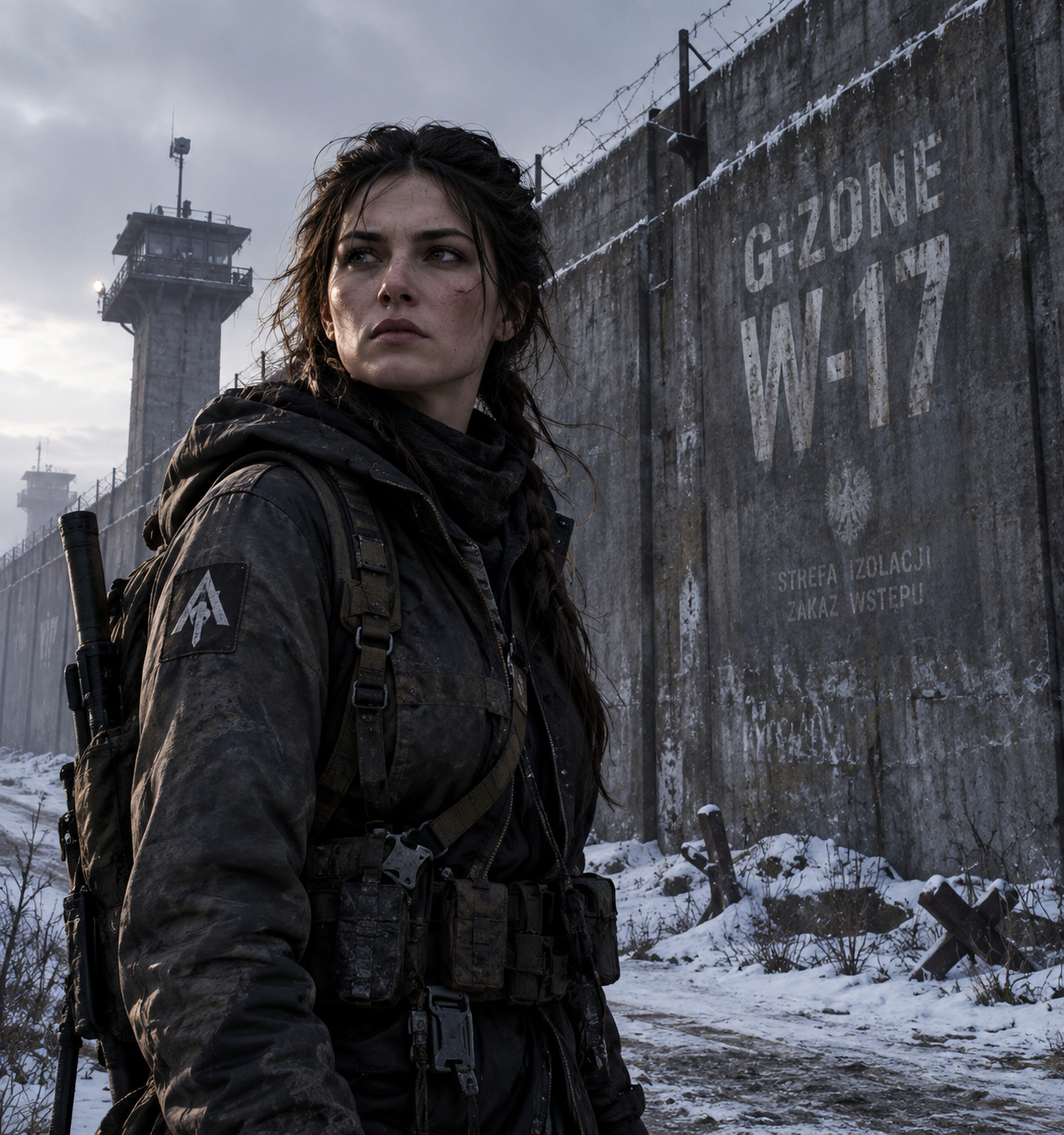
Codename: Faust
Affiliation: Monolith
Origin: Warsaw G-Zone W-17
Faustyna Kurdziel knows what hunger feels like. Not the hunger of missing a meal, nor the theatrical hunger of a Reich citizen complaining because the ration dispensary issued the wrong protein allotment. Faust knows the hunger that hurts.
She knows the cramps that come first, when the stomach still expects to be fed. She knows the weakness that follows. She knows how eventually the pain becomes something duller and more dangerous, when the body begins accepting that food may simply not come.
She knows what boiled leather tastes like. She knows which insects can be eaten raw. She knows that mold can be scraped from one side of bread while poison has already spread through the other. She knows that a dead rat belongs to whoever reaches it first. And she knows that hunger can make good people do terrible things.
Faust was born behind the walls of G-Zone W-17, one of the sealed districts buried within the vast Warsaw G-Zone. By then nobody inside knew what W-17 originally meant. The designation appeared on ancient signs attached to walls, gates, utility tunnels, and automated security stations. The people simply called it the Seventeen.
Her parents were Sheep. That is what the raiders called them. Sheep stayed in one place. Sheep planted vegetables in contaminated soil. Sheep collected rainwater. Sheep repaired old buildings and barricaded the entrances. Sheep hid food underground and tried to raise children. Their fortified settlements were called Folds. Faust’s parents lived in one. She remembers very little about it. Warm hands. A vegetable garden beneath sheets of cracked transparent plastic. Her mother’s voice. Her father teaching her never to waste water.
Then the Wolves came when Faust was eight. Her Fold was raided and she remembers fire, screaming and her father pushing her beneath a table. She remembers someone dragging her out and then everything after that belongs to the Wolves. The raiders took food, tools, weapons, medicine and children. Adults who resisted were killed. Adults who could be useful were sometimes taken.
Faust never learned what happened to her parents. The Wolves raised her. By twelve, she could strip copper from abandoned buildings. By fourteen, she could climb the interior face of the Wall without touching the automated detection grid. By sixteen, she had killed. By eighteen, Faustyna Kurdziel was leading raids of her own. She stopped thinking of herself as someone who had once been a Sheep. She was a Wolf and Wolves ate.
There was no morality more complicated than that. You found food, protected your tribe and took what you needed. If someone else had something and you were hungry enough, eventually it became yours. The Wall taught them that.
Faust had imagined the gates opening many times, like every Seventeen had. There were stories that somewhere beyond the Wall there were endless fields of food. There were rivers of clean water. There were cities where lights burned every night and people threw away more food than a Fold possessed.
Some said there was nothing outside, that the whole world had died. Some said the Wall protected them from whatever had happened to everyone else.
Then Monolith came.
They did not open the gates – they destroyed them in an fiery explosion, never to be closed again. Automated sentries that had killed anyone approaching the perimeter for generations were reduced to smoking metal. Surveillance towers exploded. Ancient security systems screamed warnings nobody inside could understand.
Then strangers came through the breaches carrying weapons. Faust expected another tribe – who eats the Wolves? Instead, they brought food. For the first time in her life, someone handed Faustyna Kurdziel something to eat without demanding anything in return. She did not trust them. She hid half the ration – that instinct took years to break.
Monolith gave the survivors a choice – Come with them, stay or go wherever they wanted. Many simply walked through the breach and kept walking. Some went east and north, toward the enormous no-man’s-land beyond the Reich’s reliable control, hoping the old Russian territories offered enough distance from the people who had built the Wall. Others remained.
Only a few joined Monolith and Faust was one of them. She had nowhere else to go. More importantly, she wanted to know who had built the Wall.
Monolith discovered long ago that G-Zone recruits require surprisingly little conventional deprogramming. There is little reason to convince someone that the Reich is lying when that person spent her entire life imprisoned inside one of its forgotten crimes. Faust required something else – Education. History, Geography, Politics.
For the first time, Faust saw a map of Europe, learned there was a name for Poland, and what Warsaw had once been. She learned why the G-Zones had been created and her ancestors had not committed some forgotten crime. She learned that there had been no catastrophe outside the Wall. The world had continued, people had lived, people had eaten, and governments had changed. Cities had grown around the prisons. And eventually the Reich had simply stopped talking about the people trapped inside.
Faust became angrier with every lesson. Her instructors initially mistook her attention for enthusiasm – it was hatred. There are Monolith agents who fight because they believe humanity can someday be free. There are agents who fight for democracy. There are agents who fight because they want their children to inherit something better.
Faust fights because someone built the Wall.
Someone ordered it, maintained it and erased it from the records. And generations of officials walked past the sealed gates knowing—or choosing not to know—that human beings remained inside.
Faust is not motivated by political philosophy. She is motivated by emotion. She hates the Wall-makers. Monolith has merely taught her their names.
Years later, Monolith sent Faust north. Intelligence had located a concealed Reich labor installation deep within the former Soviet territories. Hundreds of Tirevolk forced laborers were believed to be imprisoned there, working somewhere beneath the frozen ground.
The facility was isolated, fortified, and difficult to approach. Monolith needed local guides. Faust knew some Or she had known them once.
Several members of her old Wolf tribe had left the Seventeen after liberation and traveled north. Intelligence suggested they had joined other G-Zone refugees and eventually established a settlement.
Faust’s assignment was straightforward – Find them, establish contact and recruit whoever was willing to help Monolith reach the labor camp. She expected Wolves, instead, she found Sheep.
They had built a Fold – Faust almost laughed when she saw it. Her old tribe—the same people who once mocked settlers for hiding behind barricades—had constructed walls from vehicle hulls, concrete slabs, shipping containers and frozen earth. Raiders and settlers lived together now. Wolf and Sheep.
Those words meant almost nothing anymore. Everyone hunted. Everyone scavenged. Everyone guarded the walls. Everyone planted whatever could survive the brief growing season. And everyone was hungry.
Faust walked through the settlement recognizing faces that had grown twenty years older than she remembered. Some recognized her and others stared at the Monolith equipment she carried. A few embraced her and a few would not speak to her. Many people she asked about were dead – exposure, disease, violence, hunger. Mostly hunger.
That was when Faust understood something she had never considered during all those years dreaming about the other side of the Wall.
Opening the gate was not the same as saving them.
Monolith had given them freedom but then Monolith had gone somewhere else. There were always more prisoners, more camps, more operations, and more people who needed rescuing. The survivors of the Seventeen had been free to go wherever they wished. So they had gone north and they had starved somewhere else.
The village elders listened when Faust explained the labor camp – Hundreds of Tirevolk prisoners. Families, perhaps; people living behind fences. People who could not leave. Faust expected anger. She expected volunteers.
Instead, an old man asked her a question. “What do we eat while your people are freeing them?”
Faust had no answer. That bothered her more than an insult would have. The villagers were willing to help. Some even knew the region around the facility. But they needed food, medicine, and fuel.
A Monolith operation might liberate hundreds of prisoners, but the people being asked to help could barely feed their own children. Faust found herself furious. At first she was furious with them but then she was furious with herself for being furious with them. Then she was furious with Monolith.
Finally she realized she was simply angry at the world. That evening, Faust sat beside a communal fire eating a thin stew. She finished it without thinking. Then she noticed a little girl sitting across from her watching the empty bowl. Faust knew that look – had worn that look.
She reached into her field pack, pulled out one of her Monolith ration bars, and handed it across the fire. The girl devoured it and Faust watched her. For the first time in years, she remembered being eight years old, before the raid, with her mother in the garden. Her father telling her never to waste water. She had been a Sheep once.
Faust contacted Monolith the following morning and reported that the local population could support the operation, under one condition. The village would be added to a regular supply route for food, medicine, and purification tablets. She pushed it and asked for agricultural equipment where possible.
Her handler reminded her that Monolith’s resources were limited and this, of course, Faust knew. Her handler explained that establishing another supply route this deep into hostile territory would be dangerous. Faust knew this too.
Then came the argument Faust had been expecting – Monolith could not save everyone. Faust stared across the settlement while she listened. A woman was dividing a loaf of bread among six children, every slice was carefully measured. Faust had seen the same ritual inside the Seventeen. Different walls, same hunger.
“No,” Faust finally answered. “We can’t.”
She watched one of the children hide part of his bread inside his coat. Faust recognized that too.
“But we can save these people.” There was silence over the radio. Faust continued. “You want recruits for the camp?”
“Yes.”
“You want guides?”
“Yes.”
“You want them to believe we’re different from the people who built the Wall?”
Another silence.
“Yes.”
Faust looked around the village.
“Then feed them.”