

Weekly: Instinct. Daily: Far to Go
Shattered Expanse
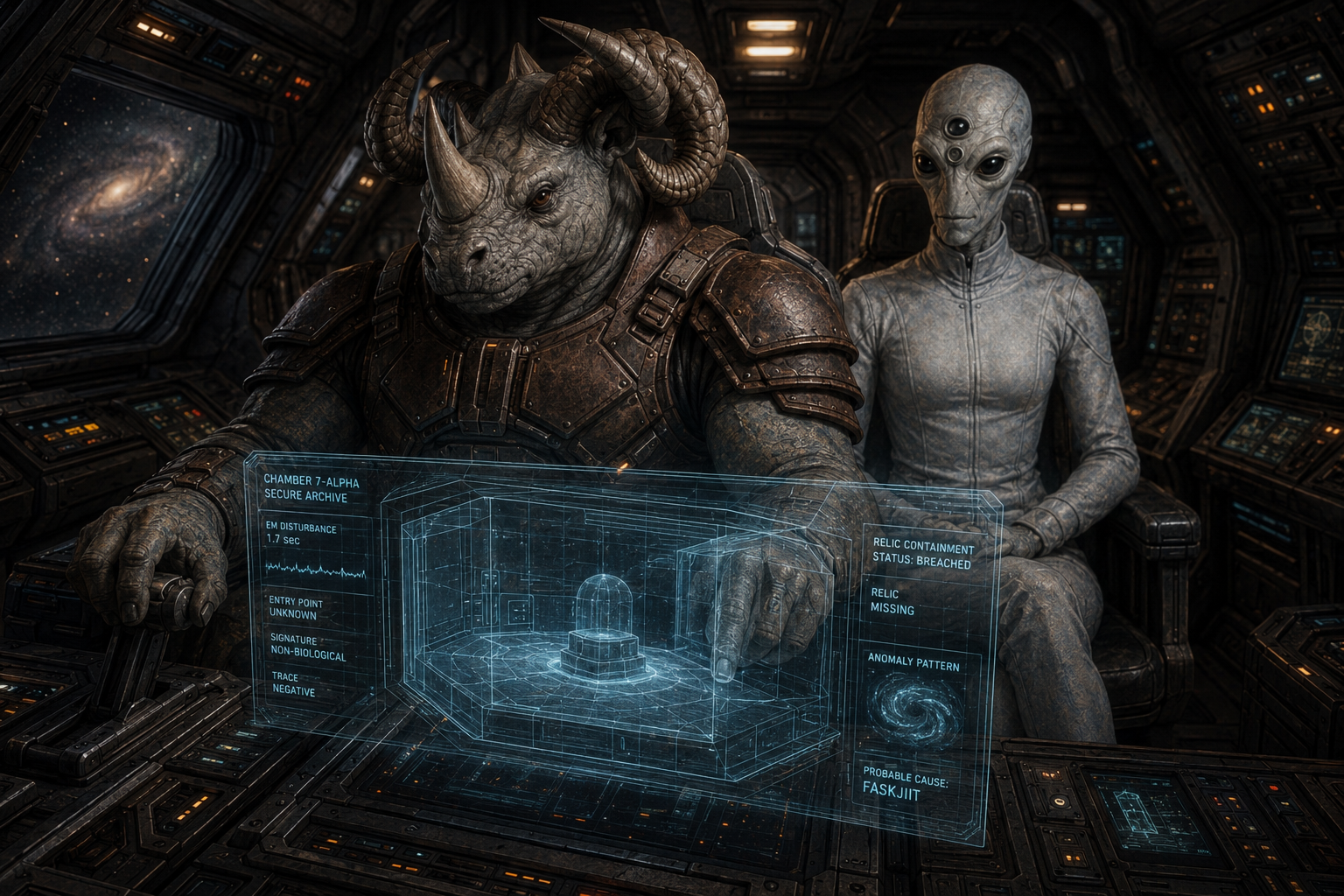
The holographic reconstruction of the chamber hung above the console for the twenty-third time. The Kordran Vesh, Candrosian relic hunter stared at it without moving.
His massive body occupied most of the pilot’s station, four legs planted against the deck while his upper arms rested beside the controls. The ship’s computer had reconstructed the theft from security records, structural scans, atmospheric sampling, and the few functioning sensors left behind.
There should have been tracks. There were none. There should have been tool marks around the containment housing. There were none. There should have been traces of an entry route. There were none. The relic had simply ceased to be there.
“Again.” The computer reset the reconstruction. The pedestal appeared. The containment field shimmered around it. Then the image distorted.
For 1.7 seconds, every electromagnetic sensor in the chamber registered fluctuations well outside normal parameters. The visual record fragmented into static. Internal diagnostics simultaneously reported contradictory readings from six different systems. Then everything returned to normal. The pedestal was empty.
The Candrosian leaned closer. “Show the electromagnetic event.”
A lattice of colored lines appeared around the reconstruction. He had seen the pattern so many times that he could almost draw it from memory. The Sarginian, Ilyaneth Sariel, sitting behind him had been silent for several minutes.
That bothered him. Sarginians always seemed to know something. Sometimes what they knew was useful. Sometimes knowing that they knew something was useful. But silence from a Sarginian usually meant the answer was going to be unpleasant.
“What?” The Sarginian tilted her head.
“I haven’t said anything.”
“You stopped saying things.”
“I was allowing you to reach your own conclusion.”
“I reached it.”
“And?”
The Candrosian enlarged the scan. “No footprints. No atmospheric displacement consistent with a biological intruder. No conventional transport signature. No forced entry. No residual Foldspace event.” He indicated the electromagnetic pattern. “But this.”
The Sarginian said nothing. The Candrosian looked over his shoulder.
“You know what this is.”
“Yes.”
“Then say it.”
“Faskjiit.” The name meant nothing to him.
That alone made him uneasy. “What’s a Faskjiit?”
The Sarginian considered the question for several seconds. Then she told him. She told him about a civilization that no longer existed. About a species that had watched its numbers diminish until survival itself became an engineering problem. About machines built for war and preservation. About armored autonomous constructs carrying fragments of biological intelligence within them. And about what remained after their creators were gone.
The Faskjiit. Machines carrying pieces of a dead people through the Expanse. Ghosts that did not know they were ghosts. The Candrosian looked back at the empty pedestal.
“One of those was in that chamber?”
“Almost certainly.” Ilyaneth said in their annoyingly calm, almost mocking tone.
“Almost?”
“Certainty is expensive.”
He snorted. “Then I’ll settle for almost.”
The reconstruction played again. Static. Empty pedestal. He had expected smugglers. Perhaps professional relic thieves. At worst, he had imagined one of the syndicates. People could be tracked. Ships could be identified. Money could be followed. Informants could be threatened, bribed, befriended, or simply waited out. People left trails.This thing had left 1.7 seconds of electromagnetic noise.
“Where did it go?”
“I don’t know.” The answer came quickly enough that Kordran turned toward her.
“You don’t know?”
“No.”
“Can you find out?”
“No.”
“Can anyone?”
“Perhaps.”
Kordran disliked perhaps almost as much as almost.
The Candrosian lowered himself slightly and stared through the forward viewport. Stars drifted beyond the glass. Only yesterday those stars had represented possibilities. Now they represented distance. The relic could be anywhere among them. He thought about the promise. At the time, it had seemed an easy thing to give.
I will find it.
He hadn’t said he would try. He hadn’t promised to discover who stole it. He had promised to find it. Kordran instincts had kept him alive for decades. They had warned him about ambushes before scanners detected them. They had told him when informants were lying, when ruins were unstable, when a trail had been deliberately manufactured.
Those same instincts spoke now. The relic was gone. Not difficult to recover. Not expensive. Not dangerous. Gone. He stared at the empty pedestal.
“How do I find a Faskjiit?”
“You don’t.” Again that tone.
His eyes narrowed. The Sarginian continued.
“Faskjiit are not fugitives. They do not participate in our economies. They do not require our ports. They do not maintain diplomatic relations, file transit plans, purchase fuel, visit stations, or announce territorial claims. They can disappear into regions where you could search for the remainder of your life.”
“Then I search for the remainder of my life.”
The Sarginian studied him. There was no bravado in the statement. That seemed to trouble her more.
“You misunderstand me.” Ilyaneth almost seemed surprised
“No. I understand you perfectly.”
He gestured toward the hologram. “I have no trail.”
“Correct.”
“I don’t know where it went.”
“Correct.”
“I don’t know why it took the relic.”
“Correct.”
“And following it could take me beyond every charted system I know.”
“Quite possibly.”
The Candrosian nodded. “Then I have far to go.”
The Sarginian was quiet again. This time he let her be. Eventually she said, “There may be another approach.”
One of his ears twitched. “You just said they can’t be found.”
“I said you cannot find one.” Kordran held himself back from physically assaulting the tall, frail androgenous alien,
The Candrosian slowly turned his chair. The Sarginian had that expression again. The one that meant she had known something from the beginning and had been waiting until he was ready to hear it.
“But,” she continued, “there are ways to make a Faskjiit find you.”
For the first time in several hours, Kordran’s instincts changed. Not hope. Something closer to the scent of a trail.
“How?”
The Sarginian looked toward the rotating reconstruction. “Faskjiit have very few predictable behaviors. They have survived too long by avoiding predictable behaviors. But there is one thing capable of reliably provoking a response.” Ilyaneth paused dramatically. “The Zed.”
Kordran knew that name. His expression changed. The Sarginian noticed. “Good. That saves another explanation.”
“No.” He killed the holographic reconstruction. The chamber disappeared. “I was hoping you meant something else.”
“I don’t.” Ilyaneth watched as her Candrosian friend flipped a few more switches.
The ship suddenly seemed much quieter. The Candrosian stared through the viewport again. A Faskjiit had taken the relic. To find the Faskjiit, he needed something capable of drawing its attention and that meant finding the Zed. His instincts spoke again. This time their message was considerably simpler.
Don’t!
The Candrosian slowly rose from the pilot’s station. “Where?”
Ilyaneth watched him intensely. “You haven’t asked what happens after you get its attention.”
“I’ll worry about that when I have it.”
“That is an extraordinarily dangerous philosophy.”
“No.” He brought up the navigation display. “It’s an extraordinarily distant problem.”
Stars spread across the console. Hundreds of systems. Thousands of possible destinations. Somewhere among them was the beginning of a trail that might lead to the Zed, which might lead to a Faskjiit, which might lead to the relic. The Sarginian regarded the map.
“You understand how improbable this has become?” Ilyaneth’s inquiry had a sense of worry in it.
The Candrosian entered the first search parameters. “Yes.”
“And you’re still going?” She seemed almost excited now.
He looked at her as though the question itself made little sense. “I promised.”
The navigation computer began calculating. The first destination appeared. It was very far away. The Candrosian looked at it for a moment. Then he engaged the drive.
Blood & Suns
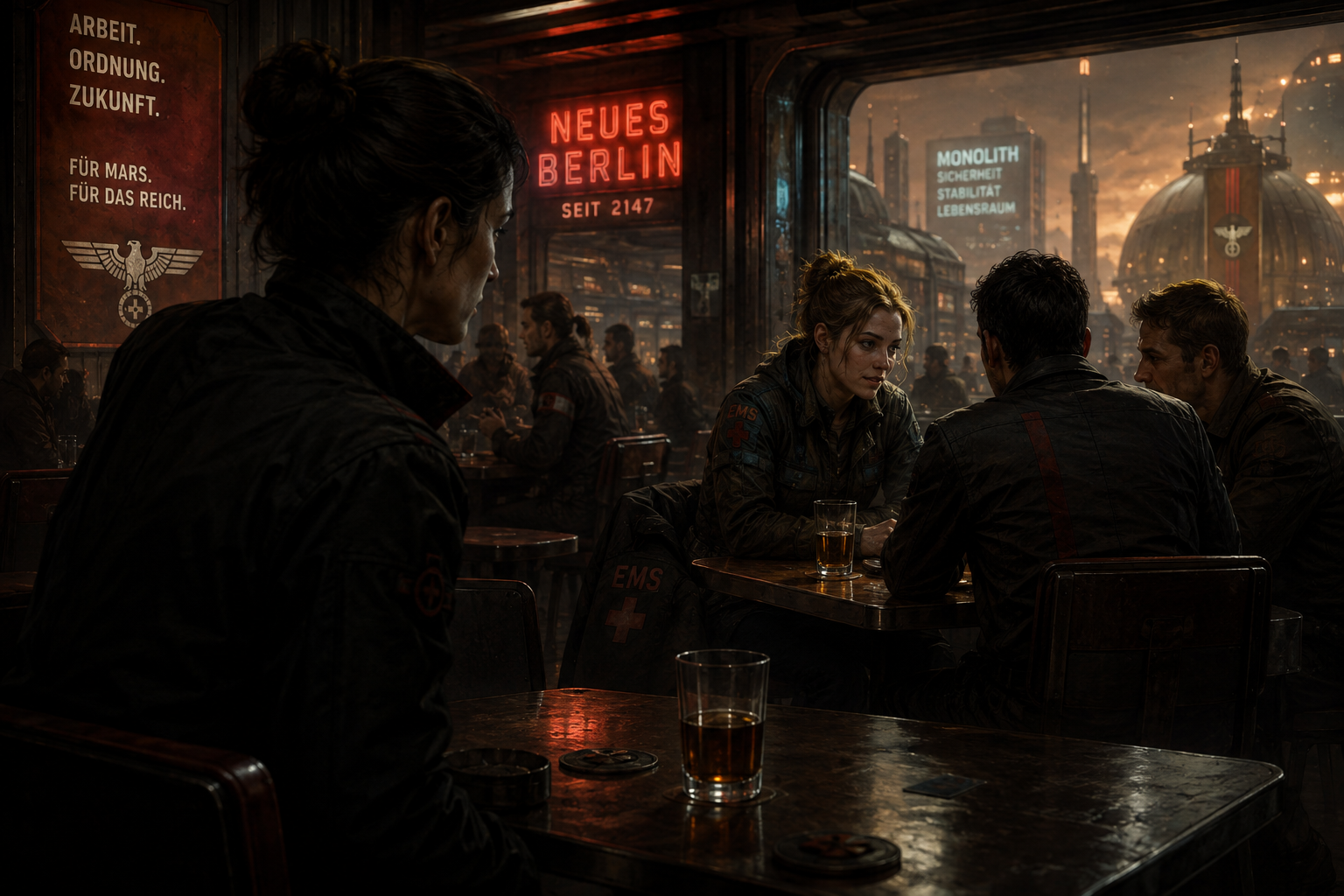
Location: New Berlin, Mars
Situation: Emergency recruitment
Immediate Need: A medic for a Monolith Cell
Arrival
Mara Keller had been on Mars for eleven hours when she decided she hated the place. It wasn’t New Berlin itself. New Berlin was exactly what she expected from a major Reich settlement – monumental architecture built to impress people who had no choice but to live beneath it, propaganda screens bright enough to compete with the artificial daylight, uniformed officials moving through crowds of workers who had learned long ago not to look at them for too long.
It was gravity.
Mara had trained for it, of course. Monolith did not send agents to another world without preparing them for the environment. Training, however, was not the same thing as living somewhere. Everything felt subtly wrong.
Her stride wanted to be longer than it should be. Objects seemed lighter than her eyes expected. Sitting down required slightly more care than seemed reasonable. Twice that morning she had pushed away from something with too much force.
So she sat in a bar in New Berlin and practiced being Martian. Pick up the glass. Put it down. Lean back. Stand. Sit. Don’t think about it. Around her, people born on Mars moved without thinking at all. Mara envied them. She also studied them. Because somewhere in New Berlin was the person she needed. And she needed that person tonight.
Three days earlier, Mara’s Cell had possessed a medic and now it didn’t. She had received the message during transit. Kessler compromised. Do not contact. Nothing more. Not good!
That could mean Kessler had been arrested. It could mean he was under surveillance. It could mean he was dead. Monolith deliberately kept such messages terse because knowing the difference rarely changed what an operative was supposed to do.
Do not contact meant do not contact. Unfortunately, the operation hadn’t changed with it. Four agents were already committed. Equipment had been moved. Identities had been prepared. A narrow opportunity Monolith had spent months creating would close in less than forty-eight hours.
And the operation required someone with medical training. Not someone who could apply a field dressing, a medic. Mara had therefore been given access to Monolith’s files on potential recruits in New Berlin.
Normally, those names represented possibilities. People would be watched. Their beliefs would be evaluated. Their vulnerabilities investigated. Contact might eventually be made. If recruited, they would undergo Monolith’s conversion and deprogramming process before anyone seriously contemplated putting them into a Cell.
Mara had no time for any of that. She needed to look at a stranger and decide – Can I make you betray everything you’ve been conditioned to obey before tomorrow night? There were procedures for recruitment. There were no good procedures for this. So Mara fell back on instinct.
Her name was Lena Voss, twenty-six years old, a Martian-born Unter. She is an emergency medical technician assigned to an industrial district of New Berlin. No criminal record, no known resistance associations, no political violations, no indication that she had ever knowingly encountered Monolith. On paper, she was almost offensively ordinary.
The file contained little that would normally justify immediate recruitment, but there were irregularities. Lena had been questioned after treating an injured laborer whom security officers subsequently detained. Her medical report disagreed with the official account of how the man’s injuries had occurred. She had been instructed to amend it and of course, like a good citizen, she had.
Three months later another patient had disappeared from her clinic before security arrived to collect him. Lena claimed he had left against medical advice and nobody could prove otherwise.
During a workplace accident the previous year, Lena had ignored a supervisor’s order and evacuated workers from a compartment that monitoring systems reported as safe. Minutes later, the compartment decompressed. Eight people lived because Lena had disobeyed. The subsequent investigation blamed faulty maintenance. Lena had signed the report but afterward she had quietly obtained copies of the original sensor logs.
Monolith knew because one of its information networks had eventually acquired those same records. None of it constituted resistance, at least not yet. But Mara recognized the pattern. Lena Voss obeyed until obedience contradicted what she could see with her own eyes and then she trusted herself.
Instinct. And this showed promise.
That was why Mara was sitting fifteen meters away from her. Lena wasn’t particularly remarkable to look at and Mara considered that an advantage.
She wore the same practical clothing as half the people in the bar, with an emergency-services jacket folded beside her. Her hair was still flattened slightly where some piece of medical equipment had rested against it during her shift.
She was drinking beer with three coworkers. Mara watched. The files mattered. People mattered more. One coworker told a story. Lena laughed. Another complained about management. Lena listened. Someone mentioned a security inspection scheduled for the following week. There. Almost nothing. Lena’s eyes moved toward the entrance. Then toward a man sitting alone near it. Then back to her friend.
The conversation continued. Thirty seconds later Lena casually changed the subject. Mara looked at the man by the entrance. Plain clothes. Good posture. Not drinking much. Security? Perhaps. It didn’t matter.
Lena had noticed him.
Better yet, she hadn’t warned her friends. A warning would itself have been suspicious. Instead, she had redirected the conversation before anyone said something dangerous. Mara made another mental mark beside Lena’s name.
Then something else happened. A drunk stumbled into one of the servers and a glass shattered. The server cut her hand and several people looked. Lena was already moving.
She didn’t make a production of it. She didn’t announce that she was a medic. She simply crossed the room, looked at the wound, took the woman’s wrist, elevated the hand, and asked the bartender for something.
Calm. Automatic. Competent. Thirty seconds later she was sitting down again.
Mara stared into her own drink. Damn it. She liked her, not personally but operationally, which was worse.
There were better-qualified people on Mara’s list. One physician even had military experience. Another candidate had access to restricted pharmaceuticals, and a third had already expressed private contempt for the Reich. Mara had rejected all three. The physician had too much to lose. The pharmaceutical technician was angry but frightened. The dissident talked. Lena was different.
She had never declared herself an enemy of the system. She simply kept encountering moments when the system demanded that she ignore what she knew to be true and each time, something inside her resisted.
That was promise.
Mara could teach someone how to make a dead drop. She could teach surveillance detection. Monolith could teach codes, weapons, covert communications, interrogation resistance, operational security, and a hundred other skills. Given enough time, Monolith could help a recruit understand how thoroughly the Regime had shaped what they believed about themselves and the world around them.
But there were things training couldn’t manufacture easily. Judgment. Empathy. The willingness to move toward an injured stranger while everyone else watched. The instinct to look at authority and think: No. You’re wrong. Lena already had those. Unfortunately, she had everything else too.
That was the part Mara couldn’t stop thinking about. Lena was still inside the veil. Not metaphorically. Her entire life had been constructed within the Reich system. Education. News. Medicine. History. Social expectations. The chemical conditioning woven into ordinary existence.
Monolith normally didn’t simply walk up to people like Lena and tell them the truth. There was a reason for that. Remove too much too quickly and some people rejected it, while others broke. Some became furious while others became terrified. Some wanted desperately to crawl back into the comforting explanation that everything they had been taught was essentially true and the unpleasant things they had witnessed were exceptions. All are dangerous to the cause.
They wanted to tell their spouses, their parents, or their friends. You don’t understand. I’ve learned something. That impulse had killed people. The conversion process existed for a reason.
Mara was contemplating skipping it almost entirely. She wouldn’t be recruiting a Monolith agent. She would be taking a conditioned Reich citizen, telling her just enough truth to destroy the certainty of her old life, putting her beside four resistance operatives, and hoping Lena didn’t panic when she finally understood what she had agreed to do.
Mara took another drink and heard clink against her teeth. Too much force. Mars again. She looked at it. Then at Lena. Perhaps that was the appropriate metaphor.
Everything Lena knew about how to move through the world was about to become the wrong weight.
Mara knew what Lena lacked. She didn’t know how to lie under interrogation. She didn’t know how to detect sophisticated surveillance. She didn’t understand Cell compartmentalization. She wouldn’t understand why Mara might refuse to give her the real names of the people she was expected to save.
She probably believed evidence could expose corruption. She probably believed there were authorities somewhere who would care if only the right proof reached them. She might even still believe that most of the Reich was fundamentally decent and that people like her supervisors were abusing an otherwise necessary system.
Monolith could eventually strip those illusions away. Eventually. Tomorrow, Mara needed Lena to keep someone alive and that was the absurdity of it. Lena had far to go before Mara would willingly call her an agent. Mara needed her to cross that distance in a night.
One of Lena’s coworkers stood. The group was leaving. Mara’s instincts started assembling the approach before she consciously decided to make it. Don’t contact her here and don’t follow immediately. Give her enough time to notice you once, but not enough to become certain.
Approach somewhere she feels safe enough not to run but private enough that she won’t worry about being overheard. Don’t begin with politics or mention Monolith. Don’t tell her the Reich is built on lies or ask whether she wants to fight tyranny.
Give her a patient. That was the answer. Mara suddenly understood why she had chosen Lena. The others would need to be persuaded to resist the Reich. Lena didn’t, not tonight. Mara only needed to persuade her that someone was going to need a medic and could not be taken to a hospital.
Lena would ask why and Mara could answer as little as possible. She would ask whether the person was a criminal. Maybe. A terrorist? Depends who you ask. Would helping them be illegal? Absolutely. Then Lena would have to decide. Not whether she believed in Monolith, whether she wanted to overthrow the Reich or whether everything she had been taught was a lie.
Just this … If someone is bleeding and I am the person who can save them, do I walk away?
Mara watched Lena put on her jacket and there it was. The pressure point, no ideology required. Just instinct. Mara left enough money for her drink and stood carefully, still consciously compensating for the unfamiliar Martian gravity.
Across the room, Lena glanced toward her. Their eyes met for perhaps half a second but Lena looked away and then looked back as if to sense a need in Mara. A need she could fulfil. She had noticed Mara watching her. Mara suppressed a smile. Good. Very good. She waited until Lena and her friends left before following.
The file had been correct. Lena Voss had promise. Perhaps more than Mara wanted. But promise was a word used for something unfinished. Something that might become extraordinary but hadn’t yet. Under normal circumstances, Monolith would take its time finding out what Lena could become. Tonight there was no time. Tonight Mara would have to trust her instincts.
And then ask Lena Voss to trust hers.