

Weekly: Instinct. Daily: Works Hard
Shattered Expanse
Garran Varkesh
Species: Human
Faction: Laconid Clans
Clan: Clan Varkesh
Homeworld: Crimson
Occupation: Royal Guard
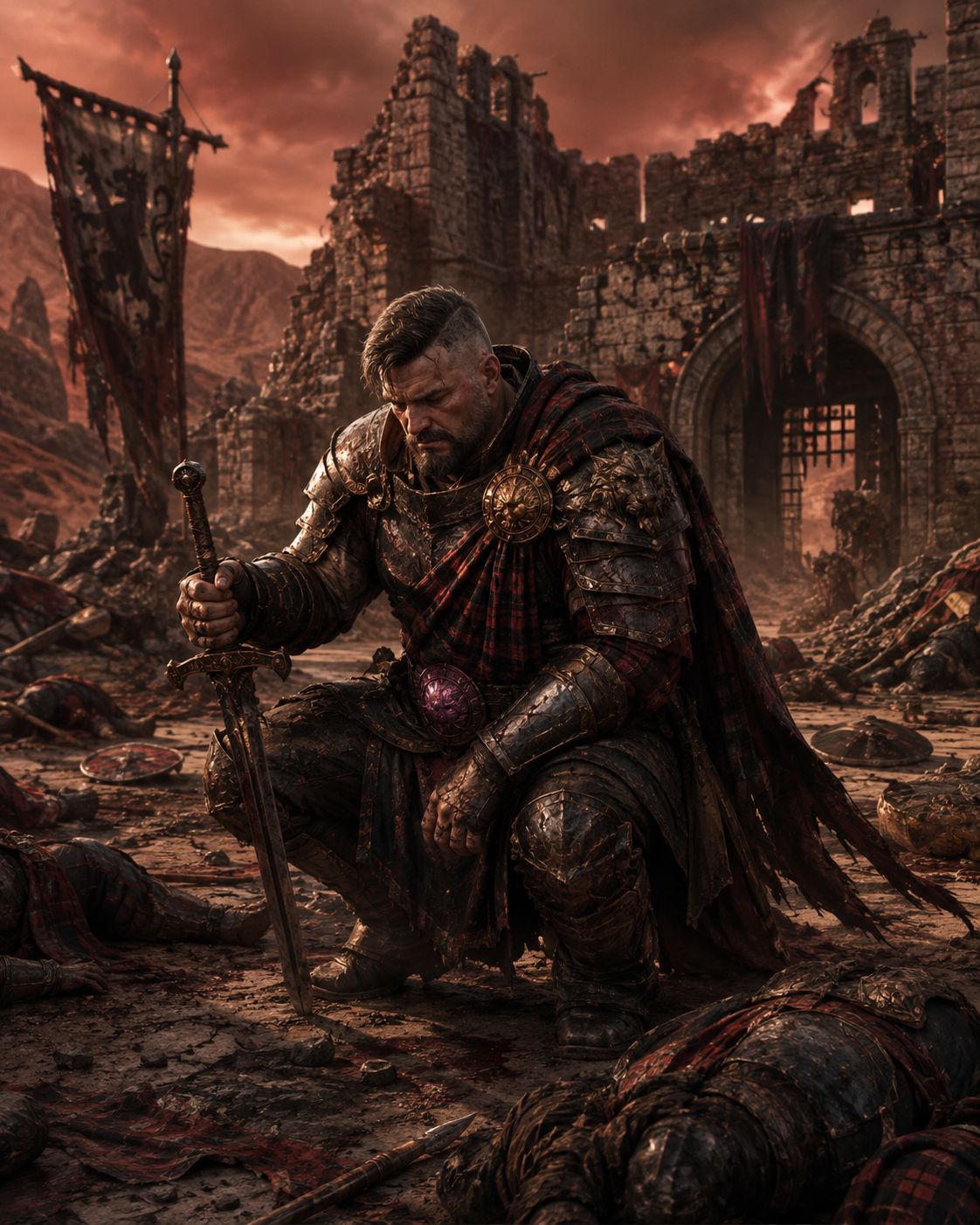
There are easier places in the Expanse to live than Crimson. That was precisely why Clan Varkesh settled there.
Crimson is a dry, high-gravity world of red stone, broken mountains, and enormous plains where the wind can blow uninterrupted for hundreds of kilometers. Its name comes not from its sun, but from the iron-rich dust covering almost everything on the planet. The dust is extraordinarily fine. It works its way through clothing, machinery, seals, food stores, and eventually lungs.
Laconids call the wilderness beyond the settled valleys the Crimson Death.
Travelers crossing it carry respirators, sealed goggles, water reclamation equipment, and considerably more water than they believe they will need. Even then, people die. Vehicles break down. Filters clog. Navigation markers disappear beneath dust storms. Native predators have evolved to survive conditions that can kill an unprotected human in days.
Clan Varkesh considered all of these things advantages. Their ancestors constructed Varkesh Hold deep within the Crimson Death, carved partly into a wall of red basalt overlooking an ancient dry basin. The location was inconvenient, expensive, and miserable. It was also defensible. For generations, that was enough.
Garran Varkesh had served the Lord and Lady of Varkesh for eleven years. He was not an heir. He was not an important cousin. He possessed no great estate and had never expected his name to appear in histories of the clan. Garran was a guard and among the Laconids, that meant something.
He stood watch when others slept. He carried what needed carrying. He trained until his muscles trembled beneath Crimson’s heavy gravity. When a gate mechanism failed, he helped repair it. When a dust storm buried the western intake vents, he took a shovel alongside the laborers. When his lord traveled, Garran walked beside him.
Work was work. A Varkesh did not complain about the distinction. That was why Garran knew almost immediately that something was wrong on the night the Hold fell. The outer alarms never sounded. He remembered that more clearly than the gunfire.
Varkesh Hold had been designed to make a frontal assault suicidal. Anyone approaching across the basin should have been detected kilometers away. Automated defenses should have awakened. Blast gates should have sealed. Instead, armed Laconids were suddenly inside. The fighting was close and vicious.
Garran remembered seeing guards dying in corridors they had defended together for years. He remembered forcing his way toward the family chambers. He remembered finding his lord alive and fighting.
And he remembered the expression on Lord Varkesh’s face, not fear but recognition. The attackers were not merely raiders from a rival minor clan. Someone had betrayed them.
Garran never reached his lord. An explosion collapsed part of the inner hall. Stone and structural plating came down around him, and something struck him hard enough that the world disappeared. When Garran awakened, Varkesh Hold was silent.
His first instinct was to find water. His second was to find survivors. Garran followed both.
His left leg was badly injured. Several ribs were probably cracked. His armor’s respirator had survived, although one filter was already approaching failure. He found an emergency water container beneath the rubble and drank exactly as much as he needed. Then he began searching.
He found no survivors. So Garran went to work. There were bodies in the corridors. Some had been burned. Others were buried beneath rubble. A few had died defending doorways and stairwells where Garran could reconstruct their last moments simply from where they had fallen.
He knew many of their names, so he buried them. It took days. Crimson’s gravity made every stone heavier. Garran’s injured leg screamed whenever he lifted anything. His hands blistered, split, and bled beneath his gloves. He kept working. When he became thirsty, he measured his water, and when he became hungry, he ate from emergency rations. When exhaustion overwhelmed him, he slept. Then he got up and worked again.
He found Lady Varkesh on the second day and found his lord on the third. Garran cleaned their bodies as well as circumstances allowed. He wrapped them in clan banners recovered from the ruined hall and carried them, one at a time, to the family crypt. Lord Varkesh was a large man and under Crimson’s gravity, carrying him nearly broke Garran. He did it anyway.
There was no one left to order Garran to perform these duties. No one would have condemned him for abandoning the dead and using what remained of his strength to save himself. That did not matter, they were his people. The dead could no longer perform their duties but the living could. So Garran worked.
When the last cairn was finished, Garran stood alone before the ruins of Varkesh Hold. Only then did he allow himself to become angry.
The nearest settlement was several days away. Garran had one functioning respirator, two replacement filters, a damaged rifle, a sidearm, a knife, several ration packs, and not nearly enough water. And no transportation outside his own two booted feet. He knew exactly what that meant.
The sensible choice was to remain at the Hold and activate the emergency beacon. Garran was far from sensible at this point. Whoever destroyed Varkesh Hold had known its defenses. They had known patrol schedules and security systems. They had known how to enter without triggering the outer alarms. Most importantly, they had known exactly where Lord and Lady Varkesh would be. Someone inside Clan Varkesh had betrayed them. Because he buried eveyone, he knew what bodies were missing.
If Garran activated the beacon, he had no way of knowing who would answer. So he packed what he could carry and started walking. The Crimson Death stretched before him, a seemingly endless plain of red beneath a white-hot sky. His survival training told him to travel during the cooler hours. His instincts told him where the wind would pile dust deepest and where predators might shelter from the heat. Years beneath Crimson’s heavy gravity had taught his body how to conserve strength.
But instinct alone would not carry him across the desert. That required work, one step at a time.Garran did not think about the settlement being days away. He thought about reaching the next ridge, and then he would find another destination. Eventually his water would run low or his filters would begin to clog or the indigenous predators would smell blood from the wounds beneath his armor. None of that changed the task.
Somewhere beyond the Crimson Death was the person who had betrayed his lord. Garran did not know who it was, but he had an idea. There were only a few bodies missing. And only fewer were capable of accomplishing the assault.
He did not know whether Clan Varkesh still existed beyond the bodies he had buried but that was a question for later. For now, Garran Varkesh had work to do. And Garran had always been very good at working.
Blood & Suns
Matthias Horvat, Beneath the Ice
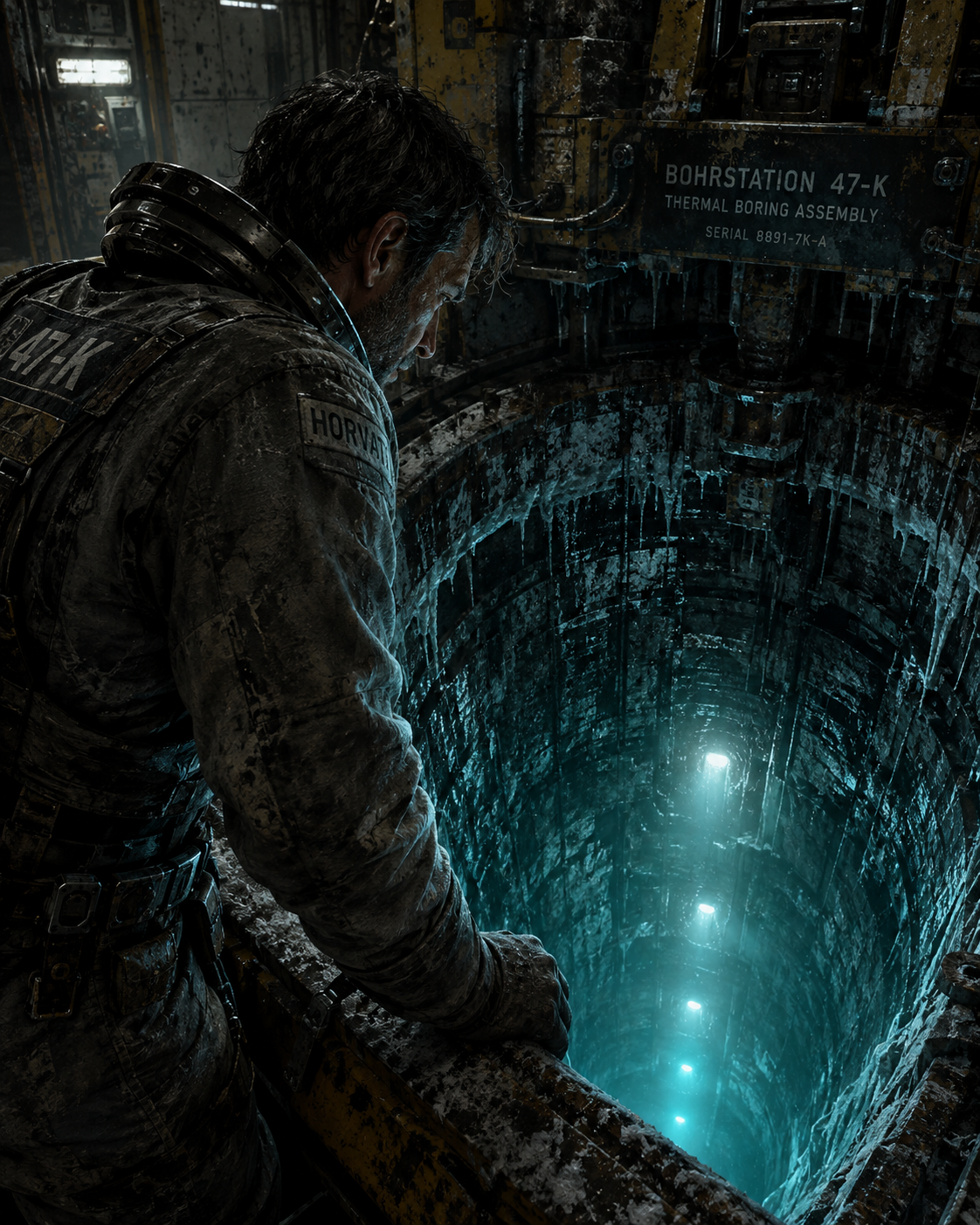
Europa taught Matthias Horvat that courage was mostly a word used by people who were somewhere warm. There was nothing courageous about climbing into a pressure suit at the beginning of a fourteen-hour shift. Nothing heroic about checking the neck seal twice because the first time you checked it you had been too tired to remember doing it. Nothing noble about crawling through a frozen service conduit with a wrench between your teeth because the heating system had failed and somebody had decided sending a man inside was cheaper than shutting down the machinery.
It was work. On Europa, there was always work. Matthias had been doing it for eleven years. His Arbeitsdienst sentence had originally been five. He had stopped asking about that sometime around the seventh.
Officially, Matthias was a Reich laborer assigned to the Europan Resource Authority. In practice, he belonged to whatever supervisor held the day’s work roster. He repaired thermal exchangers, power conduits, drilling equipment, pressure seals, crawler engines, and anything else someone with a cleaner uniform decided could be fixed by a man with tools.
Matthias was forty-five years old. Europa had given him the hands of someone twenty years older. His fingers were thick around the joints. Three nails had never grown properly after frostbite. His right shoulder hurt when he lifted his arm above his head. There was a scar beneath his chin where a pressure fitting had burst six years ago. He could tell when the atmospheric recyclers needed servicing by the taste of the air.
None of those things made him special. Nearly everyone who had survived Europa long enough had similar scars. The dead didn’t. That was the first lesson Europa taught. The second was to trust your instincts. Machines lied. Supervisors lied more. Your body usually didn’t. If the deck vibrated strangely, stop drilling. If the ice groaned twice, move. If your suit suddenly felt warm, check the regulator. If the Vorarbeiter told you there was plenty of time, assume there wasn’t.
Matthias had survived eleven years because he had learned to listen to that quiet voice inside himself. That morning, it told him something was wrong.
There were seven laborers aboard the crawler heading toward Bohrstation 47-K. None knew exactly what had happened there. The official work order said that the station’s thermal boring assembly had suffered a mechanical failure. Matthias and the others were being transferred from Eiswerk 12 to repair it.
Someone asked what had happened to the maintenance crew already stationed at 47-K. The guard told him to shut up. Nobody asked again.
Matthias sat against the bulkhead and tried to sleep. He had learned to sleep almost anywhere – beside turbines, inside cargo compartments, and sitting upright in crawlers. Once, during a thirty-six-hour emergency repair, he had slept for eleven minutes while standing against a wall.
But he couldn’t sleep that morning. Something about the crawler bothered him. Not the machine itself, but the ice. Europa was never truly silent. Kilometers of frozen water shifted under tidal stresses imposed by Jupiter’s immense gravity. Sometimes the sound traveled through the ice and into the crawler’s hull—a distant groan that seemed less heard than felt.
Veteran workers learned to ignore it. Matthias had but this was different. He felt a vibration through his boots – three seconds and then nothing. He looked around. Nobody else seemed to notice. Matthias returned his head to the bulkhead, thinking it was probably ice movement.
Twenty minutes later, the crawler stopped. A section of ice had damaged the port traction assembly. It wasn’t serious, according to the driver. Nothing on Europa was serious to the person who didn’t have to go outside and fix it. Four workers suited up and of course, Matthias was one of them.
Outside, Jupiter dominated the sky. Matthias had seen it thousands of times and still avoided looking at it for long. There was something wrong about an object being that large. Jupiter seemed less like a planet than a wall filling half the universe. Some say if you stare too long you go mad, Matthias didn’t believe that, at least not completely.
He climbed beneath the crawler and surveyed the damage. It wasn’t complicated – A cracked retaining bracket and they had replacements. Maybe forty minutes of work. They only concerned was air and they had spares of that as well.
Matthias lay on his back beneath the crawler while another worker held the replacement bracket in position. His shoulders were already aching when he tightened the first bolt.
The supervisor’s voice came through the radio. “Faster!”
Matthias tightened the second bolt. His suit flashed an oxygen consumption warning. HIs was elevated, so he slowed his breathing, as per his training.
“Faster, Horvat!”
Matthias tightened the third and as he reached for the fourth, he saw it – something beneath the ice. At first he thought it was the crawler’s shadow. He turned his head and the shadow moved. Matthias stopped breathing for a few second.
Europa’s surface was scarred and fractured, layers of ancient ice overlapping one another. In places, pressure and geological activity created strange variations in opacity. Here the ice beneath the crawler had a bluish translucence extending farther down than usual.
Something moved through it. Matthias froze and stared. A faint blue-green light appeared beneath the ice. Then another and then another. They illuminated nothing clearly. They merely suggested scale. Something enormous was moving beneath him.
Matthias felt the wrench slip from his fingers and strike the ice beside his helmet.
“Horvat?” He didn’t answer. “Horvat!”
The worker beside him kicked his boot. “What?”
“You all right?”
Matthias looked toward him and then back at the ice. Nothing, only darkness. May be he was going mad.
“Thought I saw something.” The other worker laughed.
“Congratulations. You found ice.”
Matthias retrieved his wrench. His instincts screamed at him not to run, not to warn anyone, but to keep your mouth shut! So he did. He tightened the fourth bolt.
Bohrstation 47-K was worse than Matthias expected. The thermal boring assembly occupied most of the station’s lowest level. The machine had been designed to melt and drill its way downward through Europa’s crust, sampling deeper ice and creating shafts for geothermal surveys. The drill wasn’t running.
Matthias understood why almost immediately that something had pushed it upward.
The arrogant Reich engineer disagreed. “Thermal deformation.”
Matthias stared at the drill housing where the mounting brackets were bent upward.
“Pressure pocket,” the engineer said smugly.
Matthias crouched beside the assembly and ran his hand across the metal. There were limits to what he understood. He wasn’t an engineer. He had never attended a university. Most of what Matthias knew had been learned by watching someone else do something and then being ordered to do it himself, but he understood broken machinery.
He had spent eleven years fixing broken machinery and could tell the difference between thermal deformation, ice pressure damage and something hitting the boring assembly from below.
He looked down the shaft – nothing but cold darkness. He remembered the lights beneath the crawler. One. Another. Another. Something moving between them.
“Horvat.” Matthias stood.
The Oberemarion supervisor was watching him.
“Herr Vorarbeiter.”
“You crossed Sector Sieben this morning.”
“Yes.”
The supervisor glanced at the engineer and then back at Matthias. “Did you observe anything unusual?” There it was, an opportunity. Matthias could tell them, explain the vibration and the lights. Whatever had moved beneath the ice. Perhaps they would believe him and even reward him.
Matthias almost laughed at that thought. The Reich did not reward forced laborers for discovering things. It interrogated them. Questions became searches. Searches became other questions. Someone would find the extra ration cards hidden behind the ventilation grille in his quarters. Someone might discover the illegal receiver in Staszek’s bunk. Someone would remember that Matthias’s work group occasionally traded machine parts for food.
And if what he had seen really was important? Then Matthias would know something the Reich considered secret and he knew what happened to people who knew secrets. Another thought came to him that surprised him. What if the secret wasn’t his? What if it belonged to Europa. Maybe.
Something enormous lived beneath kilometers of ice without the Reich knowing it was there. Meanwhile the Reich drilled, explored, and claimed. Everything it found became something to exploit, study, control, weaponize, or destroy.
Matthias looked at the bent drill. For eleven years, the Reich had treated him exactly the same way. He was useful until broken. He made his decision.
“No, Herr Vorarbeiter.” The supervisor watched him. Matthias had spent eleven years learning how not to look afraid. “Nothing unusual.”
The supervisor studied him for another second. Then nodded toward the damaged machinery.
“Get back to work.”
“Yes, Herr Vorarbeiter.” Matthias knelt and opened his tool case.
He removed the damaged housing, inspected the first coupling, and began loosening the bolts. They had seized from the cold. His shoulder hurt. His fingers were stiff. He put both hands around the wrench and pulled. It didn’t budge. He repositioned himself and pulled again. It began to give a little.
Behind him, engineers argued about pressure calculations. Above him, the Reich continued its endless business of extracting something useful from every person and every place it possessed. Matthias kept working.
Then he felt it – a familiar vibration traveled through the floor. Once. Matthias stopped but nobody else did. A few seconds later it came again, slow, deep, and deliberate. Matthias looked toward the drill shaft.
Something far below answered with a faint blue-green light. His heart stopped. He lowered his eyes before anyone noticed and his hands returned to the wrench, and pulled. The bolt turned.
Tomorrow they would probably order him back down here. Tomorrow his shoulder would hurt worse. Tomorrow there would be another machine to repair, another supervisor shouting at him, another meal that barely filled his stomach, another shift that lasted longer than it was supposed to. And tomorrow Matthias Horvat would put on his boots. He would check his pressure seals twice. He would pick up his tools. He would go back to work.
Europa had taught him what grit really was. It wasn’t believing things would get better or being unafraid. Sometimes it was simply knowing exactly how frightened and exhausted you were— and pulling the wrench one more time.