

Weekly: Instinct. Daily: Blessed
Shattered Expanse
Corren Vey
There is an old saying among Riftrunners that fortune favors the bold. Corren Vey believes it is incomplete. Fortune favors the bold because the cautious never get close enough to grab it. Corren has spent most of his adult life proving that philosophy correct.
Explorer, relic hunter, sometime smuggler, amateur archaeologist, professional Riftrunner and unapologetic treasure seeker, Corren has made a career out of going where sensible people refuse to go. He has descended into ruins condemned by professional survey teams, boarded derelicts whose crews vanished centuries before, crossed disputed borders using credentials of questionable authenticity, and followed Foldspace coordinates that experienced navigators described as suicidal. He has been shot, stabbed, poisoned, stranded, arrested and once officially declared dead. Twice, according to Corren, although the second government eventually admitted it had confused him with someone else.
Through it all, Corren has survived and more importantly, he usually comes back with something.
Corren was never particularly interested in wealth for its own sake. Money was useful because it purchased fuel, equipment, information and passage to the next place. What fascinated him was finding something that had been lost.
As a young man, Corren devoured accounts of the Terran Empire, the First Builders, isolated Fringe civilizations and the countless mysteries left behind by the Collapse and Long Silence. Where academics saw frustrating gaps in the historical record, Corren saw invitations. Somewhere, the answers still existed, you simply had to be willing to look for them.
He eventually became a licensed Expanse Operative, although the distinction between licensed Riftrunner and unlicensed treasure hunter has occasionally depended upon which side of a customs checkpoint Corren happened to be standing.
His reputation grew and so did the stories. Corren Vey survived because Corren Vey was lucky – at least, that was what everyone else said. Corren disagreed. Luck had very little to do with it. It was honed instinct through experience and grit.
He learned early that there are moments when there simply isn’t enough information. A corridor branches in three directions. A stranger offers you a deal. Sensors give contradictory readings. The floor beneath you makes a sound that nobody else notices. You can stop, debate and calculate probabilities. Or you can choose. Corren takes the latter path.
He has an uncanny ability to notice the insignificant detail that later proves important. He knows when a person is holding something back. He recognizes when an apparently worthless piece of debris deserves another examination. He has abandoned expeditions minutes before disaster and entered ruins moments before someone else decided they were too dangerous. His instincts are not infallible. They are merely right often enough to have kept him alive.
Then Corren found the Benediction of Vael.
The Benediction is one of those artifacts whose reputation is considerably larger than the evidence supporting its existence. References to it appear sporadically across ancient records under several different names: Vael’s Benediction, the Fortune of Vael, the Divided Blessing, and, in one obscure translation Corren particularly favors, the Gift Given Twice.
Who was Vael? The records are unclear. Depending upon the source, Vael was a king, saint, prophet, traveler, conqueror or god. Some historians doubt Vael was a person at all. The word may simply be a mistranslated title from a civilization whose language has been dead for millennia.
The stories agree on only two details. The Benediction was divided into two pieces and whoever reunited them would be “…blessed with great fortune.”
Most reputable scholars consider the legend exactly that – a legend. Corren owns one of the pieces, found it almost by accident.
Corren had joined a small expedition investigating ruins on an uninhabited world well outside the major trade corridors. The expedition wasn’t looking for the Benediction. In fact, nobody on the expedition knew the Benediction had any connection to the site. For three days they found almost nothing but then Corren stopped in front of a wall.
There was nothing unusual about it. Scanners showed solid material. The expedition’s archaeologist had already examined it but Corren stared at it and something bothered him. He couldn’t explain what but the proportions were wrong. Or perhaps they were too perfect.
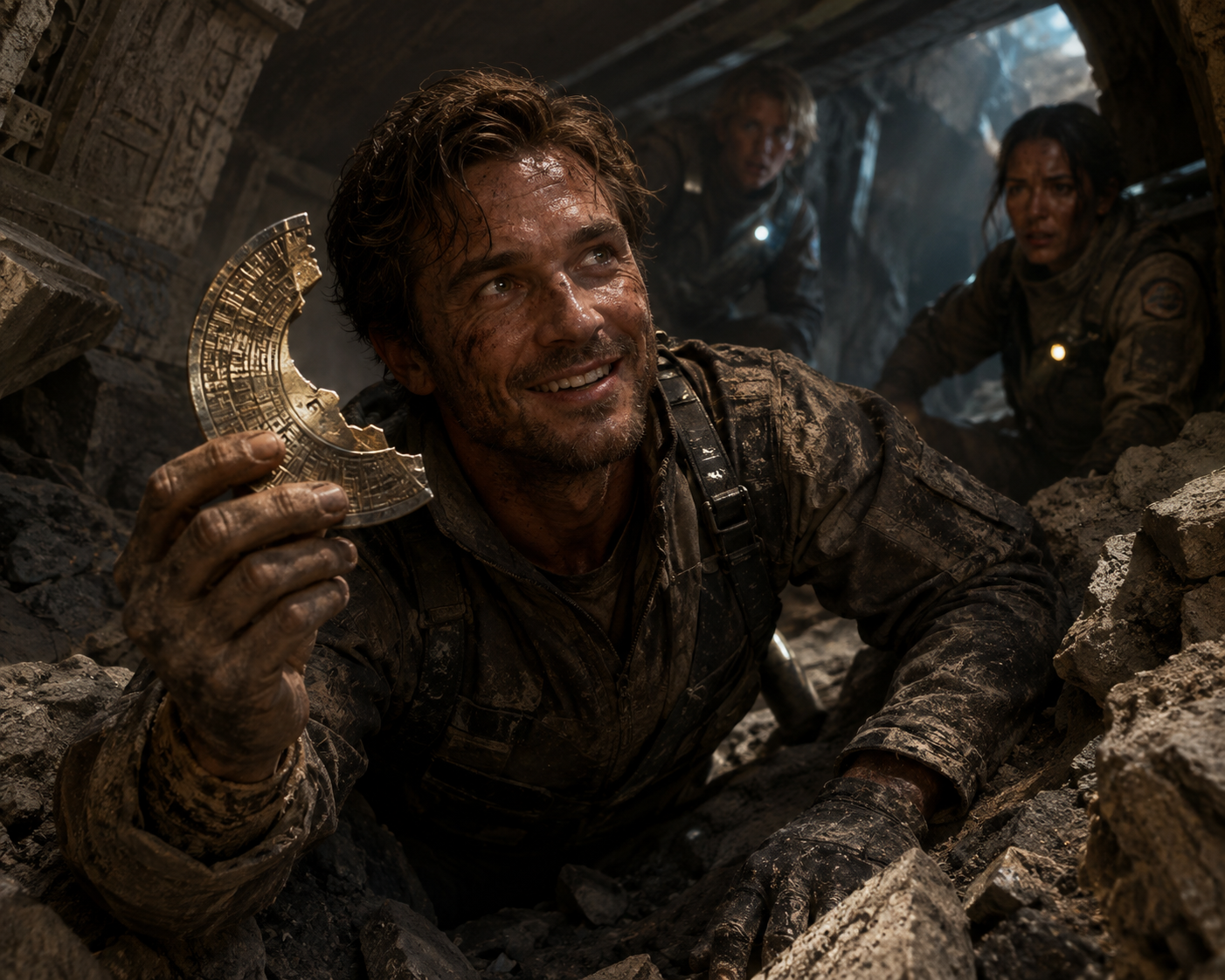
Corren removed a tool and started working. The archaeologist told him he was wasting his time but twenty minutes later they found the cavity. Inside rested a palm-sized crescent of pale metallic material covered in microscopic geometric markings. One edge was smooth. The other ended in an intricate series of projections and recesses suggesting that something was meant to fit against it.
Corren reached for it and someone shouted at him not to touch anything. He didn’t listen. The chamber collapsed. That was the last thing Corren heard for hours until they dug him out. Later, nobody could adequately explain how he survived. A section of flooring gave way beneath Corren at almost precisely the right moment. He dropped into a narrow maintenance cavity while several tons of ancient structure collapsed above him.
When the others dug him out, Corren was bruised, bleeding and laughing but thankfully, the artifact was still in his hand. That was just the beginning.
Afterward, strange things started happening. Nothing impossible. Corren never walked through walls. Bullets didn’t reverse direction. Money didn’t spontaneously appear in his accounts. Things simply seemed to work out – a weapon misfired, a pursuing ship suffered a drive malfunction, or (Corren’s favorite) a customs officer received an urgent call just before opening the compartment containing something Corren would have preferred not to explain.
Once, while escaping an angry group of mercenaries, Corren chose between two identical corridors without hesitation. “This one.” His companion asked why. “Feels right.” Seconds later an explosion collapsed the other passage.
In another instance, a supposedly worthless data fragment purchased from a drunken prospector contained coordinates to an undiscovered ruin. This led to enough credits to pay off a debt with pirates.
Stories spread – Lucky Corren, they called him. Corren hated the nickname, at first. Then he began wondering.
The artifact remained aboard his ship and the more he researched it, the more references he found to people associated with impossible reversals of fortune. Coincidence? Exaggeration? Or just ancient folklore? Or perhaps Corren Vey was carrying half of something that actually manipulated probability.
That possibility should have frightened any normal Riftrunner but instead for him, it became irresistible.
Corren spent years looking for the other half but most leads went nowhere. Some nearly killed him. One led him to a beautifully preserved alien funerary complex that had absolutely nothing to do with Vael but contained enough artifacts to pay his expenses for two years.
Corren considered that evidence that the Benediction approved of his methodology – that it wanted to be completed.
Then buried in an archive assembled from fragments recovered across several unrelated expeditions, he found the inscription. Most researchers had ignored it because the translation was uncertain. Corren recognized a symbol etched into the piece he carried. The surviving passage read:
The Hand of Vael awaits its Brother beneath the Crown of the Dying Sun. Joined again, the Benediction shall make fortunate the hand that bears it.
For the first time, Corren had something better than rumor – a destination. Or at least the beginning of one. The Crown of the Dying Sun appears in several obscure Fringe legends, always associated with an ancient structure somewhere beyond reliable Foldspace routes. Its exact location has been lost. Corren intends to find it. Unfortunately, someone else is looking for it too.
Corren knew someone had been inside his quarters the moment he entered. Nothing was missing and that was part of the problem. A thief would have taken something. The Benediction was exactly where Corren had left it, concealed inside a compartment that shouldn’t have appeared on any schematic. He checked the seals. They remained untouched.
Then he noticed the drinking glass beside his bunk that Corren always left upside down. It was upright. Corren smiled and somehow someone knew.
The next morning he discovered that three archival records concerning the Crown of the Dying Sun had been accessed within hours of his own searches. One had subsequently been deleted. Someone wasn’t following Corren – they were racing with him.
For most people, that realization would have been cause for caution. For Corren Vey, it was confirmation that there really was something at the end of the trail. He returned to his ship, tossed his pack into the cockpit and began plotting the first of several extremely questionable Foldspace jumps.
His navigator looked at the route, then at Corren, then back at the route. “That’s insane.”
Corren settled into his chair. “Probably.”
“We don’t even know what’s there.”
“No.”
“We don’t know who we’re racing.”
“No.”
“And your entire argument for doing this is that an ancient piece of metal is supposedly going to make you lucky?”
Corren considered that. “No.”
He reached beneath his shirt and pulled out the small crescent of pale metal hanging against his chest.
“The artifact isn’t why we’re going.”
“Then why are we going?”
Corren looked through the cockpit glass toward the stars. Somewhere beyond them was a place where people had hidden something and forgotten. Someone else desperately wanted to find it and every instinct Corren possessed was screaming at him to go.
He grinned. “Because I think we’re going to get there first.”