

Shattered Expanse
In the world of Shattered Expanse, when I think of Privilege, I think of the upper echelons of leadership. The Human Confederation is primarily led by the human faction known as the Luminar Accord. This faction has the closest relationship with the mysterious Sarginians, the aliens responsible for establishing the Expanse. That relationship with one of the oldest and most influential civilizations in known space has brought the Luminar considerable political and diplomatic privilege, as well as a degree of mistrust and resentment from the other human factions.
President Nickolas Cauthron Layton of the Luminar Accord is the duly elected leader of the Human Confederation and, in many ways, embodies that privilege. Layton was born into a world where doors were already open to him. His family was well connected within Luminar society, he received an exceptional education, and from an early age he moved comfortably among diplomats, military officers, corporate leaders, and Sarginian representatives. Opportunities that others might spend their entire lives pursuing were simply part of the environment in which Layton grew up.
None of this means that Layton is incompetent or undeserving of his position. He is intelligent, charismatic, politically skilled, and genuinely believes in the Human Confederation. He won the presidency through legitimate elections and takes the responsibilities of the office seriously. His privilege does not invalidate his accomplishments; it means that he began his journey with advantages unavailable to most of the people he now governs.
His Luminar heritage carries advantages of its own. Sarginian officials are more willing to meet with him, Luminar institutions instinctively understand how to navigate Sarginian protocols, and generations of diplomatic contact have given his people access to relationships and knowledge unavailable to newer members of the Expanse. Layton may enter a Sarginian diplomatic chamber expecting to be heard while another human leader enters wondering whether they will be permitted to speak at all.
This creates one of Layton’s greatest political weaknesses: he does not always recognize privilege when he encounters it. To him, many of these advantages simply feel normal. He believes strongly in merit, cooperation, and opportunity because those principles appear to have worked throughout his own life. When someone from the Frontier, Dominion, or another human faction tells him that the Confederation does not treat everyone equally, his first instinct may be genuine confusion rather than dismissal. From his perspective, the institutions are open to everyone. He does not always see how much easier those institutions are to navigate when one was born knowing the people who built them.
Among his supporters, Layton represents the best of the Luminar Accord: educated, cosmopolitan, diplomatic, and committed to maintaining humanity’s place within the Expanse. Among his critics, he represents an entrenched Luminar establishment that speaks constantly of unity while continuing to enjoy disproportionate access to Sarginian influence, advanced institutions, and the highest levels of Confederation government. Both perceptions contain some truth.
Layton can walk into situations where the Sarginians simply treat him differently because he is Luminar. Nobody passed a law granting him that advantage. Nobody necessarily intends to discriminate against the other factions. Centuries of relationships, protocols, personal connections, shared history, and institutional familiarity simply produce that outcome.
Sarginian Privilege
Requirements: Novice, GM approval; appropriate background or relationship with the Sarginians
For reasons of history, lineage, service, or cultural affiliation, the character is regarded favorably by the Sarginians. They are not Sarginian themselves, nor do they possess any formal authority over them, but Sarginians tend to extend them courtesies and consideration rarely afforded to outsiders.
The character gains +2 to Persuasion and Networking rolls involving Sarginians and receives a +1 bonus to Reaction rolls from Sarginian NPCs.
More importantly, the character is granted a degree of presumed access. Sarginians may agree to meetings normally denied to outsiders, answer questions they would otherwise dismiss, permit the character into restricted diplomatic or cultural spaces, or give serious consideration to requests from the character. This never compels a Sarginian to cooperate, reveal protected information, violate their laws, or act against their interests.
The privilege has consequences. Other peoples of the Expanse recognize the special relationship, and some view it with suspicion or resentment. When the character’s Sarginian connections are known and relevant, the GM may impose a –2 penalty to Persuasion or Networking with individuals openly distrustful of Sarginians or those who resent their influence.
I think there’s an important distinction worth preserving: Sarginian Privilege isn’t necessarily something the character earned. That’s what makes the name work.
Nickolas Layton might possess it because he grew up within the Luminar political establishment, but another character could have it for entirely different reasons. A Frontier explorer who once saved a Sarginian delegation might have acquired the same Edge through personal history. A character could even be baffled as to why the Sarginians treat them differently.
That last possibility feels especially useful given how mysterious the Sarginians are. A player taking Sarginian Privilege could potentially be handing the GM a very interesting unanswered question: Why do the Sarginians know who you are?
President Nickolas Cauthron Layton
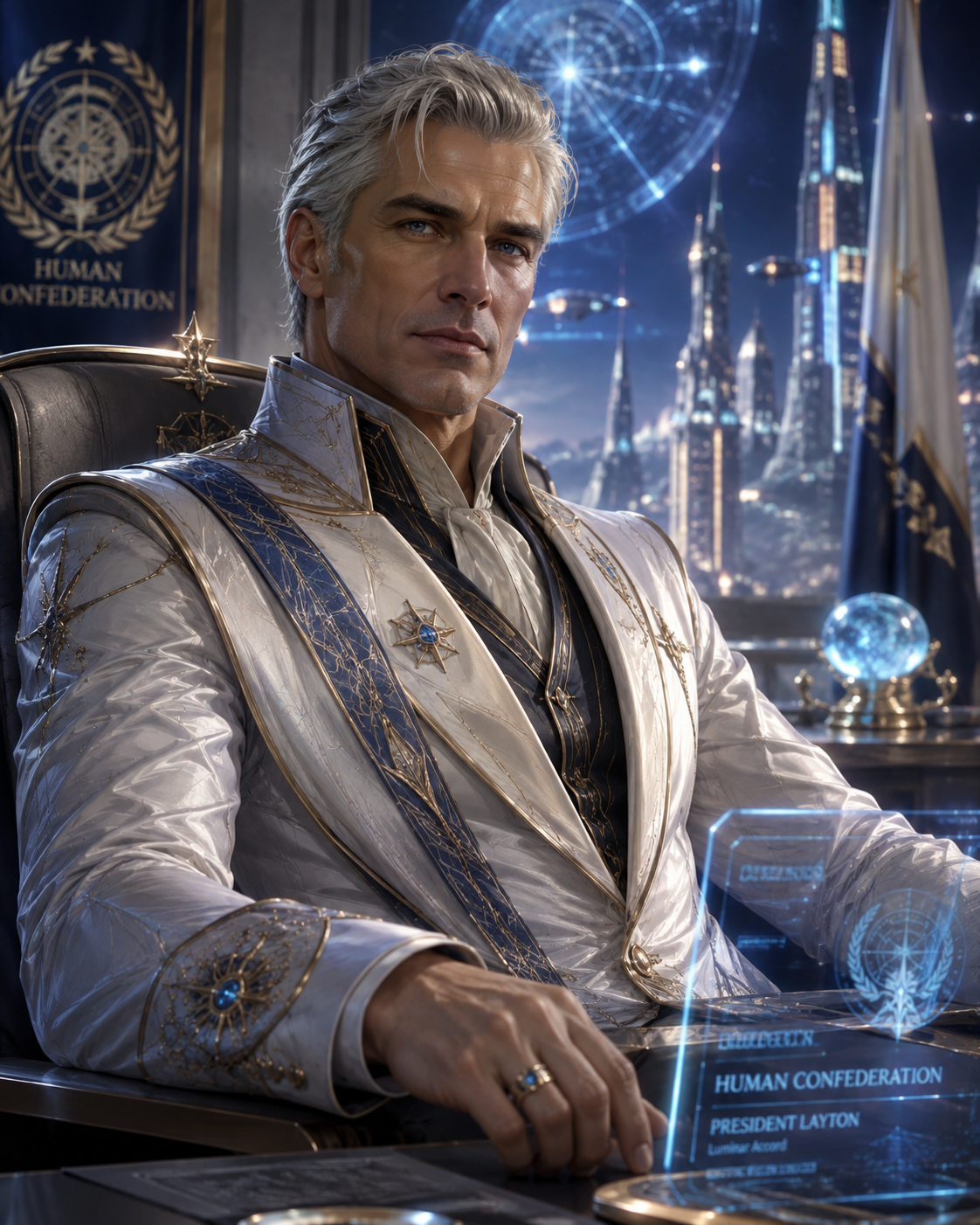
Luminar Human, President of the Human Confederation — Wild Card
Attributes: Agility d6, Smarts d10, Spirit d10, Strength d6, Vigor d6
Skills: Academics d10, Athletics d4, Common Knowledge d12, Fighting d4, Notice d8, Persuasion d12, Research d8, Shooting d4, Stealth d4
Pace: 6; Parry: 4; Toughness: 5
Hindrances: Cautious (Minor), Loyal (Confederation), Obligation (Major—President of the Human Confederation), Overconfident (Minor)
Edges: Charismatic, Connections (Confederation Government), Connections (Luminar Accord), Command, Humiliate, Sarginian Privilege, Diplomatic Neuroconditioning, Resonant Mediator
Sarginian Privilege: Layton gains +2 to Persuasion and Networking rolls involving Sarginians and +1 to their initial Reaction toward him. His position within the Luminar establishment also gives him a degree of presumed legitimacy among the Sarginians, allowing him to request audiences and diplomatic consideration normally unavailable to most humans. This is influence, not authority; Sarginians remain free to refuse his requests.
Diplomatic Neuroconditioning: Diplomatic Conditioning. You gain +2 to Persuasion and Performance rolls involving negotiation, mediation, or conflict resolution. Once per encounter, you may reroll a failed Persuasion test.
Resonant Mediator: As an action, make a Persuasion roll opposed by Spirit against all hostile targets in a Small Burst Template. On success, affected targets cannot take offensive actions on their next turn unless attacked first. This is not mind control – it’s emotional stabilization.
Gear: Personal communicator, executive identification implant, formal diplomatic attire. When traveling outside secure areas, Layton is normally accompanied by a Confederation presidential security detail.
Languages: Luminar Standard, Confederation Standard, Sarginian (conversational).
This gave me an idea for a Savage Worlds Edge for Shattered Expanse.
Sarginian Privilege
Requirements: Novice, GM approval; appropriate background or relationship with the Sarginians
For reasons of history, lineage, service, or cultural affiliation, the character is regarded favorably by the Sarginians. They are not Sarginian themselves, nor do they possess any formal authority over them, but Sarginians tend to extend them courtesies and consideration rarely afforded to outsiders.
The character gains +2 to Persuasion and Networking rolls involving or connecting to Sarginians and receives a +1 bonus to Reaction rolls from Sarginian NPCs.
More importantly, the character is granted a degree of presumed access. Sarginians may agree to meetings normally denied to outsiders, answer questions they would otherwise dismiss, permit the character into restricted diplomatic or cultural spaces, or give serious consideration to requests from the character. This never compels a Sarginian to cooperate, reveal protected information, violate their laws, or act against their interests.
The privilege has consequences. Other peoples of the Expanse recognize the special relationship, and some view it with suspicion or resentment. When the character’s Sarginian connections are known and relevant, the GM may impose a –2 penalty to Persuasion or Networking with individuals openly distrustful of Sarginians or those who resent their influence.
GM Note: Layton’s Guardian Angel
Layton’s Privilege extends farther than even he realizes.
Unknown to Layton, a Herald of Sargo has been assigned to watch over him. Wherever Layton goes, the Herald is never far away. In the dense urban environments he favors, it remains concealed among the architecture—perched atop distant towers, hidden within maintenance levels, standing motionless in abandoned structures, or observing from some shadowed place high above the streets.
Layton has never knowingly seen it.
The Herald does not accompany him openly, nor does it interfere with the ordinary dangers of his life. Its purpose is not to make Layton invulnerable or spare him every consequence. It watches, evaluates, and waits. Only when a threat exceeds what Layton could reasonably survive—or when his continued existence becomes important enough to Sarginian interests—does the Herald act.
When it does, its intervention should be subtle whenever possible. A pursuer disappears. A weapon inexplicably fails at the crucial moment. A sniper never takes the shot. Someone preparing an ambush is later found unconscious—or simply never seen again. Layton is free to attribute such incidents to luck, coincidence, his reputation, or the advantages his position affords him.
The Herald itself remains the final contingency.
Should circumstances ever force it to reveal itself, the appearance of an otherwise ceremonial and openly deployed Herald of Sargo acting specifically in Layton’s defense should be a significant revelation. Heralds are normally living symbols of the Continuum’s authority—beautiful, alien, and terrifyingly effective instruments of Sarginian judgment. One hiding in the shadows solely to protect a single individual is anything but normal.
Privilege, it seems, even extends to the kind Layton is unaware he possesses.
Blood & Suns
Privilege means something totally different in the world of Blood & Suns. Privilege is only available to the elite class. In the Reich, the Vice President of the Reich State of America is Chancellor Konrad Wilhelm Reinhardt.
MONOLITH INTELLIGENCE REPORT
SUBJECT: KONRAD WILHELM REINHARDT
Classification: BLACK STAR // EYES ONLY
Status: Prospective Political Asset
Current Position: Vice President, Reich State of America
Ancestry: Edel Über
Place of Birth: Reich State of America
Political Affiliation: National Socialist Party
Assessment: DISILLUSIONED / POTENTIALLY RECRUITABLE
Operational Value: EXTREME
Operational Risk: EXTREME
SUBJECT OVERVIEW
Vice President Konrad Wilhelm Reinhardt is one of the highest-ranking political figures in the Reich State of America and among the most socially privileged individuals on the North American continent. He is an Edel Über, born through a state-directed eugenics program specifically intended to produce candidates for senior political, military, and administrative leadership. Reinhardt has never experienced life outside the Reich elite.
He has never stood in a ration queue. He has never undergone a labor assignment. He has never been stopped at a checkpoint without the officer already knowing his name. He has never worried whether an illness would be treated, whether his residence would be searched, whether his employment would be reassigned, or whether an inappropriate statement might result in his disappearance.
Doors do not simply open for Konrad Reinhardt. Most were built open. This distinction is important when evaluating his growing hostility toward the Reich government. Reinhardt is not a victim of the system in any conventional sense. He is one of its intended beneficiaries.
THE REINHARDT LINE
The Reinhardt family traces its documented ancestry to German immigrants who settled in the former United States generations before the Greater War. Following the Reich consolidation of North America, the family’s German heritage, political reliability, and favorable genetic markers brought them into increasingly prestigious state circles.
By the late 21st century, the Reinhardts were no longer simply a family. They were a breeding line. Konrad’s parents were selected for participation in an advanced Edel eugenics program intended to produce politically viable leadership candidates adapted specifically to the Reich State of America. Their marriage was arranged through genetic compatibility assessments, psychological profiling, hereditary disease screening, and ideological evaluations.
Konrad and his identical twin brother, Klaus Wilhelm Reinhardt, were the program’s most celebrated result. State physicians monitored the twins before birth. Their childhood nutrition, education, physical development, psychological conditioning, social exposure, and eventual career paths were carefully managed. Their family publicly referred to them as sons.
Internal records referred to them as the Reinhardt Pair. Both boys were raised knowing that they were exceptional. Not talented. Not fortunate. Superior.
CHILDHOOD
Reinhardt’s childhood bears almost no resemblance to that experienced by the overwhelming majority of citizens in the RSA. The brothers were raised on a secured family estate outside one of the principal Über districts, with private instructors, domestic staff, medical personnel, security officers, and government-appointed educational supervisors.
Most Ünter children encounter the Reich first through discipline. Konrad encountered it through service. His teachers came to him. Doctors made house calls. Government officials remembered his birthday. Military officers addressed him respectfully while he was still a child. His first firearm was presented ceremonially during adolescence. His first government identification granted him access to places most citizens could not enter in their lifetime. A chauffeur transported him past districts whose residents required transit authorization simply to cross into the next sector. There is no evidence Reinhardt found any of this unusual. Why would he? He had never known anything else.
EDUCATION AND POLITICAL DEVELOPMENT
Konrad and Klaus attended the elite Canton Party Academy (former Ohio) intended for the children of senior Über families. Their curriculum combined political philosophy, statecraft, economics, military history, rhetoric, diplomacy, behavioral psychology, and Reich racial doctrine. Evaluations consistently described Konrad as charismatic, socially perceptive, and unusually talented at political negotiation. His Edel traits were apparent early.
Observers noted that Reinhardt could dominate a room without raising his voice. Instructors frequently reported that other students unconsciously deferred to him during group exercises, even when no formal command structure existed. The Reich interpreted this as proof of successful genetic design. So did Konrad.
His brother Klaus developed differently. Where Konrad excelled at persuasion and negotiation, Klaus demonstrated a stronger ideological commitment to the Reich itself. Klaus became known for discipline, orthodoxy, and an almost instinctive deference to established hierarchy. The distinction between the brothers appears to have begun here. Klaus believed they had been created to serve the Reich. Konrad increasingly believed the Reich had created them to rule it. The difference would not become politically important for several decades.
CAREER
Reinhardt’s political rise was extraordinarily rapid by ordinary standards and entirely predictable by Edel standards. He served briefly in several prestigious administrative positions, none long enough to develop genuine expertise but each long enough to establish the appearance of experience. Appointments followed one another with little interruption. Municipal administration, Regional Party advisory boards, Federal economic committees, Diplomatic assignments, and Party leadership councils. Eventually he landed in national office.
At virtually every stage, more experienced officials were responsible for the actual administrative work beneath him. Reinhardt gave speeches, chaired meetings, and announced initiatives while others implemented them. His political biography describes this progression as evidence of exceptional leadership.
Monolith assessment suggests something simpler:
Konrad Reinhardt has spent his entire life being prepared for the next room before he fully understood the one he was already standing in.
This should not be mistaken for incompetence. Reinhardt is intelligent, educated, persuasive, and politically sophisticated. But he has rarely suffered the consequences of failure. When one initiative collapsed, subordinates were blamed. When another exceeded its budget, additional funding appeared. When he publicly contradicted an established policy early in his career, Party officials quietly revised the official transcript. When security personnel discovered prohibited literature among the possessions of one of his university associates, the associate disappeared. Reinhardt was questioned for eleven minutes. The incident never appeared in his record. He may not even recognize these events as privilege. To him, they are simply how the world functions.
THE VICE PRESIDENCY
Reinhardt accepted the vice presidency believing it would position him as the natural successor to the RSA presidency. Instead, he discovered that the office possesses substantially less influence than he expected.
The President maintains direct relationships with Berlin, the SS, major industrial interests, military leadership, and the federal security apparatus. Important strategic decisions frequently reach Reinhardt only after they have already been made. Reinhardt attends ceremonies, receives foreign dignitaries, and addresses Party congresses. He represents the administration at memorials, industrial openings, military graduations, and public celebrations. He is photographed constantly, consulted selectively and the distinction appears to infuriate him.
According to several indirect sources, Reinhardt has privately described the vice presidency as a “golden waiting room.” The remark is perhaps the most accurate description of his present psychological condition. For the first time in his life, Konrad Reinhardt has encountered a door that does not automatically open and he does not like it.
DISILLUSIONMENT
Monolith surveillance indicates that Reinhardt’s political dissatisfaction has grown substantially during the last several years. He has questioned the competence of RSA security agencies, privately criticized Berlin’s interference in domestic affairs, expressed frustration with SS oversight, and argued that the RSA government has surrendered too much autonomy to European leadership.
More significantly, Reinhardt has begun criticizing aspects of Reich governance itself. His language remains careful, he does not speak of democracy nor does he speak of equality. Instead, he speaks of waste, inefficiency, stagnation, and mismanagement. He has questioned whether constant surveillance produces loyal citizens or merely frightened ones.
He has argued that compulsory labor assignments damage productivity and privately called several ancestral regulations politically obsolete. Reports say he has reportedly questioned whether Berlin understands America at all in local bar halls. These statements would constitute serious ideological deviations from almost anyone else and Reinhardt continues to make them.
Still there has been no arrests or midnight visits. No one has called for a disciplinary tribunal and his remains in the public eye. This fact should not be overlooked. Even Reinhardt’s rebellion is protected by his privilege. And this could be used.
RELATIONSHIP WITH KLAUS REINHARDT
Klaus Wilhelm Reinhardt remains one of Konrad’s closest personal relationships and potentially his greatest vulnerability. The twins remain physically almost indistinguishable despite minor cosmetic differences deliberately maintained in adulthood. Klaus has pursued a career aligned more closely with Party administration and national security circles and is regarded by all available intelligence as a committed loyalist. Klaus is aware of his brother’s dissatisfaction but we do not believe he understands its full extent.
Their disagreements appear increasingly personal. Klaus reportedly views Konrad’s complaints as vanity and according to one intercepted private exchange, Klaus told his brother:
You were given everything a man could be given, and somehow you have convinced yourself that you were cheated.”
Our analyst responsible for the Reinhardt file noted: Klaus may understand Konrad better than we do. Konrad’s resentment toward the Reich is real and so is Klaus’s accusation.
PRIVILEGE AS PSYCHOLOGICAL BLINDNESS
Reinhardt has spent his entire life looking downward at the structure of Reich society. He has rarely had reason to look upward. However, the vice presidency changed this. For perhaps the first time, Konrad has discovered that there are people who can dismiss him, restrict him, exclude him, and determine his future without consulting him.
He has interpreted this experience as injustice. This creates an obvious contradiction but also opportunity, given the right manipulation. A man who has accepted the subjugation of millions has become politically radicalized by discovering that his own authority has limits. Monolith personnel approaching Reinhardt must understand this clearly.
Do not mistake wounded entitlement for ideological awakening.
At present, Reinhardt does not appear to believe that the Reich’s victims deserve freedom. He believes the Reich has become unworthy of him and that difference may eventually disappear. So the opportunity is now.
WHY MONOLITH IS INTERESTED
Whatever his motivations, Reinhardt represents an intelligence opportunity of extraordinary proportions. His office provides direct or indirect access to RSA executive schedules, Federal security briefings, Military readiness reports, Party leadership communications, Industrial production data, Internal political rivalries, Berlin-RSA communications, SS political assessments and Presidential travel and security arrangements.
Reinhardt also possesses relationships across the highest levels of Über society that would take Monolith decades to reproduce independently. He does not need to steal documents. People tell him things because they assume he belongs in the room. That may be his greatest operational value.
RECRUITMENT ASSESSMENT
Reinhardt should not initially be approached as a prospective member of Monolith. He is not ready and likely never be. Instead, he should be cultivated and manipulated as a confidential source who believes he is participating in an internal effort to reform or protect the RSA from extremist elements.
Appeals to universal freedom are unlikely to succeed. Appeals to his intelligence, dignity, political legacy, and belief that the RSA is being mismanaged are substantially more promising. He must believe he reached his conclusions independently. His Edel psychology will resist any implication that someone else “opened his eyes.” Give him information and allow him to discover its meaning. Let his own arrogance do the rest.
CRITICAL WARNING
Konrad Reinhardt has never meaningfully risked everything. If exposed, he may discover very quickly that his commitment to reform ends when his estate, medical treatments, reputation, family, and life are threatened. He has spent decades criticizing a cage while holding the keys. We do not yet know what he will do when someone asks him to open it.
ANALYST’S NOTE
There is a temptation within Monolith to romanticize defectors from the ruling class. Do not do that with Reinhardt. He eats food grown by people he has never met. He lives in buildings cleaned by workers he never sees. He travels through checkpoints that inconvenience him only because his vehicle occasionally has to slow down. He has signed legislation whose penalties he could never personally suffer. He has visited labor districts as part of carefully managed political tours and returned home afterward to an estate where the evening temperature had already been adjusted to his preference.
And now he is angry because the President does not take him seriously. That anger may give us access to the heart of the RSA government. Use it but never confuse access with virtue.
#RPGaDAY2026