

Shattered Expanse
Nothing in Shattered Expanse embodies the idea of Secrets more completely than the Sarginians. They formed the Expanse, gathering races into its shelter while empires crumbled around them. They freed entire peoples from slavery and gave them the opportunity to thrive, while standing by as others dwindled to the edge of extinction. They have intervened in wars, shaped the destinies of civilizations, and withheld their hand when intervention might have saved billions. Yet through all of this, no answer has ever been given to the most obvious question: Why? The Sarginians know. They simply aren’t telling.
Ambassador Jinedanel Calthatari knows at least some of those answers.
To the Human Confederation, Calthatari is the face of the Sarginians. She is an accomplished diplomat, a patient negotiator, and one of the Confederation’s most important connections to the enigmatic people who created the Expanse. She has served alongside presidents, diplomats, explorers, and military leaders, but few humans have grown as close to her as President Nickolas Cauthron Layton. Their relationship has long since moved beyond diplomacy. Layton considers her a trusted adviser and, more importantly, a close personal friend. Jinedanel feels much the same toward him. But friendship does not mean honesty.
Jinedanel is considerably older than she allows others to believe. Her memories reach back through events that most inhabitants of the Expanse know only through histories, fragmented records, and Sarginian accounts carefully prepared for outsiders. She knows the circumstances surrounding the formation of the Expanse and understands that the Sarginians’ great acts of salvation were not always as altruistic as they now appear. She knows truths concerning the collapse of the Terran Empire that could fundamentally alter humanity’s understanding of its own history. Whether the Sarginians merely witnessed that catastrophe, attempted to prevent it, or played some role in bringing it about is something Jinedanel has never revealed.
More troubling are the things she knows about the Abyss. To most, the Abyss is the chaotic space that exists somewhere between Reality and Foldspace – a place encountered through terrible accident, reckless experimentation, or circumstances that Sarginian science insists should never occur. Jinedanel knows better. She knows enough to recognize the signs of its influence, enough to fear those who return touched by it, and enough to understand why some Sarginian records concerning the Abyss were not merely classified, but deliberately erased.
There are questions even Nickolas Layton has learned not to ask her. Perhaps the greatest secret surrounding Jinedanel Calthatari, however, is not any single truth she possesses. It is that no one outside the highest circles of Sarginian society knows exactly how much she knows. She can speak with complete sincerity while revealing only a fraction of the truth. She can answer a question accurately while leaving its most important implication unstated. She has practiced this art for longer than most human nations have existed.
Jinedanel does not consider herself a liar. She considers herself a custodian. Some truths can change governments. Some can destroy civilizations. And some, she believes, become dangerous simply by being known.
GM Secret: The Truth of Sanctuary

Jinedanel Calthatari knows the true origin of Sanctuary Station. It is not Sarginian. It is Shri’iki.
Long before the peoples of the modern Expanse discovered the station, Sanctuary was a massive Shri’iki invasion platform—part warship, part mobile staging ground, designed to transport troops, weapons, and perhaps entire armies across extraordinary distances. Its strange internal dimensions and seemingly impossible architecture were not originally supernatural phenomena. They were products of advanced Shri’iki spatial engineering, allowing a structure far larger internally than its exterior dimensions should permit.
Then something went catastrophically wrong. During an ancient campaign, the platform attempted a jump directly into—or through—the region now known as the Rift. Whether the Shri’iki understood what lay there remains uncertain even to Jinedanel. The jump failed, and the station did not simply suffer a Foldspace accident. It entered the Abyss. What emerged was no longer entirely the vessel that entered.
Sanctuary’s impossible corridors, temporal echoes, shifting geometry, strange psionic behavior, and apparent ability to repair or rearrange itself are consequences of that exposure. The Abyss became embedded within the station’s systems and architecture. Shri’iki spatial technology survived, but its rules were rewritten by something that does not obey the ordered laws of Reality or Foldspace.
The Core Well is not a reactor in any conventional sense. It is the remains of the platform’s original Foldspace transit system, permanently contaminated by the Abyss and still maintaining some form of connection to it.
This is why the Shri’iki avoid Sanctuary. They recognize it. More importantly, they know what happened to it.
The Sarginians discovered the truth long ago and quietly concealed it. Officially, Sanctuary remains an artifact of unknown origin. Even most Sarginians know little more than this. Jinedanel is among the handful who have access to the surviving records of the incident.
She has never told President Nickolas Cauthron Layton. Not because she does not trust him. Because she does.
Blood & Suns
DELPHI
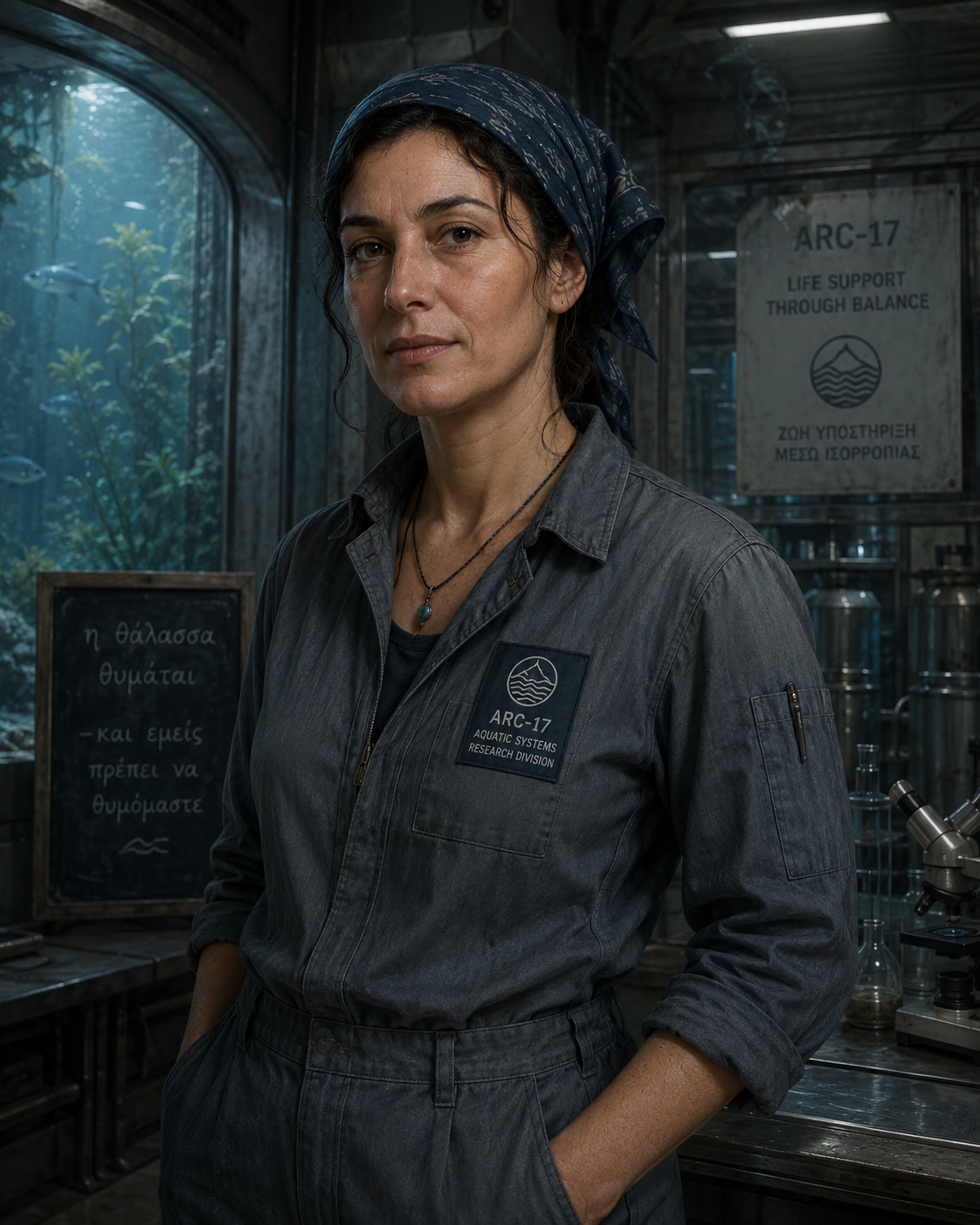
The Woman No One Knows. Few within Monolith have ever met Directorate Codename DELPHI. Fewer still know her real name. Among field personnel, there are persistent assumptions that Delphi is a committee, an intelligence-analysis system, an old OSS-derived computer network, or simply a codename used collectively by several senior operatives. Monolith has never bothered correcting any of these theories.
The truth is considerably less impressive—and consequently much safer.
Delphi is an Unter woman of Greek descent living in one of the Mediterranean’s submerged arcologies. Officially, she is a marine biologist employed in the arcology’s aquaculture and environmental-management systems. Her work concerns algae cultures, fish stocks, nutrient recycling, contamination control, and maintaining the carefully engineered ecosystem that keeps thousands of inhabitants alive beneath the Mediterranean. Her personnel record describes a technically competent but politically insignificant colonial scientist. She attends work, files reports, complains about maintenance schedules, and possesses precisely the sort of career the Reich expects an educated Unter to possess: useful enough to retain, but never important enough to notice.
Her neighbors know another Delphi entirely—though they do not call her that. To them, she is the quiet woman who knows which families are hungry.
Using her access to aquaculture production data, she has spent years helping several small resistance groups divert food from government-controlled production facilities. A few kilograms disappear here. A shipment is recorded as contaminated there. Fish mortality figures are inflated. Nutrient cultures supposedly destroyed by bacterial outbreaks instead find their way into improvised kitchens. Individually, the discrepancies are meaningless. Collectively, they feed hundreds of people the Reich’s rationing system has abandoned or deliberately deprived.
The resistance cells believe she is one of them. They do not know she is one of the people running Monolith.
Directorate Assessment: SECRET
Delphi understands something many intelligence officers never learn: the best secret is not information that nobody knows. It is information everyone believes they already understand. Her marine biology career and concern for hungry families is real. Her participation in the food thefts is a risk but something she is driven to do. Her contacts are true friendships and they trust her. Her resentment toward the occupation authorities is genuine. None of these things she considers a cover. They simply one part of her life – the incomplete truth.
Her position gives Monolith something far more valuable than another hidden headquarters. Mediterranean aquaculture facilities maintain connections with shipping, atmospheric processors, pharmaceutical suppliers, arcology engineering departments, naval logistics, food-distribution networks, and environmental monitoring stations. Delphi consequently sits inside an enormous flow of seemingly mundane information. A change in fish-production quotas can reveal an approaching troop deployment. Unexplained chemical orders can expose a classified research program. Alterations in naval exclusion zones appear first as environmental restrictions. Increased ration reserves can indicate that authorities expect civil unrest before the Sicherheitsdienst tells anyone else.
Delphi reads the Reich through what it eats, what it grows, what it moves, and what it suddenly stops allowing civilians to see. That talent eventually brought her to Monolith’s attention. What began as a local source became an analyst, then a handler, then a regional coordinator. Somewhere along the way she crossed an invisible threshold and became one of the Directorate.
Almost nobody noticed and that was intentional.
The Secret Behind Delphi
Delphi does not know the identities of the other Directorate members either. Monolith learned long ago what happens when resistance movements create identifiable councils of leadership. Delphi therefore helped establish a compartmentalized Directorate system in which members communicate through carefully isolated channels and operational identities.
GM Note: The Directorate’s Secret
Delphi knows one secret shared by every member of the Monolith Directorate because she was personally involved in making it possible.
They are all much older than they appear.
At some point in Monolith’s history, the organization acquired access to Life Extension Treatments normally reserved for the privileged classes of the Regimes. The Directorate decided that certain individuals—and the knowledge, experience, contacts, and institutional memory they possessed—were simply too valuable to lose. Delphi was among those selected.
Her scientific background meant that Delphi did more than receive the treatments. She participated in the program itself. She knows who received them, understands something of the process used to keep them alive, and knows the true ages of people whose supposed predecessors were sometimes simply earlier identities of the same person.
To most of Monolith, the Directorate is an institution whose membership changes over generations. Directors retire, die, disappear, and are replaced. Codenames pass from one individual to another. Sometimes that is true. Sometimes only the name changes.
Delphi understands why the Directorate chose this path. Monolith’s struggle spans generations, while the Regimes possess governments, bureaucracies, intelligence services, and institutions capable of surviving for centuries. Preserving experienced leaders gave Monolith continuity that an ordinary resistance movement could never possess.
But Delphi also recognizes the terrible contradiction. Monolith condemns societies whose privileged elites enjoy extended lives while ordinary people struggle for food, medicine, and shelter. Yet hidden within Monolith is another tiny group of powerful individuals who decided that their own lives were important enough to extend.
This is one reason Delphi still steals food. Her involvement with the small Mediterranean resistance cells is unnecessary for someone of her position. It is dangerous. Directorate protocols would be better served if Delphi remained isolated, protected, and far removed from petty acts of sabotage that might expose her. She refuses.
Delphi deliberately continues working beside people who have no idea who she really is. She helps falsify production reports. She reroutes food shipments. She crawls through maintenance passages with frightened young resistance fighters. She carries crates herself when another pair of hands is needed. She knows the families receiving the stolen food, hears their complaints, watches their children grow, and occasionally watches those same people disappear into Reich custody. She does it to remain grounded.
After living far longer than an ordinary person should, Delphi fears something more than capture or death: she fears becoming detached. She has watched generations grow old while she remained. She has seen resistance movements appear, fracture, and disappear. People she once knew as children have died of old age. Causes that once seemed immediate have become entries in Monolith archives.
The local resistance prevents those people from becoming statistics.
When Delphi helps steal food, the struggle becomes a hungry family rather than a strategic objective. When she risks arrest beside an inexperienced resistance fighter, she remembers what courage looks like when someone does not possess decades of training, secret medical treatments, or the protection of the Directorate.
The others believe Delphi helps them because she is one of them. In a sense, they are right. She works very hard to make sure she still is.
No stats this time. These two are too big to stat out. They have big roles in the overall story and really should seem larger than life.
#RPGaDAY2026