

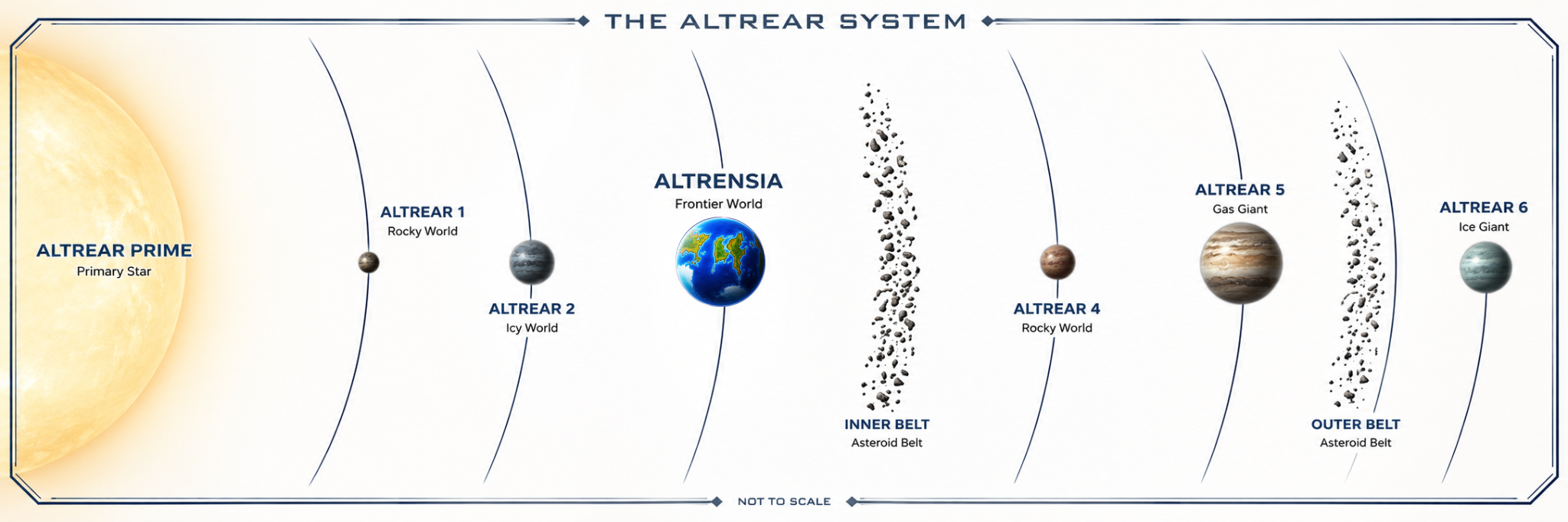
Altrensia
System: Altrear
Altrensia is a stark, wind-carved frontier world of vast ochre plains, fractured basalt highlands, and cold inland brine seas that shimmer beneath a pale sun. Constant winds sculpt towering rock formations and drive fine mineral dust across much of the surface, creating landscapes both breathtaking and unforgiving. While the atmosphere is fully breathable, its reduced oxygen content leaves most humans and many alien species fatigued during prolonged exertion. Visitors commonly wear rebreathers or oxygen-assist masks when working outdoors for extended periods.
Native life is resilient rather than abundant. Tough silica-reinforced grasses ripple across the plains, interspersed with hardy vascular shrubs capable of surviving months without rainfall. Slow-moving grazing animals wander the open steppes, protected by dense mineralized hides that shield them from the planet’s intense ultraviolet radiation. Predatory life exists but is uncommon, relying more on endurance and camouflage than speed.
Despite extensive orbital surveys, Altrensia shows no evidence of a prior intelligent civilization. There are no ruins, orbital debris, or artificial structures—only untouched wilderness stretching across an ancient, geologically stable world. This absence has made the planet especially attractive to colonial planners seeking a rare opportunity to build from an entirely clean slate.
Beneath that untouched surface lies Altrensia’s true value. Geological surveys have revealed enormous deposits of rare-earth elements, extensive helium-3 reserves trapped within the upper crust, and trace concentrations of several exotic isotopes believed to dramatically improve the efficiency of Fold stabilization arrays. If extraction proves commercially viable, the world could become one of the Confederation’s most strategically important industrial assets.
Altrensia is economically promising.
Politically radioactive.
Multiple governments, corporations, and independent interests have already laid competing claims to its mineral wealth, each citing conflicting historical surveys, exploration rights, or treaty interpretations. Although no major conflict has yet erupted, diplomatic tensions continue to escalate as prospectors, security forces, and scientific expeditions converge on the planet. Many observers believe Altrensia represents not merely the next great mining colony, but the first test of whether the post-war powers can resolve competing ambitions without another interstellar crisis.
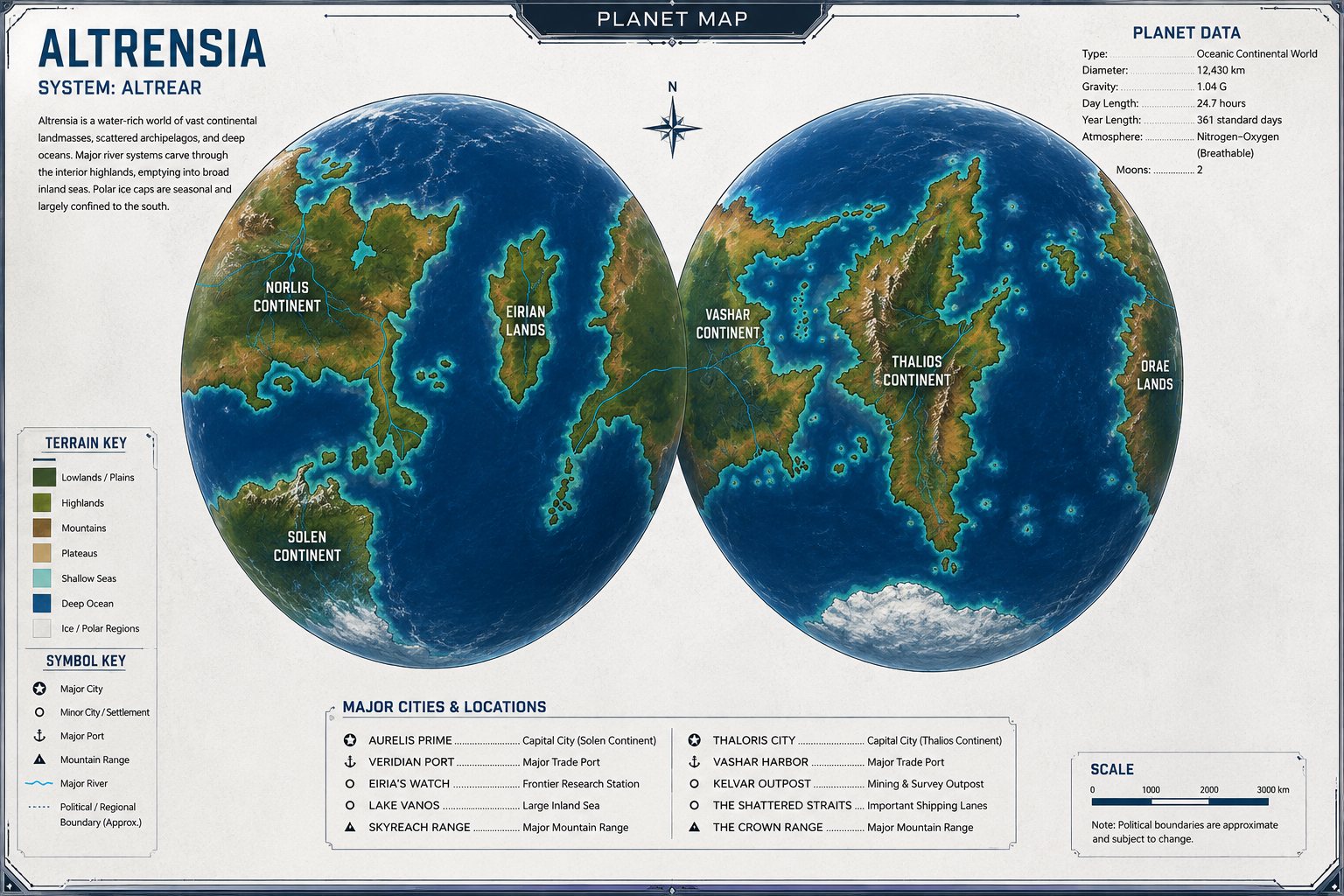
Continents
Norlis Continent
The largest and most heavily surveyed landmass on Altrensia, Norlis consists of broad wind-swept plains broken by ancient mesas and shallow river valleys. Rich deposits of rare earth elements beneath its western highlands have made it the primary focus of corporate prospecting expeditions.
Eirian Lands
An isolated central continent characterized by rolling basalt plateaus and deep freshwater rift lakes. The region’s stable geology and mild climate have made it a favored location for scientific survey camps and proposed colonial capitals.
Solen Continent
Located in the southern hemisphere, Solen is colder and considerably less explored than the northern continents. Seasonal ice sheets cover much of its coastline, while powerful winds have sculpted dramatic cliffs and extensive salt flats inland.
Vashar Continent
A rugged western continent dominated by fractured canyons, volcanic uplands, and mineral-rich escarpments. Prospectors have reported unusually high concentrations of exotic isotopes throughout the region, drawing both scientific interest and political attention.
Thalios Continent
Perhaps the most visually striking continent, Thalios is split by a massive mountain spine running nearly its entire length. Numerous rivers descend from the highlands into fertile coastal basins, making it the most promising location for future large-scale settlement.
Orae Lands
A narrow eastern landmass separated from the main continents by deep ocean trenches. Sparse vegetation and harsh coastal weather have limited exploration, though orbital scans indicate significant helium-3 deposits beneath its northern basin.
Cities & Locations
Aurelis Prime
Originally established as the first planetary survey headquarters, Aurelis Prime has grown into Altrensia’s largest permanent settlement. It serves as the administrative center for scientific expeditions, colonial planning, and diplomatic negotiations.
Veridian Port
The world’s primary spaceport and orbital logistics hub, handling nearly all personnel and cargo entering the Altrear System. Though still relatively small, it has become a bustling crossroads of prospectors, surveyors, corporate representatives, and government officials.
Eiria’s Watch
A remote Confederation-operated xenobiological research station overlooking the Eirian Rift. Scientists here study the planet’s unique low-oxygen ecosystem while monitoring unexplained geological anomalies.
Lake Vanos
A vast inland brine sea whose exceptionally clear waters conceal mineral formations unlike any found elsewhere on Altrensia. The lake has become both a scientific curiosity and an important freshwater processing site.
Skyreach Range
The tallest mountain chain on Altrensia, with peaks rising above much of the breathable atmosphere. These windswept summits contain some of the richest concentrations of Fold-reactive exotic isotopes yet discovered.
Thaloris City
The largest settlement on Thalios Continent, Thaloris City is envisioned as the future commercial heart of Altrensia. Though still under construction, it already serves as a regional hub for engineering firms, survey teams, and colonial infrastructure projects.
Vashar Harbor
A fortified coastal settlement supporting mining operations throughout western Altrensia. Massive ore processors and cargo elevators dominate the harbor skyline, making it one of the busiest industrial sites on the planet.
Kelvar Outpost
A small but strategically important frontier installation located deep within the Vashar Highlands. Its geologists were the first to confirm the presence of Fold stabilization isotopes beneath Altrensia’s crust.
The Shattered Straits
A maze of narrow channels, rocky islands, and submerged basalt ridges separating the Vashar and Thalios continents. Violent tides and unpredictable magnetic disturbances make navigation hazardous despite the route’s strategic importance.
The Crown Range
A dramatic chain of snow-capped mountains forming the northern terminus of the Thalios Highlands. Their towering peaks are visible from orbit and are considered one of Altrensia’s defining natural landmarks.
Creatures of Altensia
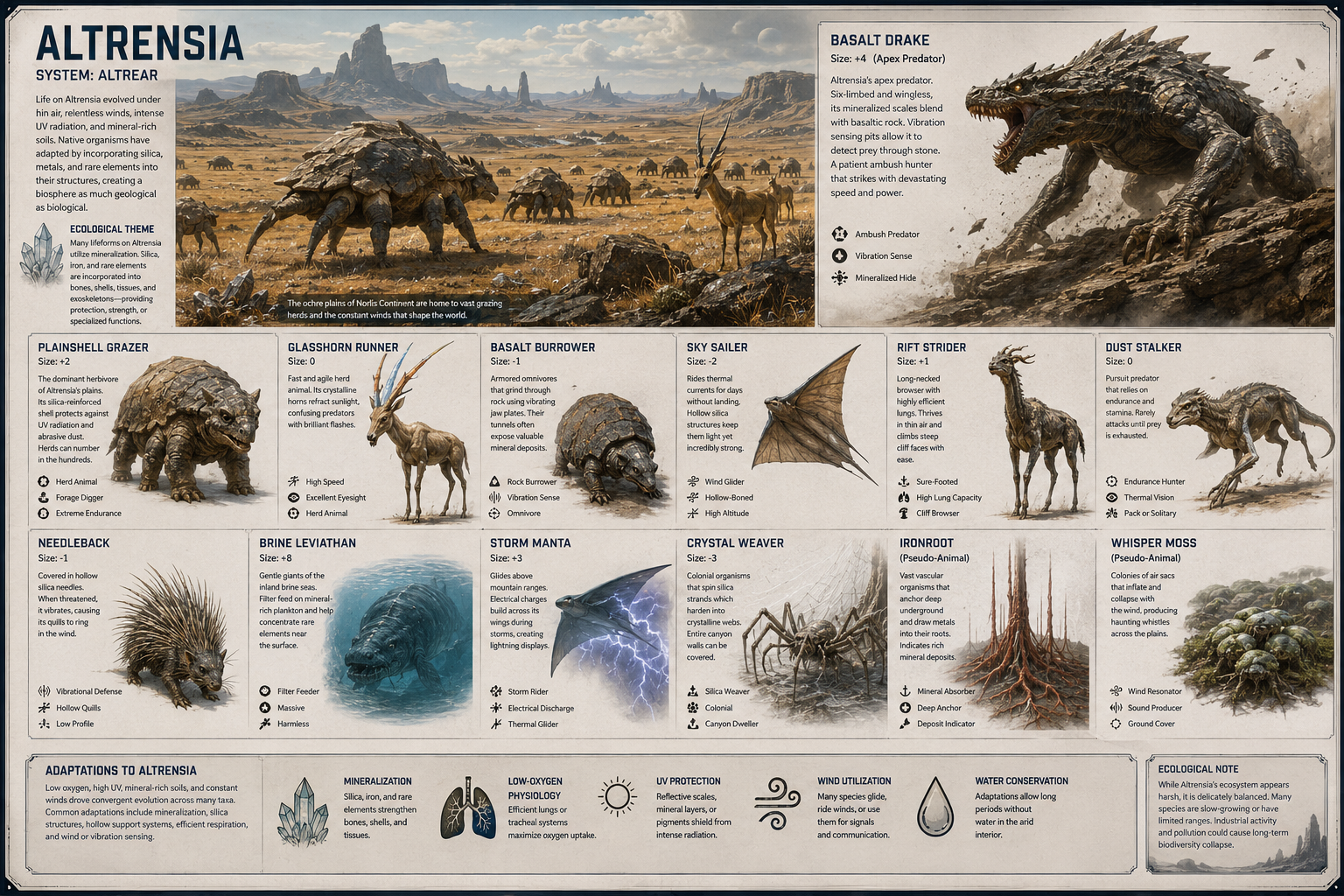
Plainshell Grazer
Size: +2
The dominant herbivore of Altrensia’s open plains, Plainshell Grazers resemble six-legged buffalo crossed with tortoises. Their broad silica-reinforced back plates protect them from ultraviolet radiation and seasonal dust storms.
- Slow but immensely powerful
- Travel in herds of hundreds
- Can survive weeks without drinking
- Dig mineral-rich grasses from beneath hardened soil
Glasshorn Runner
Size: 0
A swift antelope-like animal with translucent crystalline horns that refract sunlight into dazzling flashes, confusing predators.
- Extremely fast
- Excellent eyesight
- Herd animal
- Horns prized by collectors
Basalt Burrower
Size: -1
Small armored omnivores resembling six-legged armadillos.
Instead of digging through dirt, they grind through soft volcanic rock using vibrating jaw plates.
Their tunnels often expose valuable ore veins.
Sky Sailer
Size: -2
Large flying organisms with enormous semi-rigid membranes.
Rather than flapping, they ride Altrensia’s constant winds for days at a time.
Their skeletons contain hollow silica tubes instead of bones.
Rift Strider
Size: +1
Tall, four-legged browsers that resemble a cross between a camel and a moose.
Their elongated lungs extract oxygen extremely efficiently, allowing them to thrive where off-worlders struggle to breathe.
Long necks allow them to feed from cliff vegetation.
Dust Stalker
Size: 0
Altrensia’s apex land predator.
Long-legged pursuit hunters covered in tan mineralized scales.
Rather than ambushing prey, they simply outlast it, slowly chasing animals across the plains until exhaustion sets in.
Needleback
Size: -1
Porcupine-like creatures covered in long silica needles.
When threatened they shake violently, producing eerie ringing sounds as the quills resonate in the wind.
Brine Leviathan
Size: +8
Massive aquatic filter feeders inhabiting the inland salt seas.
Despite their immense size they’re completely harmless.
Mining crews often follow their migrations because they naturally concentrate rare minerals near the surface.
Storm Manta
Size: +3
Large gliding creatures that surf thermal currents above mountain ranges.
Electrical charges accumulate across their wing membranes during storms, creating spectacular displays of blue-white lightning.
Crystal Weaver
Size: -3
Spider-like colony organisms.
Rather than spinning silk, they extrude transparent silica fibers that harden into crystal webs.
Entire canyon walls can become covered in shimmering geometric structures.
Ironroot
Not technically an animal.
A massive vascular organism that anchors itself dozens of meters underground.
Its root system slowly absorbs metallic elements from the surrounding soil, leaving distinctive reddish halos visible from orbit.
Mining companies often use Ironroot groves to locate rare-earth deposits.
Whisper Moss
Another pseudo-animal.
Dense colonies of tiny air sacs inflate and collapse with changing winds, producing haunting whistles across the plains.
Settlers often mistake the sounds for distant voices.