

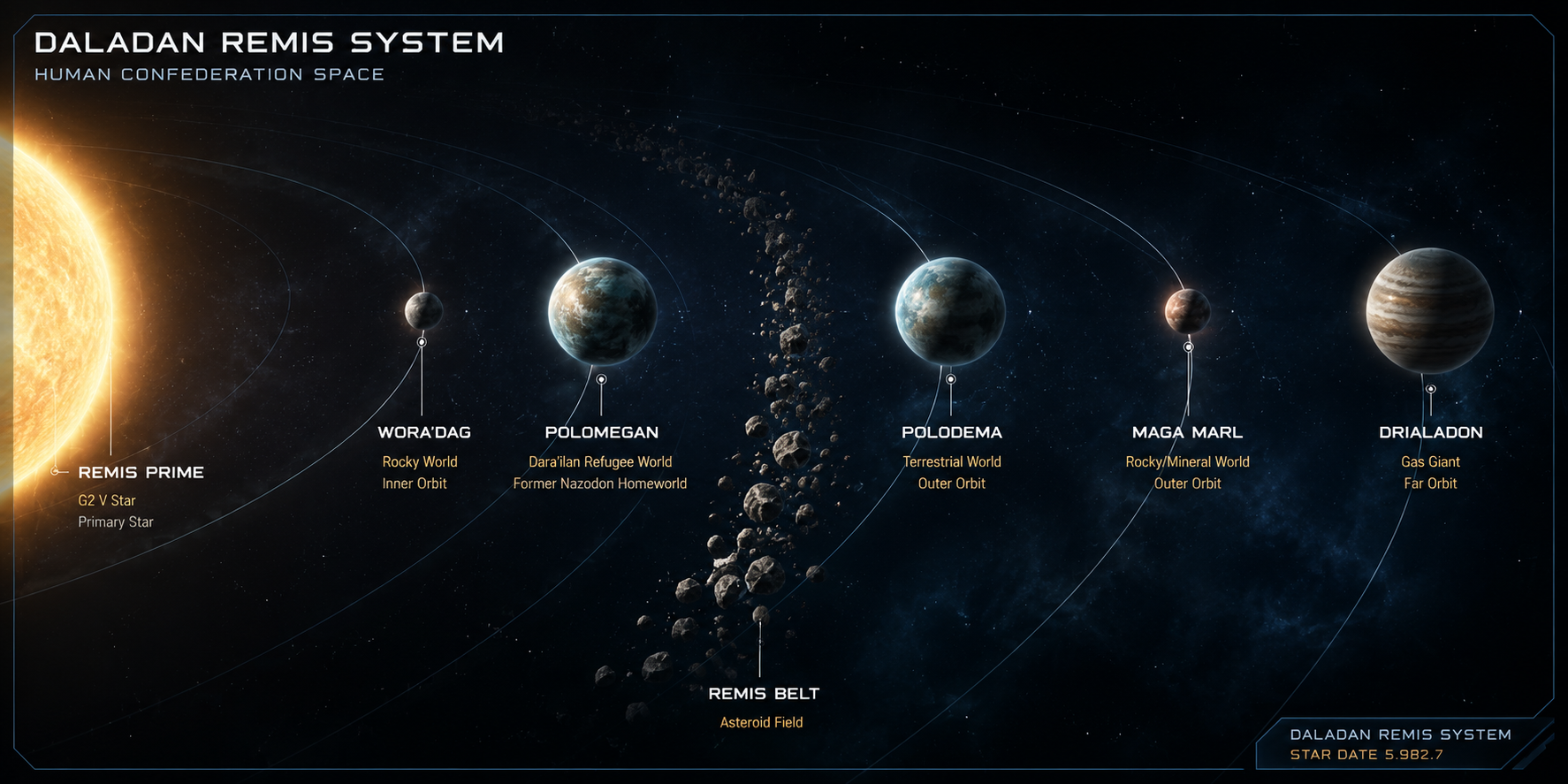
System: Daladan Remis (Human Confederation)
Dara’ilan Refugee World
Polomegan is a scarred Terran-era world reclaimed by the Dara’ilan following their long exodus—a planet already broken long before they arrived. Once the homeworld of the Nazodon, an ancient Terran Strain renowned for its military discipline and monumental engineering, Polomegan became one of the Terran Empire’s greatest fortress worlds. Massive fortress-cities, orbital defense platforms, subterranean military complexes, and sprawling industrial arcologies transformed the planet into an impregnable bastion guarding the frontier of human space.
That strength ultimately proved insufficient.
During one of the final civil wars of the Terran Empire, Polomegan became the center of a devastating planetary campaign. Orbital bombardments, kinetic strikes, biological weapons, and decades of relentless warfare reduced thriving continents to blasted wastelands. Megacities collapsed beneath nuclear fire, oceans swallowed entire population centers, and planetary infrastructure was shattered beyond repair. Though the Nazodon fought to the bitter end, the conflict consumed both their civilization and their people. By the time the war ended, the Nazodon were extinct, leaving behind silent fortresses, buried cities, and the ghosts of a forgotten empire.
Centuries later, the Dara’ilan refugee fleets arrived in the Daladan Remis System while searching for a permanent home. They found no surviving civilization, but they did discover a world rich with abandoned infrastructure: ruined arcologies, ancient shipyards, orbital habitats, buried transit networks, and military installations built to survive the very apocalypse that claimed their creators.
Rather than beginning from nothing, the Dara’ilan chose to build upon these foundations.
Flooded arcologies became thriving aquatic-capable cities. Ancient transit tunnels were restored as secure transportation corridors. Ruined industrial districts once again echoed with manufacturing, while surviving orbital infrastructure was painstakingly reconstructed to support modern starships. Across Polomegan, the remains of one civilization became the cornerstone of another.
To the Dara’ilan, Polomegan is both sanctuary and warning. Every shattered skyline stands as proof that even the mightiest civilizations can destroy themselves, while every restored district demonstrates that perseverance can overcome catastrophe. Their government, the Continuance Assembly, oversees the world’s recovery as a generations-long campaign, coordinating ecological restoration, infrastructure reconstruction, archaeological exploration, and planetary defense with characteristic Dara’ilan discipline.
Entire generations have now been born among the ruins of the Nazodon. As a result, Polomegan has developed a unique identity that blends traditional Dara’ilan resilience with the practical realities of inhabiting an ancient world. Children grow up exploring abandoned transit systems, studying Terran engineering, and living within structures thousands of years older than their own civilization.
To outsiders, Polomegan appears bleak—a world of broken cities, rusting orbital rings, and endless ruins. To its people, however, it represents something entirely different: a monument to survival, where civilization is not inherited, but earned through relentless determination.
Daladan Remis System
A mature yellow star located within Human Confederation space, the Daladan Remis System was once a prosperous frontier colony of the Terran Expanse. During the Third Sathar War, the system became a major battleground, leaving several worlds devastated or abandoned. Today, the system has begun a slow resurgence, anchored by the Dara’ilan reconstruction of Polomegan.
Remis Prime
Type: G2 V Yellow Main Sequence Star
The system’s primary star provides stable conditions for several terrestrial worlds and a rich asteroid belt. Its calm stellar activity has long made Daladan Remis an attractive system for colonization and industrial development.
Wora’Dag
Type: Rocky World
A scorched, airless planet orbiting close to Remis Prime, Wora’Dag was never successfully colonized due to its extreme temperatures and lack of atmosphere. Despite its hostile environment, the planet possesses exceptionally rich mineral deposits and remains an important source of strategic metals and rare elements. Fully automated mining operations extract resources continuously, with only a handful of orbital support stations occupied by personnel.
Polomegan
Type: Terrestrial World
The only major inhabited world in the system, Polomegan was originally settled during the Terran Expanse and eventually became one of the political and economic centers along the frontier between the Dominion and the Frontier. Governed by the independent Polomegan Confederacy, the planet prospered for centuries before becoming one of the principal targets during the Third Sathar War.
The Sathar assault devastated the world, destroying much of its civilization and leaving its cities in ruins. Centuries later, the Dara’ilan reclaimed the abandoned planet, transforming the shattered remains into the thriving world that exists today.
Remis Belt
A broad asteroid belt rich in metals, volatile compounds, and ancient wreckage. Numerous abandoned mining platforms, prospecting stations, and wartime debris fields remain scattered throughout the belt, making it a profitable—but often dangerous—destination for salvagers and independent miners.
Polodema
Type: Terrestrial World
- Diameter: 13,840 km
- Gravity: 0.93 G
- Day: 42 hours
- Year: 435 days
- Moons: 1
Originally colonized during the expansion of the Terran Expanse, Polodema grew into a prosperous agricultural and manufacturing colony. During the Third Sathar War, however, the planet suffered a catastrophic orbital bombardment that annihilated nearly every population center. Its lone inhabited moon shared the same fate.
Today, Polodema is a silent world. Scattered ruins, abandoned orbital infrastructure, and lingering battlefields remain as stark reminders of one of the darkest chapters in the system’s history.
Maga Marl
Type: Rocky World
A cold, windswept world lacking a breathable atmosphere, Maga Marl never supported permanent civilian settlements. Prior to the War of the Chain, however, the local colonists began constructing an extensive military logistics and defense complex intended to protect the outer approaches to the Daladan Remis System.
Construction was abandoned before completion, leaving behind partially finished fortifications, military shipyards, and underground installations that have remained largely untouched for centuries.
Drialadon
Type: Gas Giant
The largest planet in the Daladan Remis System, Drialadon dominates the outer reaches with its immense gravity well and extensive family of moons. Before the War of the Chain, several moons were being developed for mining, fuel refining, and scientific research. Although many of these operations were abandoned during the war, a handful have since been reoccupied, and renewed interest in the system’s abundant resources has attracted prospectors, corporations, and adventurous salvagers alike.
Planetary Statistics
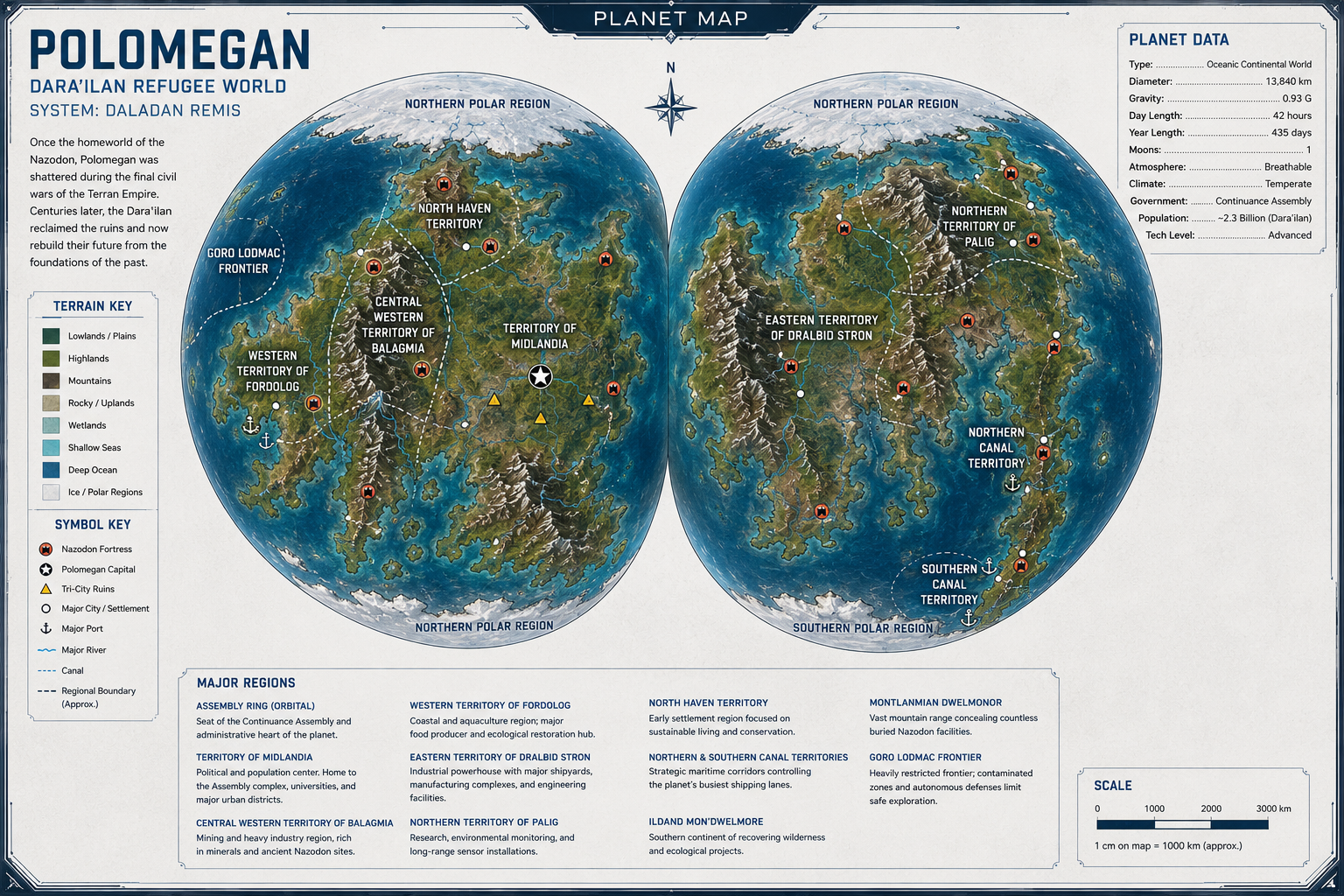
| Attribute | Details |
|---|---|
| Star System | Daladan Remis |
| Government | Continuance Assembly |
| Population | Approximately 2.3 Billion (Predominantly Dara’ilan) |
| Gravity | 0.97 G |
| Atmosphere | Breathable |
| Climate | Temperate with extensive flooded coastlines and reclaimed wetlands |
| Tech Level | Advanced |
| Primary Exports | Heavy Engineering, Naval Construction, Salvaged Terran Technology, Refined Alloys, Industrial Equipment |
| Primary Imports | Luxury Goods, Agricultural Products, Medical Supplies, Cultural Media |
Major Regions
Assembly Ring
Suspended in geostationary orbit above Midlandia, the partially restored Assembly Ring serves as the seat of the Continuance Assembly and the administrative heart of Polomegan. Once a Nazodon military command station, it now coordinates planetary reconstruction, orbital defense, interstellar commerce, and traffic throughout the Daladan Remis System.
Territory of Midlandia
The political and cultural center of modern Polomegan, Midlandia contains the Continuance Assembly’s governmental complex, major universities, research institutes, diplomatic facilities, and the planet’s largest concentration of restored urban districts.
Central Western Territory of Balagmia
Dominated by rugged mountains and mineral-rich highlands, Balagmia is Polomegan’s principal mining and heavy industrial region. Massive excavation projects recover both natural resources and long-buried Nazodon infrastructure hidden beneath the ancient bedrock.
Western Territory of Fordolog
Known for its reclaimed coastlines and extensive aquaculture facilities, Fordolog produces much of Polomegan’s food supply while supporting some of the planet’s largest ecological restoration projects.
Eastern Territory of Dralbid Stron
The industrial powerhouse of Polomegan, Dralbid Stron houses major shipyards, manufacturing complexes, armored vehicle production facilities, and much of the world’s heavy engineering industry.
Northern Territory of Palig
A sparsely populated region devoted to scientific research, environmental monitoring, and long-range sensor installations. Much of Palig remains untouched wilderness as ecological restoration slowly returns the land to health.
North Haven Territory
One of the earliest Dara’ilan settlement regions, North Haven combines restored population centers with protected wildlife preserves and serves as a model for sustainable planetary reconstruction.
Northern and Southern Canal Territories
Separated by a narrow isthmus, these strategically vital territories oversee the busiest maritime shipping lanes on Polomegan. Enormous lock systems, commercial ports, and naval facilities ensure uninterrupted trade between the planet’s northern and southern oceans.
Ildand Mon’Dwelmore
A largely undeveloped southern continent of recovering forests, wetlands, and rugged wilderness. Once devastated by orbital bombardment, it has become the focus of long-term ecological restoration and scientific exploration.
Montlanmian Dwelmonor
This immense mountain range conceals countless buried Nazodon facilities. Geological surveys continue to uncover sealed military complexes, forgotten industrial vaults, and abandoned transit systems beneath its towering peaks.
Goro Lodmac Frontier
A heavily restricted frontier marking the limits of safe exploration. Vast portions remain contaminated by ancient warfare, unexploded ordnance, unstable military infrastructure, and autonomous defense systems that continue to function thousands of years after the fall of the Nazodon. Access is tightly controlled by the Continuance Assembly.
Points of Interest
Nazodon Fortresses
Scattered across Polomegan are dozens of colossal fortress-cities built during the height of the Nazodon civilization. Designed to withstand years of planetary siege, these immense complexes descend deep beneath the surface and contain hardened command centers, industrial districts, aerospace hangars, fusion reactors, and powerful defensive systems.
Many have been reclaimed by the Dara’ilan as regional capitals, military headquarters, and population centers. Yet even today, vast sections remain sealed or unexplored, their automated security systems and forgotten technologies still waiting beneath layers of reinforced armor.
The Tri-City Ruins
The greatest archaeological site on Polomegan, the Tri-City Ruins encompass the remains of three interconnected Nazodon megacities destroyed during the Imperial Civil Wars. Their collapsed arcologies, buried transit networks, and subterranean districts continue to yield technological discoveries, historical archives, and dangerous relics from humanity’s distant past.
Much of the complex remains inaccessible beneath centuries of debris, making it one of the Human Confederation’s largest and most important archaeological excavations.
The Nazodon
The Nazodon were a Terran Strain that believed civilization survived only through preparation, discipline, and endurance. While other strains expanded through commerce, science, or diplomacy, the Nazodon engineered worlds capable of surviving any imaginable catastrophe.
Their cities were designed as fortresses. Their factories doubled as military arsenals. Their transportation networks could instantly become defensive corridors. Even civilian arcologies were constructed to continue functioning during prolonged sieges.
To outsiders they appeared austere—even militaristic—but the Nazodon viewed these measures as simple prudence. History, they believed, inevitably repeated itself, and only civilizations prepared for the worst would survive.
Ironically, they were wrong.
When the Imperial Civil Wars erupted, Polomegan became one of the conflict’s principal strongholds. Its immense defenses prolonged the fighting for decades, transforming the planet into one of the bloodiest battlefields in Terran history. Entire continents were destroyed, orbital infrastructure was shattered, and biological and radiological weapons poisoned much of the surface. The very fortifications built to preserve civilization instead prolonged its destruction.
By the war’s end, the Nazodon had vanished. Whether they perished in the fighting, succumbed to famine and disease, or were eradicated during the final campaigns remains unknown. No confirmed descendants have ever been discovered, and no Nazodon colonies are known to have survived beyond Polomegan.
Today, they are remembered only through the monuments they left behind: colossal fortress-cities, subterranean military vaults, orbital defense rings, and engineering works that continue to function thousands of years after their creators disappeared.
Adventure Hooks
Ghost Protocol
A sealed Nazodon command bunker unexpectedly reactivates, causing dormant planetary defense systems to identify all modern vessels as hostile targets.
The Lost Vault
Explorers uncover an intact subterranean military complex containing advanced Terran technology—but its autonomous guardians have spent millennia preparing for intruders.
Ashfall
Orbital sensors detect an ancient defense satellite emerging from dormancy. The heroes must locate its command protocols before it resumes the bombardment that once devastated Polomegan.
Echoes of the Empire
Archaeologists excavating the Tri-City Ruins discover evidence suggesting that the final days of the Nazodon were far more mysterious than official history records, raising unsettling questions about what truly brought their civilization to an end.